Sunday, 27 July 2014

Laphroaig 18 VS. Ardbeg Corryvreckan, Reviewed & Compared! Whisky Fight!

So, I had a bit of a conundrum recently. Having an opportunity to purchase a whisky duty free with a family member coming over from New Zealand, there was a difficult question to answer: Which one do I get? I had a few criteria to meet, mainly that it was from Islay, that it was heavily peated, and preferably that it was something I didn't already have in the working collection.

After a quick browse of what the duty free store in question had available, I settled on a couple of bottles which I had not tasted in a long time, and had never owned myself. Laphroaig 18 year old, and Ardbeg Corryvreckan. But how was I going to choose between them? That's easy, I just went to Cobbler and had them fight each other!


            Laphroaig 18 year old                             VS.                           Ardbeg Corryvreckan
These are two rather different whiskies, with the Laphroaig being 18 years old, watered down to 48% and a mix of bourbon and sherry casks, and the Ardbeg being Non-Age Statement (NAS), and bourbon cask only. They are both non-chill filtered, but the Laphroaig has a little caramel colouring added, and the Ardbeg does not. But, being from perhaps the two most well-known and well-respected distilleries on Islay, being heavily-peated, and selling at a similar price, I thought they made for a good match-up for this heavy weight bout. ARE YOU READY TO RUMBLE!?!

Fighter's Stats!
Laphroaig 18yo: 48%, 18 years old, first fill bourbon, non-chill filtered, no colouring. The ageing veteran.
Ardbeg Corryvreckan: 57.1%, NAS, bourbon casks, non-chill filtered, no colouring added. The big, scary-looking 'young up & comer'. 

(both tasted neat)
Colour: Laphroaig 18: Medium gold.  Corryvreckan: Polished bronze.

Texture: Laphroaig: Thick & creamy, buttery.  Corryvreckan: Light & clean, deceptive! 

Round 1: Nose:
Laphroaig: Inviting, but surprising heat. Laphroaig medicinal peat and iodine/disinfectant, salty, a little smoky, and some sweetness. Instantly recognisable, but nothing stands apart from the 'house style'.
Ardbeg: Wow! Big and bold, but little heat for high ABV%. Salty maritime aromas, sea spray, tarred rope, supple, worn leather. Some sour fruit, and vanilla-soaked bananas. 

Round 2: Taste:
Laphroaig: Signature Laphroaig, sweet medicinal peat, substantial smoke & salt, iodine and disinfectant. A little heat, giving way to buttered peat and some sweet smoke, very light sherry sweetness.
Ardbeg: Big peat and smoke, a little heat and 'prickle' but not much considering the ABV%. Could probably take some water, but still awesome without. Some vanilla sweetness, but fantastic salt and maritime flavours. Keeps with the Ardbeg style but ramps up the intensity and depth. Very, very good. 

Round 3: Finish:
Laphroaig: Buttery & oily, a bit of nutty sweetness, smoky. Long and warming. 
Ardbeg: Peat, tarred ropes, pepper and leather. Some oak sweetness but mostly dry and mouth-watering. Clean, medium-length finish, very more-ish.

The Judge's Scorecards!
Round 1 (nose): Ardbeg. Round 2 (taste): Ardbeg. Round 3 (finish): Laphroaig. Total Scores:
Laphroaig: 3 out of 5.
Ardbeg: 4 out of 5.

Ardbeg Corryvreckan takes the win by split decision! 

Notes: The younger, bolder Corryvreckan simply out-classed the veteran Laphroaig 18 year old early on, but the veteran came back late in the third round, regaining some dignity. 

The 18 year old Laphroaig is certainly a good whisky, but I don't feel the value for money, or quality for age, is there. It strikes me as a more mature Quarter Cask, but the maturity does not make it better or worse, but rather more reserved. Perhaps with some sherry cask influence it would have gained more complexity, although the finish is very good, the star of the show in this bottling. As a whole, not very close to my favourite 'phroaig, the PX. 

Ardbeg Corryvreckan, meanwhile, is still expensive, and lacking an age statement, but the quality is there in spades! Deep, mysterious aromas & flavours, much like those of the Scottish whirlpool it is named after! Intense and powerful, but manageable and very, very pleasant. As the distillery says, not for the faint hearted! The clear winner in this fight. But is it better than my lovely mistress the Ardbeg Uigedail? Not for me, no. Look for a review of that one in the future, it's worth the wait!

Full disclosure: In the interests of blogger-integrity, I must disclose that neither of these whiskies was chosen as my order for the duty free shopping opportunity. Rather, after much consideration, I went for a second bottle of Laphroaig PX. Why? Because it can only be bought from duty free stores, and is great value for money ($40-60AUD less than the two in this fight), so I could not pass up the chance to grab another bottle. Both the Laphroaig 18 and Corryvreckan are readily available, and are not likely to go away soon, so the sense of urgency was not there for me. But rest assured they are both worthy of your consideration, though the Ardbeg has won itself a decisive victory tonight. Cheers!

Sunday, 20 July 2014

Caol Ila Distillery Profile


Another of the lesser-known Distilleries on Islay, Caol Ila (Gaelic for 'Sound of Islay', and pronounced 'cull-eel-a) distillery is also one of the largest whisky producers by volume. They produce in a week what some smaller distilleries produce in a year, but around 90% of their whisky goes into blends, such as Chivas Regal and Johnnie Walker. Their single-malt whiskies are well balanced, usually lightly peated, but they have also produced some unpeated bottlings, but we're not too interested in those! They primarily bottle at 43% ABV, although there is a cask-strength bottling out there if you can find it, and it is fantastic! Likewise their Distiller's Edition is very good, finished in Moscatel casks, but their mainstay is the standard Caol Ila 12 year old.

Distillery location: Eastern Islay, near Port Askaig, Scotland 

Owner: Diageo 

Producing since: 1846

General Whisky Style: Lightly peated, smoky, medicinal and maritime flavours. 

I would like to see more Caol Ila bottled as a single-malt, by the distillery, and I say that because there are many, many different independent bottlings of single-cask Caol Ila available, where an independent bottler has purchased the cask from Caol Ila, then matured and bottled it themselves, usually at cask strength. If only the distillery would do more of that! They do produce great whisky, and although considered one of the 'lighter' Islay whiskies, Caol Ila hold their own in a big way, get out there and try it!


Port Charlotte 'The Peat Project' (Bruichladdich) Whisky Review

Port Charlotte is a small coastal town on Islay, south of Bruichladdich distillery, on the western shore of Loch Indaal. The town was once home to Lochindaal distillery, which closed in 1929 after over 100 years of production of heavily-peated whisky. This served as inspiration for Bruichladdich distillery to produce a heavily peated whisky, which they named 'Port Charlotte'.

Bruichladdich produce three styles of whisky (plus 'The Botanist' gin, which is actually very good-might have to review it!), Bruichladdich, which is essentially un-peated, Port Charlotte, which is heavily peated to around 40ppm, and Octomore, which is very / super heavily peated, at up to 169ppm phenols (see here for ppm explanation).

Their Port Charlotte bottlings were initially released periodically, starting at five years of age with PC5, then PC6, and so on, up to PC11. These were all bottled at cask strength and are highly collectible (and thus expensive and hard to find), with the exception of 'Port Charlotte 10 Year Old', which was bottled at 46% as an addition to Bruichladdich's 'core' range. Confusingly, there was also a PC10 cask strength bottling released around the same time. There have also been non-age statement (NAS) bottlings of the Port Charlotte whisky, named An Turas Mor, The Peat Project, Scottish Barley, and Islay Barley.


Port Charlotte 'The Peat Project' (Bruichladdich), NAS, 46%, Islay, Scotland.
Non-chill filtered, no added colouring (definitely). A mix of multiple vintages. No details on maturation time, techniques or casks stated, but I suspect only bourbon cask maturation, and mostly young spirit in the mix. 

(tasted neat and with water)
Colour: Very pale gold, think champagne.

Texture: Long, slow-moving legs. 

Nose: Medicinal peat, salt, a little smoke. Sour sherbet, and some musty, under-ripe banana. With water, some more smoke, pepper, and more tropical fruit in the background.

Taste: A big peaty wallop! Some dark, thick smoke, and some sour sherbet, but also quite hot for the relatively low ABV (46%). Not much going on really, even with water added there is very little complexity. The peat and smoke are there in force, but while fighting each other for the win, they end up cancelling each other out in a very short, but brutal, fight. 

Finish: Surprisingly short, some peat, but also still some heat! Water helps to calm it down, but there is not much happening here to keep me interested. I have had this bottle open for almost a year, and have tasted it repeatedly over that time, and not a lot has changed. Still hot, aggressive and one-dimensional. 

Score: 2 out of 5. 

Notes: Very disappointing. No question I think that young spirit has predominantly been used here, and there has been hardly any detectable cask influence. Very young and aggressive, at cask strength I imagine this would have been unpleasant. There is little to no development, and considerable heat, and water does not calm it as much as it should. Bruichladdich's tall stills usually add complexity and 'gentleness' to heavily peated spirit, but they have not had much effect here. 

From my favourite Laphroaig in the last review, to my least favourite Bruichladdich in this one! I have tried the Port Charlotte 'Scottish Barley' bottling, which is also NAS and 46%, since, and it is far, far better. Likewise the An Turas Mor, although I have not tried it myself, received positive reviews before being replaced by The Peat Project. I suspect both of these had more older spirit, and more cask influence.

This Peat Project bottling is priced, at least in Australia, at a similar point to Ardbeg 10 and Laphroaig 10, and even the unpeated Bruichladdich 'Laddie Classic', and it just does not hold a candle to them, it's not in the same league. If you see it on the shelf, look past it towards the Port Charlotte 'Scottish Barley', which far as I can tell has replaced 'The Peat Project' anyway, and for good reason.

Cheers!

Friday, 11 July 2014

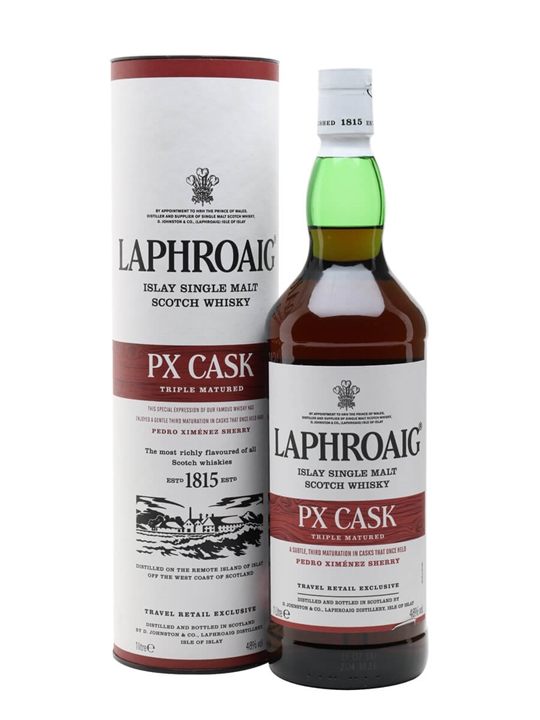
Laphroaig PX Whisky Review

My last review of a Laphroaig Single Malt, the Triple Wood, was a little disappointing, so I thought I would make up for it with a review of my current favourite Laphroaig. OK, I admit it, it has been my favourite for quite a while.

One of a range of three 'travel-retail exclusive' (can only be purchased from duty free stores) whiskies, all of which are non-age statement (NAS) bottlings, it may have started as a bit of an experiment, and the other versions (QA, for Quercus Alba, or American oak, and An Cuan Mor, or 'big ocean') are not as popular, although I haven't yet tried them myself. The travel-retail thing also means they come in 1-litre bottles (bonus!), and they can now be found in some online whisky shops as well as duty free stores.

Believe me though, age statement or no, if it was an experiment, it was very, very successful. 
Laphroaig PX Cask, NAS, 48%, Islay, Scotland.
'Third maturation' in PX (Pedro Ximenez sherry) casks. The first two being Bourbon cask and Quarter cask respectively. Unfortunately the label & tin do not mention whether it is chill filtered or not, or whether or not it has had caramel colouring added. I don't believe it to be chill filtered, based on the mouth feel and finish, and if there has been caramel added, I would say it was more for consistency rather than intentional modification.

(tasted neat)
Colour: Deep gold.

Texture: Oily in the glass, but surprisingly clean in the mouth.

Nose: Lovely! Instantly recognisable as Laphroaig whisky, with medicinal peat, some Iodine, and lovely salty sea spray. Very little smoke on the nose, perhaps lightly smoked straw. Significant sweetness, and a hint of mature, rich sherry. 

Taste: Even more lovely! The oaky sweetness and medicinal peat balance each other quite nicely, then a hint of rich sherry and wood spice, some salt and sea spray, and a very nice handful of ash, (even cigarette ash), which beats back the sweetness, and dries the mouth. Well balanced but the sweetness wins the fight, but only by split decision! The ash may not sound very appealing, but it is not overpowering, and believe me, it is awesome. It helps this whisky really stand out in the crowd. 

Finish: Long, sweet, peaty and salty. Delicious. Again the sweet oak and sherry is balanced by the peat, salt and ash. There is some smokey vanilla and marzipan right at the end, after the ash has cleared and left you longing for more.  

Score: 4.5 out of 5. 

Comments: As you may have guessed, this whisky (and all Laphroaig whiskies which undergo a 'third maturation' start this way) is essentially Laphroaig quarter cask, which has then been finished in PX sherry casks. The Triple Wood is matured the same way, but is finished in Oloroso sherry casks, and has not worked anywhere near as well as the PX cask whisky. 

This truly is excellent stuff, that sweet Pedro Ximenez sherry finish has added just enough fruit & spice to balance the oak and smoke. If the sweetness was just a tad more subdued, and it stated on the label if it was chill filtered, it likely would have scored even higher! Definitely my favourite Laphroaig so far, followed closely by Quarter Cask and 18 year old.

I strongly recommend doing your utmost to get a hold of this stuff, so if you know anybody who is travelling soon, see if they'll get you a bottle, or, what better reason is there to take a holiday? 

Cheers!

Monday, 30 June 2014

Springbank 10 year old Whisky Review

Springbank distillery is not very well-known in the whisky world, but they should be! They are very passionate about what they do, and they uphold as many traditional production methods as they can. They do not chill filter (and never have!), they do not add caramel colouring, they bottle at a minimum of 46%, and they do not shy away from experiments. Campbeltown, where the distillery is located, is actually recognised as it's own whisky region, and once was home to over 30 whisky distilleries. There is now only three, and Springbank own two of those in their namesake distillery, and Glengyle Distillery (producing Kilkerran whisky).

They are also one of the few distilleries in Scotland to do everything in-house. That means they malt their own barley, while most distilleries buy their barley in from external malting operations, and the whisky does not leave the distillery grounds until it is bottled, while some distilleries send their whisky to central off-site warehouses to mature and be bottled. Great stuff Springbank!

Springbank Distillery produce three distinct 'styles' of their whisky: Hazelburn, which is triple-distilled and un-peated, Springbank, which is '2.5 times' distilled and lightly peated, and Longrow, which is double distilled and heavily peated. All three of these labels have multiple expressions as well. I'm starting with what is probably their most widely available, Springbank 10 year old.

Springbank 10 year old, 46%, Campbeltown, Scotland. 
'2.5 times distilled', primarily matured in bourbon casks, but some sherry as well. Lightly peated, non-chill filtered, and no added colouring. Excellent!

(tasted neat)
Colour: Yellow gold.

Texture: Gorgeous, not too oily or too thin, instantly obvious quality.

Nose: Very interesting, initially sweet & sour, opens slowly, giving salt and sea air, dry sherry, green apples and a slight hint of peat. Disclaimer: it's unusually cold here tonight, and while I did try and warm the whisky as much as possible, it is usually more complex, so it may still have been a little 'uncomfortable'.

Taste: The hint of peat from the nose is joined by some light smoke, before giving way to salty, dry sherry, some dry spices and brine. Some salted caramel and tart fruit adds a tiny amount of sweetness, but savoury notes are the leaders here.

Finish: Medium, drying (saliva-inducing!). Earthy peat, salt and dry sherry remain until the end, leaving with wisps of smoke and subtle wood.

Score: 3.5 out of 5.

Comments: Excellent quality, but perhaps not suitable for a beginner whisky drinker, the dry and sometimes sour notes may be off-putting. Personally, I find them intriguing and very enjoyable. I have tried the Longrow version (Longrow CV) from Springbank distillery, and although it's more noticeably peated, I do prefer the Springbank at this stage. I would love to give the Springbank 12yo cask strength bottling a go, I think it would be amazing. Springbank in general are producing outstanding quality whisky, with true 'craft presentation' (no colouring or chill-filtering, and bottling at 46%) and traditional production methods adding to their reputation. Keep it up please Springbank!

Being a little more low-profile than some brands, it can be more difficult to find, but can usually be found on online whisky shops such as this one, or in specialist whisky bars retailers. If you see it, give it a go! Cheers.

Friday, 20 June 2014

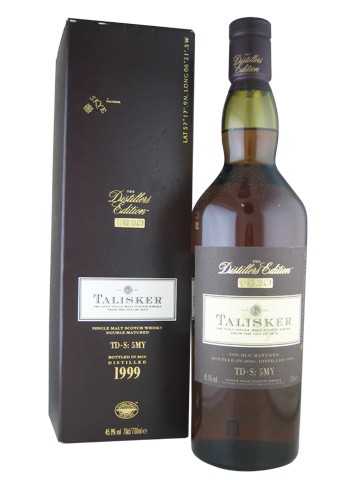
Talisker Distiller's Edition 1999 Whisky Review

Considered to be an 'entry level' peated whisky, Talisker is a very popular and well-known distillery, and is probably the easiest single-malt Scotch to find in a bar or pub, in Australia at least. It is also a controversial distillery, in that most of their expression's are chill filtered and have colouring added, Talisker is very approachable and easily enjoyed by the less experienced whisky drinker. But, their whisky is still enjoyable for the enthusiast, particularly the 18 year (and older if you're pockets are deep enough), '57 degrees north' (which is bottled at 57% abv), and the distiller's edition bottlings.

While it is the only distillery on the Isle of Skye (a rugged island off the west coast of Scotland, north of Islay), a fact they are rightly very proud of, their whisky is aged / matured off-site, on the Scottish mainland. They are also, perhaps unfortunately, starting to incorporate a few No Age Statement (NAS) bottlings into their line-up without corresponding price decreases, but they're hardly alone there. And as per owner Diageo's status quo, they use E150 caramel artificial colouring, and they chill filter their whiskies before bottling. Personally though, I find Talisker to be of good quality, and very consistent, although the newer bottlings are vastly different to the older.


Talisker Distiller's Edition, 45.8%, distilled 1999, bottled 2010, Isle of Skye. 
'Double matured' (finished) in Jerez (pronounced h'reth) Amoroso sherry casks, after the standard ageing process for the 10 year old bottling. Chill filtered, and caramel colouring added.

(tasted neat)
Colour: Dark bronze, almost brown (definitely artificial).

Texture: Clean and light, but with nice legs.

Nose: Initially quite closed, but still not overly complex once it's opened up. Drying sherry notes of booze-soaked raisins, juicy stone fruit, and distant mild sea spray with a hint of earthy, dry peat.

Taste: Juicy, sweet stone fruit, raisins and newly-ripe banana, drying with mild earthy peat and bitter-sweet dark chocolate. Some very distant salt with caramel, and a burst of pepper.

Finish: Relatively short, clean, still some stone fruit and pepper, drying.

Score: 3 out of 5.

Comments: Really held back by the chill filtration, in my opinion, particularly in the mouth feel and the finish. The sherry finish has overpowered the trademark Talisker sea spray and pepper, it is still there but subdued, deep in the shadows. Still interesting and rewarding in this expression, but vastly different from the standard bottlings which Talisker is known for.

Having also tried the earlier 1996 distiller's edition bottling (bottled in 2008), I do prefer the older bottling. Having also tried their 'storm' and 'dark storm' NAS bottlings, I would like to see one of those finished in a sherry cask (and preferably with an age statement!), I think it would be very interesting.

 If you are a big fan of big, fruity whiskies this is a fresh take and is well worth trying, although the earlier bottlings are getting hard to find. Have a look here for a more recent version at SM Whisky Australia. They also have a fantastic Talisker 'gift set', which includes 3 x 200ml bottles, the standard 10yo, the distiller's edition, and the excellent 18yo. Also great value at only slightly more than a 700ml bottle of the 10 year old, it'd be a good tasting / comparison experience for Talisker amateurs and enthusiasts alike. Tell them peated perfection sent you! Cheers 'til next time.

Monday, 16 June 2014

Does Age Really Matter? The Age Old Question!

Age before beauty? Or beauty before age?

The age of a whisky, specifically the amount of time a whisky spends in a cask after distilling - a.k.a maturation - has a huge effect on whisky, but does that magic number dictate the quality of the end product? No, it does not. It certainly drives the price up, and is extremely effective marketing. This is due to the general perception out there in the world, that if a whisky is old, it must be good. But this is definitely not the case, and in reality there is no magic number.

How does age affect a whisky?

This is a bit of a 'how long is a piece of string?' question, as alluded to above. In general terms, maturation in casks will gradually mellow the 'new-make spirit' (malt spirit fresh out of the stills which can't yet be called whisky), integrating and balancing the flavours, imparting flavours through both the oak wood (in the case of Scotch whisky), and also the remnants of whatever was in the cask previously, such as sherry or bourbon. So it stands to reason that more time in the cask will give more flavour to the whisky. This is basically true, but it is not that simple.

The flavours given by the cask can overpower or cancel out others, for example a whisky can become overly-oaky, particularly if the cask used was a first fill (has not previously been used to mature whisky) cask, or if it spends too much time in the cask. An over-aged / too-old whisky can become fragile, it loses some of it's inherent flavours and quality, does not hold up to temperature variations or time in the glass, or water being added, as well as it could have when it was in its prime, and it becomes less complex and less interesting than it could have been. And, probably the biggest effect of a whisky being aged/matured for too long, is that it generally loses alcohol content (and whisky content in general) through evaporation, known as the angel's share, each and every year it is maturing. Although this can vary depending on local climate and specifically humidity, in some cases the water will evaporate faster than the ethanol, which means that the alcohol percentage actually increases!


At the other end of the scale, a whisky which has not had enough time to mature in the cask / is too young, will often be 'hot', in terms of alcohol, which will give you that trade mark 'burn' in the throat, make your tongue go numb, and will singe your nasal hairs when you nose the glass. The flavours will be not be balanced, and the whisky will be aggressive and disjointed.

The cask itself is also extremely important. The size of the cask, the previous contents, how many times it has been used, the process used to 'season' (dry) the wood before coopering, and natural or man-made imperfections in the wood or construction of the cask can be a huge difference to how effective or active that particular cask is. There are many 20- or 25-year old whiskies with age statements that taste far younger than the age suggests, and the reverse is also true.

It is important to note that the Scotch Whisky Association (SWA) requires a minimum of 3 years maturation in oak casks for the spirit to be called Scotch Whisky. There is no limit to how many different casks can be used, what the previous contents was (as long as they're considering to be "traditional"), or the style of cask/s used, provided they're under 700-litres in capacity, for that maturation period. There is of course no maximum maturation period, either, but that's usually dictated by the aforementioned angel's share (or leaky casks) when the ABV drops below the minimum 40% required for the spirit to be called Scotch Whisky.

There are many different size casks available to a whisky distillery, and many different 'previous owners' to choose from, as in what liquid the cask held previously, and a cask can (and usually is) re-used or recycled again after use. All of these factors and many more have a huge effect on the finished product. But these are subjects for another day.

What about the peat?

One more major effect of cask maturation on peated whisky specifically is that the peaty, smoky flavours diminish over time, lost to evaporation (called the 'angel's share'), wood contact and general mellowing. So, in my opinion, be wary of any peated or heavily-peated whisky which is over 18 years of age. It may still be a great whisky, but the level of peat & smoke flavour present may not be what you were hoping for.

As an example, Bruichladdich Octomore, the most heavily peated whisky in the world, is usually aged for only 5 years, allowing the whisky to mature while still retaining the maximum peaty, smoky kick. At the other end of the scale, they have recently released a 10-year old version, which is still bottled at high strength, but is considerably lower in alcohol strength, peaty-ness and smoky-ness. It's still good, but different, and much more expensive at around twice the price of the other expressions.

To combat this effect of maturation, distilleries will often bottle their older whiskies at higher alcoholic strength or proof, and also to give better value to the customer, justifying the increase in price (in some cases). So all is not lost, but this is also a subject for another day.

The No Age Statement 'NAS' uprising

As the popularity of whisky increases, so does the pressure on the distilleries to get the stuff out the door and on the shelves as quickly as possible. If it isn't there, they can't sell it. So, rather than having a lot of stock sitting in their warehouses maturing peacefully, many distillers will blend (still a single malt though, remember, because it's made at one distillery) some younger casks with some older ones, and either state the age of the youngest contents (as required by the SWA rules), or simply leave that part out and not tell you how old the whisky is, because they don't want this to influence your purchasing decision. This is known as a No Age Statement, or NAS, bottling.

This does not make it a good or bad whisky, you simply do not know how old the contents of the bottle are. This is not a very popular thing in the whisky world, as you can't form an opinion based on the age of the product, and also cannot use that to gauge the value for money you are / are not getting with your purchase, which makes it more difficult to make an informed decision come buying time. Naturally the assumption is that if they're not telling you how old it is, some or all of it must be young. And to be fair, this is often correct!


A good example of this is Talisker's current line-up (not to pick on them, most distilleries are doing this, they just came to mind first). Their standard bottling is, and has been for a long time, 10 years old. Reasonably priced and of decent quality, it is widely popular and is quite a good first step into peated whisky if you haven't ventured that way before, as it is only lightly peated. They also offer (or have offered in the past) 18, 25, 30 and 40 year old bottlings, at various ABV % levels. In those cases they had casks sitting in their warehouse for 18-40+ years before they saw a return on their investment, so to speak.

They have since released Talisker 'Skye', '57 Degrees North', 'Storm' and the travel-exclusive 'Dark Storm' and 'Neist Point', none of which have an age statement. The Skye, Storm and Dark Storm are bottled at the same strength as the standard 10 year old (45.8%), and are at a similar price as well. So naturally one would assume they are a younger product than the 10yo bottling, or at least contain some younger whisky. This one fact does not make them better or worse than the 10yo, but depending on your perspective, does perhaps give you less value for money since you are getting at least some less mature whisky for the same amount of money, often at the same (or lower) alcohol percentage.

So what's the golden rule, then?

Well, there isn't one, sorry! While age / maturation has a big effect on the whisky, it is only one of many, many factors which the distiller and their customer must take into account. That number on the label should not be the deciding factor in your purchasing decision, because there are many other factors of equal importance.

Likewise if there is no number on the label, that should not turn you away on it's own. Some of my favourite whiskies do not have and never have had an age statement printed on the label (looking at you, Ardbeg Uigeadail). Likewise some old (20+ years) whiskies I have tasted do not live up to the promise of quality their age might imply. So, I say beauty before age!

If you can't try before you buy, then read reviews online, ask your friends or independent experts, and make as informed a decision as you can. Happy hunting!

SMWS 53.509 14 Year Old Caol Ila Whisky Review!

A rich & tarry 14-year old single cask Caol Ila (Distillery #53) from the Scotch Malt Whisky Society, selected by their Australian branc...