Tuesday, 29 November 2016

Tasmanian Whisky Adventure, Chapter 2, Pt. 4: Heartwood Revisited!

Yes, I did visit this slightly-mad alchemist and all-round gentleman during the last Tasmanian adventure, but I couldn't visit Tasmania without knocking on his door again! Once again I was lucky enough to taste some more amazing examples of his whisky, including a couple of very special 'previews' which aren't ready for bottling just yet. This visit was definitely the other highlight of the trip!

I don't think it's much of a secret that I'm a massive fan of Tim Duckett's work, and I still believe Heartwoods to be the best value for money Australian whisky you can buy. Yes they're expensive, but they're absolutely worth every cent if you ask me. In fact Tim's range of single malts and vatted / blended malts are the only independent bottlings I will buy without tasting them first. If it has Tim's personal seal of approval, you can rest assured it's going to be good! Heartwood's popularity is ever-increasing, and nowadays there's a lot more attention and interest coming from overseas (and a couple more awards from Jim Murray), to the point where Asian companies have wanted to buy entire Heartwood releases to re-sell in their local markets (and he turned them down, which is awesome). But he has his feet planted firmly on the ground, he's not going anywhere, and as always quality is king: if a whisky isn't ready for bottling, and/or he isn't entirely happy with it, it doesn't get bottled.

I did cover more of the details in Part 1 of last year's adventure, and in previous reviews, but let's refresh our memories! Tim purchases new make spirit from a number of different Australian (primarily Tasmanian) distilleries, and matures them long-term using full-size 200-litre and larger casks, before bottling them at natural cask strength, without any adding anything or taking anything away. His methods are a little unusual and unorthodox, including literally beating and verbally berating his whiskies, and/or moving them into the 'sweat box', the hottest area of his bond store, to bring them into line. Heartwood's past releases have been some of the oldest and highest strength Australian whiskies ever bottled, such as the 15-year old and 73.5% ABV 'Devil in the Detail', and if a cask isn't up to Tim's standard he has no hesitation in blending them in with other casks or moving them into a fresh cask to fix any shortcomings.

The 'Smoking Gun' - one to look out for!

He actually starts this process when he tastes the new make spirit, identifying what the spirit needs to meet his desired standard and dinosaur-shaped style, e.g. more length or more sweetness, and puts that plan into action when he sends the cask/casks for filling. It's important to note that this is actually rare among many independent bottlers, who typically buy filled casks of already-mature or maturing whisky from the distilleries, and either mature them further themselves or bottle and sell them straight away. Tim's quite modest when it comes to his own abilities and talents, but there's absolutely no doubt that he knows what he's doing. And there are plenty of awards and tasting panels, not to mention a growing legion of die-hard fans, who can attest to that!

I think I know how Indiana Jones felt when he found the holy grail...

During this visit I was actually lucky enough to get a peek inside the inner sanctum, the holy ground that is Tim's bond store! And I was treated to a few very special nips straight from the cask, that won't be ready for bottling for some time yet. These included the current iteration of what was to be Beagle 4, and the sulphurous and astringent casks that were responsible for it being held back, which are currently being finished in fresh heavily-charred sherry casks to fix them up (and apparently they've already improved substantially). I was lucky enough to taste the current iteration of the next Dregs release, and a delicious future release which was only 3 years of age at the time, but has spent those 3 years in an Australian dessert wine barrel. The plan is to aptly name this one "Smoking Gun" thanks to it being 100% peated Lark spirit aged in a muscat cask (which is pronounced like 'musket'...), and it'll definitely be one to look out for. Hell, it's pretty much ready now if you ask me! Oh and speaking of Dregs, as an interesting little point, the iridescent labels on these very limited releases (the second batch will be yellow rather than green) cost a whopping $15 each to have made! Just something to bear in mind next time you're admiring the collection.
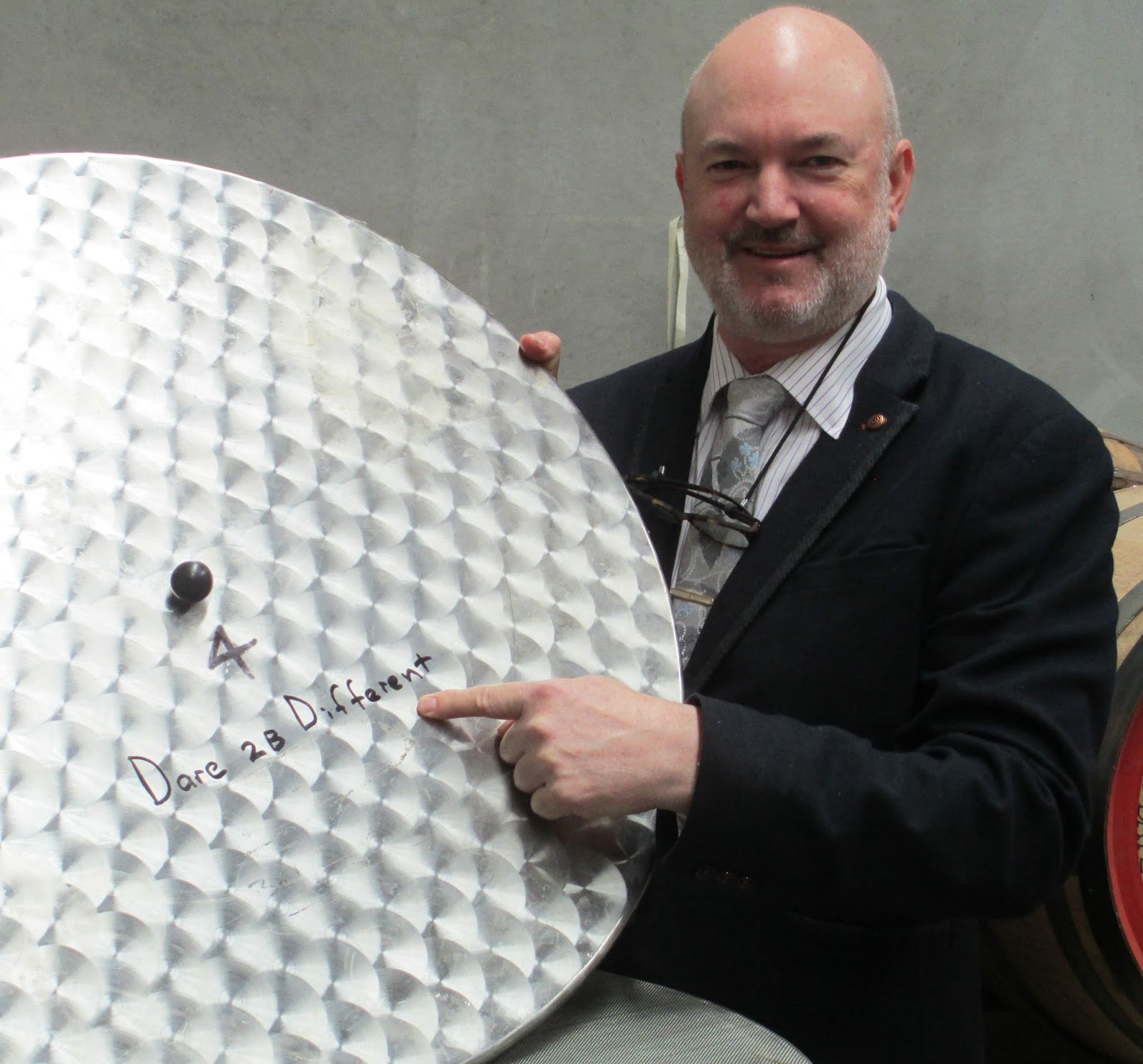
The proud father himself!

I was also treated to a nip of the very tasty bourbon cask-matured 'We are Cousins' bottling that was due to be released in the coming days (and is now sold out), and a couple of nips of the incredible Dare to be Different that was already in the decanting vat, and which has since been bottled and subsequently sold out! Tim has actually declared that this is (or rather, was) his best release yet, and while I haven't tasted it since my visit, I don't doubt that it'll be right up there. It was fresh out of the 'sweat box' at the time I tasted it, and while the initial taste was already very good, Tim then grabbed the paddle that he often smacks his whiskies around with, and gave the vat a stir before I tasted the contents again. There was a definite and noticeable difference! It makes sense of course as some of the heavier compounds will settle towards the bottom of the vat (and the same would also happen in casks), but it was a very interesting demonstration of yet another aspect to consider in the art of whisky making.
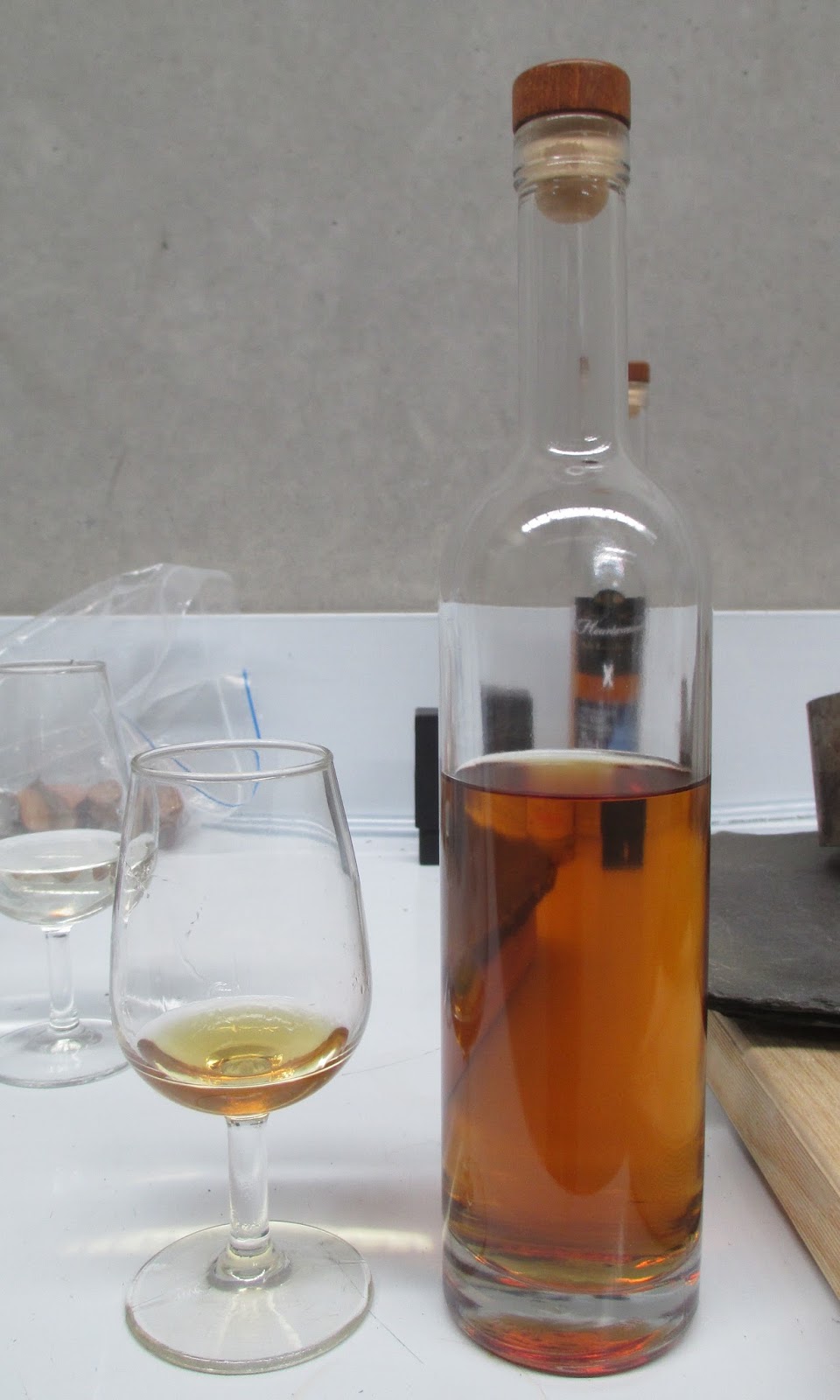
We are Cousins. Lovely stuff.

Since this is the final instalment in the Tasmanian Whisky Adventure, I've decided to review a very special Heartwood which followed roughly the same recipe as the Dare to be Different, but the end result is actually quite different (get it). This release was named Mediocrity be Damned, and is an almost 8-year old, 100% peated single malt from Lark Distillery that was matured in an Oloroso sherry cask. It was bottled at a pretty substantial cask strength of 67.2% ABV, and of course is not chill filtered or tampered with in any way, and of course is completely sold out. This bottling was dedicated to Lyn Lark, who along with her husband Bill is pretty much responsible for the existence of Tasmanian whisky as we know it!

Heartwood Mediocrity be Damned, NAS (but see below), 67.2%. Tasmania, Australia.
100% peated Lark single malt, matured in an Oloroso sherry cask. Cask LD530, 280 bottles. Distilled 9/2008, bottled 8/2016. Non-chill filtered, natural colour.

Colour: Reddish bronze. Gorgeous. 

Nose: Hello there! Big, bold and complex. Very fruity, with rich dry sherry - raisins soaked in booze, wood spices (nutmeg, allspice), roasted nuts (walnut, almond). Cough drops, warm rich oak, hints of menthol and baked stone fruit. Very dynamic and quite complex. 

Texture: Boom! Massive flavour explosion. Rich and intense, but not overly heavy and very little heat.

Taste: Intense fruit and spice. Burnt toffee, toasted spices, tropical fruit juice (guava and mango in particular?), slight hint of earthy peat behind. Drying sherry, coffee grounds and more warm oak. 

Finish: Long. A little spirit-y and drying, but in a pleasant way. Then a little tannin, stone fruit syrup lasting for quite a while, and more oak & spice. Hint of soft earthy peat. Quite subtle, but still complex.

Score: 4 out of 5.

Notes: Delicious, as always! This being the first 100% sherry cask-matured Heartwood I've looked at this closely, I wasn't entirely sure what to expect, especially considering my love for the port cask-matured releases. But this is a beautiful whisky, and it certainly lives up to its name! It is definitely different to the Dare to be Different, despite it following the same recipe, although I haven't tasted the bottled version of that release yet. From what Tim has been saying, it's even better than this one, which is very high praise indeed! If you manage to find a bottle of either of these releases out there, it almost goes without saying, I'd recommend that you grab one while you can! 

I can't wait to see what Tim Duckett comes up with next, although it sounds like there may be a few months' wait until we find out what that is! But having tasted a few potential future bottlings, I have no doubt they'll be well worth the anticipation. I know I'm repeating myself, but I still believe Heartwood bottlings to offer the best value for money you can find in Australian whisky. Yes they're expensive releases, and they're only 500ml bottles, but for the level of quality and the massive flavour experience you get in return for your hard-earned money, they're worth every cent. And remember, you're getting the true natural cask strength in these bottlings, presented in the most natural way possible. Outstanding stuff.

Love your work Mr. Duckett, and thanks for taking the time out of your busy schedule to give me a peek inside the inner sanctum. Keep 'em coming! 


So, this brings chapter two of the Tasmanian whisky adventure to a close. While I'm sure there'll be more chapters added in the future, I'm already missing the place. If you haven't visited the whisky isle (forget about the apples), get yourself down there and take a look. Chances are you'll love it just as much. 

Cheers!

Sunday, 20 November 2016

Tasmanian Whisky Adventure, Chapter 2, Pt. 3: William McHenry & Sons Distillery!

Our third stop is certainly one of the prettier Tasmanian distilleries! Situated on the side of a mountain near the world heritage site of Port Arthur, a former convict settlement and prison established in the 1830s, William McHenry & Sons Distillery is actually Australia's Southern-most distillery. Located on the Tasman Peninsula, around 1.5 hours drive south-east of Hobart, it may not be the easiest of the distilleries to reach, but it's well worth the effort if you ask me.


William McHenry was a pharmaceutical executive in Sydney in a past life (well, just over 10 years ago), and the career chemist and agricultural scientist decided that he'd had enough of that life, and needed to make a change. When a friend suggested that with a name like his he should be playing bagpipes and making whisky, it struck a chord, and became embedded in the back of Bill's mind. Then during a holiday to Tasmania the family became enamoured with the place, and Bill then began searching for the ideal location for his distillery, with a few research trips to Scotland in between! He found it around 2010, an undisturbed 100-acres near Port Arthur which ticked all the boxes, and the McHenry family relocated to Tasmania.

Bill's cottage on top of the mountain. Not a bad spot!

Thanks to the southern latitude and proximity to the ocean (Antarctica is the next stop south, a few thousand km away), the distillery enjoys a cool, stable and often wet local climate, quite different and more consistent than that experienced in Hobart, in fact it's closer to what you might find in Scotland. This means that the whisky matures considerably slower than its Northern cousins, and the long-term plan is to mature the whiskies for longer and in full-size casks to take advantage of these local characteristics. Another key point of the location is the abundance of natural underground springs on the property, which provide the distillery with extremely clean, soft, naturally-filtered water which is then put to use as cooling, diluting and of course distilling water.

The distillery's hybrid-style steam-jacketed still.

The set-up at William McHenry & Sons is very interesting, particularly with regards to the still itself (pictured above) which is a hybrid style, having the base / body of a traditional pot still and the neck of a column still. The entire still is made from copper, and what you're seeing above is a stainless steel water jacket which encases and heats the body of the still itself using steam. This unique design allows for more versatility across different spirits and more stable temperature control, and the hybrid design is utilised to produce a lighter and more refined product through high levels of reflux. There is also a larger second still in the works as part of the large expansion that is currently under way at the distillery. The wash for McHenry's whisky is sourced from Moo Brew, a popular craft brewery in Bridgewater, north of Hobart. The narrow spirit cuts are done by hand, and once collected the new make is typically filled into 100-litre American oak ex-bourbon barrels, for a long, peaceful maturation. You'll also also find ex-port, sherry and wine casks in the bond store, which will definitely be worth keeping an eye out for!

The afore-mentioned expansion also includes a larger bond store, a separate visitors centre / cellar door, and even boutique accommodation towards the top of the mountain. This accommodation will share the incredible views with Bill's own cottage pictured above, and guests will be able to look across at Hobart to the north, and as far as the Hartz mountain range to the west. Not a bad spot to spend the night as it is, but when you add the fact that this spot is located at a whisky distillery, and is about five minutes from Port Arthur itself, it doesn't get much better than that!

The current range of spirits produced at the distillery.

The distillery is producing a range of different spirits, from a barrel-aged gin, and a gin-based liqueur flavoured with sloe berries, to a triple-distilled vodka, and of course their flagship single malt whisky. The distillery also runs gin workshops, where customers can make their own custom-made gin, learn how the entire process works, and finally can bottle their own bespoke gin. While many young whisky distilleries produce white spirits merely as a stop-gap to keep the wheels turning while their whisky matures, McHenry's range of spirits have been widely acclaimed, and are very popular in their own right. I have to say as far as gins go (it's not my usual go to spirit!), the barrel aged example from McHenry's, which is given a quick maturation in a solera-style system of ex-bourbon casks, was very enjoyable and offered more depth of flavour and a softer experience than I typically find in your average gin.


Whisky-wise, in the early days Bill released a whisky under the label Three Capes, which was a private bottling of 10-year old single malt from Tasmania Distillery (Sullivan's Cove). It was an enjoyable whisky and was quite reasonably priced, but has since completely sold out. Not to worry though, as the first release of Bill's own whisky debuted earlier this year. There have been 3 releases to date, which were all matured in 100-litre ex-bourbon casks before being finished in smaller dessert or fortified wine casks, and all have been around 5 years of age. Thanks to the local climate and the other factors explained above, they are quite different to what you may expect from a Tasmanian whisky, being of a lighter and more gentle style than most of its cousins. So far they're also bottled at a slightly lower strength than most, but much to the distillery's credit they're still non-chill filtered and naturally coloured. so there's no tomfoolery here, and they also have distillation & bottling dates and cask details printed on the rear labels. Great stuff!

I'm looking at barrel number 3 here, which was finished in a 20-litre tokay wine cask. Tokay (also known as Tokaji) is a non-fortified dessert wine where traditionally the grapes are left on the vines for an extended period, also known as 'late harvest' or 'noble rot', to maximise the sugar content of the fruit. Whisky matured in tokay casks seems to generally be quite lightly influenced flavour-wise, at least in all-but-one of the examples I've tried so far, particularly when compared to the more common port or sherry cask. This release of 200 x 500ml bottles is largely sold out, but barrel number 4 is due for release in late November 2016. Unfortunately I reviewed this whisky in a bar in Hobart (I didn't think to do it at the distillery), so in the interest of fairness I'm not going to score it, and my notes are not as detailed as usual. But I hope it's enough to give a general impression of what we're looking at here.

McHenry Single Malt Whisky, barrel 3, NAS, 44%. Tasmania, Australia.
Approx. 5 years of age, bottled 2016. Matured in a 100-litre ex-Maker's Mark bourbon cask and finished in a 20-litre tokay wine cask. 200  x 500ml bottles. Non-chill filtered and naturally coloured. 

Colour: Amber.

Nose: Sweet & quite fruity with spicy oak, toffee sauce, a hint of spent coffee grounds.

Taste: Light, sweet and subtly spicy with peppery oak, vanilla and dried fruit, both stone & tropical. 

Finish: Fairly short and delicate, slightly floral with spiced stewed fruit and drying, slightly tannic oak. 

Notes: This is certainly a well-made whisky, particularly considering the relatively young age. And remember that's largely without the accelerated maturation that most Tasmanian distilleries enjoy. This is perhaps not the most complex or exciting dram, but it's very drinkable and easy going, and would certainly be a crowd-pleaser, and even a summer's day whisky. It's also important to note that this is only the third whisky released from William McHenry & Sons, and it's only six months or so since the first release, so I'm sure there'll be bigger things to come from the distillery in the near future. 

If you can't make it to the distillery itself, there's currently a cellar door conveniently located on the Hobart waterfront inside the Brooke Street Pier, where you can sample the wares and purchase bottles. But if you ask me the distillery is handily located, being close enough to Port Arthur for a quick stop before or after visiting the site, which really is a must for visiting history buffs. And of course both the distillery and the general area are beautifully scenic, remote and unhurried. Certainly an excellent day trip from Hobart, at the very least. Just be sure to email or call ahead to check availability.

A big thanks to Bill & team for taking time out of their day to show us around. We're looking forward to visiting again and seeing the new additions in action!

Cheers!

Sunday, 13 November 2016

Tasmanian Whisky Adventure, Chapter 2, Pt. 2: Belgrove Distillery!

This next stop on the Tasmanian whisky adventure would have to be the world's most environmentally sustainable distillery. At the time of writing it's also Australia's only rye whisky distillery, and the man behind it is easily one of the most multi-talented people I've ever met. We're headed around an hour north of Hobart, on the outskirts of the town of Kempton, to the absolutely extraordinary Belgrove Distillery. It may not be as visually appealing as some, but visiting this totally unique distillery was without a doubt one of the highlights of the entire trip.


Peter Bignell (pictured above) has been a Tasmanian grain and sheep farmer for over 40 years, but is also much, much more. This man's resume would be enough to crash the servers of your average recruitment agency. He studied agronomy and microbiology, has a bachelor's degree in agricultural science, and dabbled in physics and chemistry, among others. He's also an ice sculptor and sand sculptor, an engineering genius and master innovator, and clearly a very talented distiller. He made his own copper pot still (which is an ingenious item in itself), and is in the process of designing and building his own column-style wash still, he coopers and chars his own casks, and makes his own bio-diesel (from used cooking oil) for use in the distillery and on the farm. Oh, and he restored the historic water mill at Nant Distillery / estate while the distillery was being built. Meanwhile, I can't remember the last time I used a screwdriver...

Belgrove's malting machine and peat smoker: a re-purposed spin-drier!

After harvesting a particularly large crop of rye one year, Peter decided to put it to use by making what was Australia's first rye whisky, building a distillery in an old stone stable behind his house. He now grows his entire grain requirement on the farm, which makes Belgrove one of three 'paddock-to-bottle' or 'farm' distilleries in the world. This means that the entire whisky making process, from growing the grain to bottling the finished whisky, is done on site. There's no commercially produced malted grain shipped in from outside sources, and there's no centralised maturation warehouse or commercial bottling plant involved here. Everything is done by hand (mostly by Peter himself), on-site at the distillery, including the malting, (where necessary for the desired type of spirit - rye whisky is not required to be 100% malted), and the milling of the grain, and the fermentation and brewing of the wash (using both commercial and wild yeast) prior to distillation. In fact the entire grain malting process takes place in the re-purposed industrial spin-drier pictured above, which when desired is also a peat smoker (well, it's usually peat smoke - read on!). 

Belgrove's hand-made pot still, with cooling jacket fitted over the neck.
  
Peter built his copper pot still (pictured above) entirely by hand, including the welding and rolling of the sheet metal, after a couple of quick lessons from a local copper-smith. The still is direct-fire heated using either biodiesel, waste cooking oil collected from nearby food businesses (to quote Peter directly - "with the chips filtered out" - !), or even used engine oil or animal fats, and the heat is regulated by a re-purposed domestic kitchen mixer! Instead of the normal lyne-arm and external condenser found on your average pot still, Belgrove's uses a removable copper cooling jacket which is fitted over the neck of the still to condense the alcohol vapours into liquid form, using water sourced from the farm's dam which is recycled after use. In fact the distillery uses no town water, it's all collected from the dam and the farm buildings' roofs, and any hot water required (i.e. during mashing and brewing) is heated using bio-diesel. Peter also discards the first few litres of the foreshots (the methanol and other volatile compounds produced early in distillation) collected from each spirit run, rather than recycling them back into the next spirit run like most distilleries, to give the spirit a head-start when it goes into cask. Oh, and the spent grain mash leftover after distillation is fed to the farm's sheep, who in turn provide the farm with fertiliser, and in one case, something else which is just slightly different!

Peat, glorious peat! And there's more to the story in this case...

As I mentioned above, Peter is using peat to smoke the grain in a couple of his whiskies, but there's something very important to note about the peat itself. While Lark Distillery has the license and lease to mine peat in Tasmania's highlands, the peat used produced at Belgrove is different. The peat came from the family farm on the north-eastern coast of Tasmania (harvested some time ago), giving it a character which is more familiar to the Scotch drinker than its inland equivalent, and making Belgrove's peated expressions totally unique. There are currently only two casks of this whisky, one rye whisky and one single malt, and they're the only whiskies in the world which have been made with coastal Tasmanian peat. In fact you could say Peter is single-handedly taking on a certain Scottish island which also happens to use the odd bit of coastal peat when making whisky. Very, very exciting stuff! As for casks, Peter is mainly using ex-Tasmanian malt whisky barrels, which are often re-coopered and often re-charred (all by Peter himself) prior to being filled.

Part of Belgrove's current range of spirits, with many more in the works!

Belgrove Distillery produces a very diverse and very impressive range of hand-crafted spirits, so far including un-aged white rye spirit, a distilled cider / un-aged apple brandy named Apple Hatchet, a distilled ginger beer named Ginger Hammer, a delicious black coffee & white rye liqueur, a barrel-aged grappa, an eau-de-vie, an oat whisky (which is also delicious), and of course his excellent rye whiskies, including a peated rye and a rye finished in pinot noir wine casks. Also due for release in the near future are a chocolate malt (heavily roasted malt) whisky, a whisky distilled from spelt wheat, a distilled IPA beer, the peated rye and peated single malt that I mentioned above, plus a highland-peated rye (which Peter has released previously), and a true peated cask-matured whisky, where the cask itself was rinsed and dried over peat smoke prior to being filled with un-peated spirit. Like I said, totally unique and absolutely extraordinary! Speaking of which, it almost goes without saying in this case, but naturally (heh) there's no added colouring or chill filtration anywhere to be seen near any of Belgrove's products.


There's another one-of-a-kind barrel (pictured above) that I can't resist mentioning, and I was lucky enough to actually taste. Sitting in Peter's warehouse is a single barrel of young spirit, distilled from rye that was smoked with... wait for it... sheep manure, that was kindly donated by the farm's sheep! As Peter puts it, that's taking recycling to the extreme! Aptly named 'wholly shit', it was a very enjoyable dram, with a very interesting grassy smoke that only emerges on the finish, but is quite prominent. I don't think you'd suspect anything if this was tasted blind. It's only a few months old at this stage, and has to be at least two years old before it can be called whisky, so it's still a while away from bottling.. Definitely one to watch out for though, as with all of Peter's products!

Peter also graciously and generously parted with a sample drawn straight from the cask pictured below, so I could share the love with yourselves! This is a 50-litre re-coopered and re-charred ex. Tasmanian Distillery (Sullivan's Cove) barrel filled with the afore-mentioned peated single malt whisky, smoked with coastal peat from the Bignell family farm in north-eastern Tasmania. This cask is currently the only one of it's kind, and is therefore some seriously rare and absolutely unique stuff with less than 50 litres (thanks to the angel's share) in existence world-wide. What a time to be alive! As you can see it was filled in March 2015, so has another six months or so left to mature before it can be called whisky, so we'll refer to it as malt spirit for the moment. Since it won't be ready for bottling for another 6 months or so, and since it's completely one-of-a-kind, I'm not going to score it (it'll likely change dramatically in those 6 months anyway), I'll just share my tasting notes and give my thoughts. Hold onto your hats folks, because this review just might be a world-first!

Belgrove Peated Single Malt Spirit, 18 months old, approx. 63% ABV. Tasmania, Australia.
Peated with coastal peat from north-eastern Tasmania. Matured in a single 50-litre re-coopered ex-Tasmanian malt whisky barrel. Barrel number PB061, due for bottling March 2017.

Colour: Pale gold.

Nose: Sweet dusty malt, thick & slightly burnt oatmeal porridge, hints of very sweet tropical fruit. Something reminiscent of a dunnage warehouse, particularly the earthen floors and dusty casks. A little mild acetone, subtle vanilla, and a hint of that slightly salty coastal peat.

Texture: Light-to-medium weight, and only a slight touch of heat - hardly any considering it's around 63% ABV and only 18 months old!

Taste: Spicy wood smoke, some subtle dry oak, warm (not hot) chilli flakes, spiced honey, slightly herbal as well.

Finish: Long and quite complex. Some hot ash, a little cinnamon, more of the slightly burnt oatmeal porridge from the nose. A little soft, dry smoke, then that dusty sweet malt again but with a lingering soft peaty edge.

Notes: Really impressive, and really unique! The peat influence is quite subtle compared to what you might expect, but it's definitely there, and compared to other peated Australian whiskies it's quite prominent. It's also markedly different to it's distant cousins, even those made with peated barley imported from Scotland. It's already a great quality spirit, and I look forward to trying it when it's come of age and can finally be called whisky! Let's hope this stuff becomes a regular part of the Belgrove line-up.

Like many Tasmanian whiskies Peter's products are in high demand, they sell out quickly and are not the easiest to find, but some can be purchased directly from his website when available, and a few specialist whisky retailers usually manage to find some stock. The fact that Peter is often invited to speak at international spirits shows and conventions is definitely testament to him being able to teach even the 'big boys' a thing or two. Let's just hope that doesn't keep him away from the still for too long!

Belgrove Distillery doesn't have a fancy visitor's centre or carefully practised tour guides, and isn't really open to the public, but tours can be booked in advance by emailing Peter and asking nicely! If you're a whisky or distilled spirits fan, I highly recommend doing so, because there's no distillery quite like this in the world. I can honestly say this was the most eye-opening and mind-blowing distillery I've ever visited. Without a doubt.

A big thanks to Peter for showing me around, and for all his hard work, and of course for that very special sample. I will be back!

Cheers!

Sunday, 6 November 2016

Tasmanian Whisky Adventure, Chapter 2, Pt. 1: Lark Distillery!

Some of you may remember last years' Tasmanian Whisky Adventure. Well, my wife & I loved the place so much that we went again this year, and I managed to visit a few of the distilleries that I missed last time, so here starts chapter 2 of the Tasmanian Whisky Adventure! This will be a four-part chapter, and as with last year, I'll be giving a little history and further details on the distillery, and reviewing one of their whiskies.


The last Tasmanian adventure was in the middle of winter, which was very cold, windy and even snowy, so we thought we'd go a little later in the year this time. Aiming for late spring, we assumed the weather would be milder. In reality it was only slightly milder, with a few beautiful sunny days mixed in with the new additions of more rain, grey skies and even stronger winds, but it was still very pleasant and very beautiful, and the weather certainly didn't dampen spirits at all (get it?). In fact I have no doubt this adventure will have even more chapters added to it in the future.


The first stop for this chapter is the original Tasmanian whisky distillery, Lark. But before we get into the distillery itself (since the two are linked) we need to briefly cover the history of Tasmanian whisky. We essentially have one man and wife duo to thank for the existence of Tasmanian whisky in its current form: Bill Lark, the Godfather of Australian whisky, and his wife Lyn. In fact I had the honour of briefly meeting the humble couple on this trip, and despite having consumed a few quiet beverages at the time, I made sure to thank them both for their efforts. It was Bill who first realised that Tasmania was the perfect environment for making whisky in the early 1990s, with clean soft water, a supply of good quality barley, the ideal climate, and even its own peat bogs. But there were a few hurdles to get over before things could get underway.

Distillation had been illegal in Tasmania for over 150 years, and the federal distilling act also proved a massive obstacle, making distillation illegal in stills under an industrial-sized capacity. Bill took the issue to his local member, who took the issue to the federal customs minister, who had the laws altered and enabled legal distilling in Tasmania on a more realistic scale. Bill then obtained his distilling license, and started Lark Distillery in 1992, at the site which is now the Lark cellar door (and also an excellent whisky bar) in Hobart. In fact when you think about it, without the Tasmanian whisky industry paving the way, would we have an Australian whisky industry? I don't think so, or at least not to the same extent that there is today. So we fans of Australian whisky owe quite a lot to the 'why not?' attitudes of Bill & Lyn Lark.

The 'Drambulance' awaits...

These days the distillery is located in the coal river valley area near Cambridge, around 20 minutes drive North-East of Hobart. While the distillery itself is not open to the public, organised tours leave twice-daily (in the 'Drambulance' pictured above!) from the cellar door in Hobart, and give a much more in-depth and hands-on experience than most distillery tours. And there's no need to organise a designated driver, so no-one misses out! There is a choice of the standard tour which runs for approximately two hours, or a full-day catered 'premium experience' which will also have you put to work in the production process, helping to actually make Lark single malt whisky. I attended the standard tour, which certainly gives a close and more technical look at the distillery's operations.

In fact where possible the tours are timed to witness the cuts being made during the spirit runs, and often include sampling of the brewing wash and the resulting new make spirit as it comes off the still, while learning about the process from the distillers themselves. You'll also be treated to a couple of samples drawn straight from the cask, surrounded by slumbering whisky in one of Lark's bond stores (warehouses). You'll also see Lark's peat smoker in action, pictured below, which gives some perspective on the size of this distillery compared to the massive kilns in use in the Scottish distilleries and commercial malting facilities.

Lark's peat smoker in action. What a wonderful aroma!

The Tasmanian barley used is sourced from Cascade brewery in Hobart, and has already been dried in the malting process, so the malt is re-wet and dried in the above peat smoker to a level of around 8 ppm. Thanks to this different process the peat influence is only light, roughly equivalent to a Springbank or Benromach level, but with the different flavours resulting from the Tasmanian highland peat it's a very subtle influence. This extra-step also means that the peating level can be varied between batches (and heavily peated batches are currently maturing), and the peated malt can of course be mixed with un-peated for an even lighter influence. Interestingly, Lark lease an area of one of the largest peat bogs in Tasmania, in the Western Highlands, and despite needing a relatively tiny amount of peat for their requirements, they had to acquire a mining license from the Australian government (not a cheap or easy process I'm sure) to be legally permitted to harvest it.

Lark is essentially using town water in their whisky production, which is very clean and soft in Tasmania, although they are a little unusual in that they are producing and brewing their own wash (the basic form of beer that is then distilled to produce whisky), rather than purchasing 'pre-made' wash from one of the local breweries. Lark also supplies wash to Old Hobart Distillery (Overeem whisky), although the methods and ingredients are a little different as per Overeem's requirements. After the seven-day fermentation process, the wash is double-distilled in Lark's two copper pot stills, and interestingly the wash still uses a worm-tub condenser, much like Mortlach or Benrinnes, while the spirit still uses the more common shell-and-tube condenser. The reason for this is to achieve a compromise between the heavier spirit (or low wines, in this case) produced by the worm-tub condenser on the larger wash still, and the lighter spirit produced by the more modern and more efficient shell-and-tube design on the spirit still.        

Lark's wash still, with worm-tub condenser seen behind

Once the cuts have been made from the spirit run, the new make is then filled into casks, with 100-litre re-coopered Australian port casks being the preferred type & size, although Lark also fill ex-bourbon, sherry, brandy and rum casks, among others. And at no stage are any of the whiskies chill filtered or subjected to added colouring. While most of Lark's whiskies don't carry age statements, they are usually bottled at around 6 years of age, although this varies depending on cask size and a few other factors, and of course the maturing whisky is given a boost by the indecisive Tasmanian climate. During our tour we were treated to samples of Lark's 'classic cask' and 'cask strength' expressions, which are matured in a mix of first- and second-fill ex-port and ex-bourbon casks, as well as cask strength drams drawn from a 20-litre ex-port cask (my pick of the bunch) and a 20-litre ex-bourbon cask, and thanks to distiller Craig's generosity we were also treated to a surprise nip of one of the 'special releases', a very interesting apple brandy cask-matured whisky bottled at 46%. Not such a bad way to spend an afternoon, and it gave a very enjoyable insight into Lark's range of expressions and the effects of the different casks that are in use. 

I stumbled across another of the 'special releases' behind the bar at the cellar door later in the trip, and since I knew I wouldn't get another chance to try it, I decided to review it on the spot for this write-up. As such my notes aren't quite as detailed as usual, and I decided not to score this dram out of fairness. This particular expression is the oldest official bottling released by the distillery, at 9 years of age, and was matured in a single ex-bourbon cask (cask no. LD240) from Heaven Hill distillery in Kentucky, before being bottled at 43%. It's certainly not cheap though, at around $450 AUD for 500ml bottle, and is only available from the cellar door in Hobart. 
Lark 'Special Releases' 9 year old ex-bourbon cask, 43%. Tasmania, Australia.
The oldest official bottling released by the distillery. matured in a single Heaven Hill bourbon cask, LD240. Non-chill filtered, natural colour. Reviewed at Lark cellar door in Hobart.

Colour: Light gold

Nose: Sweet, soft and delicate. Slightly dusty honeyed malt, oak, ripe tropical fruit, hint of bees wax.

Texture: Light. Sweet and delicate, a little heat towards the finish.

Taste: Sweet, toasted grains, tropical fruit again, tiny hint of earthy peat towards the finish.

Finish: Quite short. A touch of spirit-y heat, then more toasted grains, oak and vanilla. 

Notes: A very different expression, which is unlike any other Australian malt I've had. In fact it's closer in comparison to a youngish ex-bourbon matured Scotch I think. I can't help but think I would've preferred it at a higher strength, but it's not unpleasant by any means. It's very easy-drinking and more laid back / delicate than your average Tasmanian single malt. It's a very expensive release unfortunately, but when it's roughly 50% older than most releases from the distillery, and single cask releases of this age are hardly going to happen often, you can understand why it's commanding a higher price. Besides, it's not far removed from the pricing from some of the other Tasmanian distilleries' bottlings. 

I'm very impressed with Lark's entire operation. They may not yet have the massive international renown of Sullivan's Cove (although I'm sure that will change), but they're working tirelessly on trying new things and constantly refining their practices. They're also a very nice bunch of people, very professional and knowledgeable, and are clearly happy to be involved. The tour in particular was one of the best I've attended, it is a far more technical and inclusive experience than most, where you're actually talking to the people that make the whisky, while they're doing exactly that right in front of you, while explaining what they're doing and why. You're not fenced off at a distance or constrained by yellow lines, you're right in the middle of the stills and equipment, enjoying the sights, smells and tastes of a working distillery. If you ask me, this is an absolute must-do for any whisky fan. And make sure you allow plenty of time afterwards for a dram at the cellar door. And now I'm wishing I was still there...

Cheers!

Sunday, 30 October 2016

Two incredibly rare Laphroaigs explored & reviewed!

I like to think I know a fair bit about Laphroaig. Seeing as it's my favourite whisky distillery, which by default makes it my favourite alcoholic beverage, I have no trouble rattling off specifications and details that would easily send the non-whisky nerd into a peaceful slumber. But in reality I have barely scratched the surface, and still have much to learn. I was reminded of this recently when Dan Woolley, Australia's national brand ambassador for Laphroaig  (and more), returned from a trip to Islay with a few very special bottlings in tow.

Among this amazing bounty was a bottle of Dan's own hand-selected custom blend of cask strength Laphroaig (aptly named 'sweet peat'), plus two different single cask bottlings, and something I'd never heard of, which carried the name 'Highgrove'. At first glance, you might pigeon-hole this mysterious bottle as a mere independent bottling, but there's more to the story behind this exceedingly rare and exclusive bottling of single malt. Highgrove is the name given to the Royal Gardens of the private residence of Prince Charles and his wife Camilla. As some may know, Laphroaig is the only Scotch whisky to carry the Royal Warrant of The Prince of Wales (meaning they are an official supplier to the royal family), and The Prince (known in Scotland as the Duke of Rothesay) reportedly has a particular affinity for the 15-year old expression. The Royal Warrant is proudly displayed on the labels and packaging of Laphroaig's official bottlings, and the distillery building itself wears The Prince's coat of arms.

Located on a 200+ year old estate South of Gloucester, England, the Highgrove organic gardens are a reflection of The Prince's commitment to environmental sustainability, and are opened for public tours in certain months of the year. The estate also includes a physical shop and online store where a number of exclusive products can be purchased, with all profits going to the Prince of Wales' charity foundation. One of these exclusive products is a private bottling of Laphroaig single malt, and there have been a number of different versions over the years, usually aged between 12- and 15-years, and bottled at either 43 or 46%. Something very interesting which I have since learned about these Highgrove bottlings, although the details are a little scarce, is that the current bottlings are made from organic Scottish barley. I would interpret this to also mean that they are made using only the floor-malted barley from the distillery, as the malt sourced from Port Ellen which supplements the distillery's own is not organic, and therefore could not be included. But I'm speculating a little there.

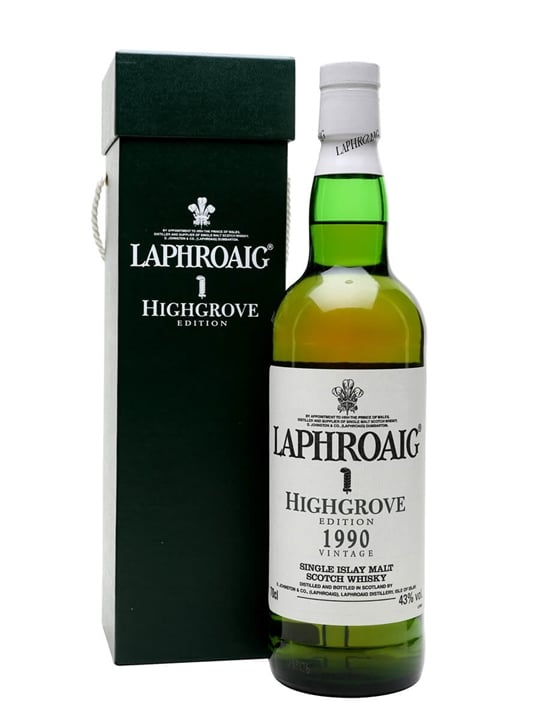
Unfortunately we can't be sure that this applies to the bottling I'm lucky enough to be reviewing here, because it was missing it's label (which is how Dan managed to get his hands on it, and luckily he was generous enough to give me a sample), so we don't know a cask or bottle number, or exactly which expression this was, but we do know that it was bottled at 14 years of age at 43% ABV. I could only find a few references to a Highgrove bottled at 43%, and all were older bottlings that displayed vintages rather than age statements, which are of course rarer than those currently available from the online store, which are hardly a dime-a-dozen anyway! Since there is no label on this particular bottle we cannot be sure, so I've chosen an image that closely reflects the details I have to hand. Being bottled at 43% will mean this bottling was likely chill-filtered, and will have had added colouring, as is the case with the 15-year old official bottling. So, let's have a closer look at this very special Laphroaig, shall we?
Laphroaig 'Highgrove', 14-year old, 43%. Islay, Scotland.
Exclusive bottling for Prince Charles' Highgrove shop, all profits go to HRH's charity foundation. Ex-bourbon cask matured. Assumed chill filtered and added colouring. Photo above for approximate reference only.

Colour: Gold. Added colouring in my opinion. 

Nose: Very soft & quite subtle for a Laphroaig. Sweet, ripe tropical fruit, rich caramel, some citrus & a nice minerality, like wet stone pavers. Hints of seaweed and dry, earthy peat.

Texture: Light-medium weight, warming & rich. No sign of any alcohol whatsoever, very soft. 

Taste: Tropical fruit again, more rich caramel, and some more dry & earthy peat, more prominent here but still quite subtle. A little soft chilli spice in there too. Slightly drier here than it was on the nose.

Finish: Medium. Drying spices, then light fruit and more wet stones, and the peat comes back towards the end. Quite a light finish, but enjoyable. 

Score: 3.5 out of 5.

Notes: Not your typical Laphroaig at all, much softer and more gentle than you may expect. Softer even than the standard 15-year old official bottling, and surprisingly different to it as well. In fact I think I prefer this expression, although it's been a while since I tasted the 15yo. The Highgrove is very, very good quality, there are no off notes or harshness, and there's no sign of any alcohol, which could get a little dangerous considering just how drinkable this one is. Very nice! I'd love to try the more recent Highgrove bottlings as well, they seem to be a couple of years younger and have gone up in strength to 46%, so they'd be very interesting!

But wait, the title says 'two incredibly rare Laphroaigs', so we're not done yet! 

This next bottling is essentially even rarer than the previous, because this sample came from a single bottle of a single cask of Laphroaig, which had not even been selected for bottling at the time. So at the moment the only way of getting yourself a dram from this cask would be getting yourself to the distillery, and then trying to bribe your way to disturbing this exact still-sleeping first-fill bourbon cask. And good luck with that! Dan really does have a dream job. Obviously there's no photo of this bottling, but we do have all the juicy details to hand. It was bottled at a cask strength of approximately 57%, at 13 years of age, without chill filtration or added colouring, and was matured in a single first-fill ex-bourbon cask from Maker's Mark. Wowsers!


Laphroaig single cask, 13-year old, 57% approx. Islay, Scotland.
Matured in a first-fill Maker's Mark bourbon cask. Definitely non-chill filtered (not filtered at all I suspect, which is very cool) and natural colour. 

Colour: Paler, lighter gold, and even some charred barrel bits! How awesome is that! 

Nose: Fruity again, but under-ripe this time. A lot of bourbon cask character, with toasted oak, sweet caramel, and even a little leather. Salted butter, a little wet soil, but no sign of any peat or smoke. A little alcoholic nip as well, but only slight.

Texture: Medium-heavy weight, lovely natural spirit. No heat at all, rich & velvety.

Taste: Starts soft & sweet, then a slow-motion explosion of dry, spicy, ashy peat. Then soft & sweet again. Some sweetened grapefruit, a good pinch of black pepper, and some strong mint. 

Finish: Medium length. Peat comes back again, then sweet caramel and oaky vanilla, more pepper and grapefruit, but it's dried now. Then something reminiscent of a mild blue cheese coated in black pepper. Weird I know, but I like it! The ashy, slightly spicy peat comes back again towards the end. 

Score: 3.5 out of 5.

Notes: Very good of course, as you'd expect from Laphroaig. A lot of bourbon character on the nose, and certainly a sheep in wolf's clothing between the nose and palate, as is the case with a lot of Laphroaigs. Some unusual notes on the palate too, not in a bad way, but rather in a very interesting way! Very drinkable again, but with more punch and definitely more recognisable Laphroaig-y notes that we all (well, most of us) know & love.

I don't think I could choose between these two very different and very interesting whiskies. One is the perfect everyday drinker, very gentle but still engaging, while the other is softly spoken and inviting, but likes to remind you it's the boss every now and then. So if such a thing were even possible, which of course it isn't, I'd have to get one of each. I'm certainly very lucky to have tried them at all.   

Mr. Dan Woolley, I really cannot thank you enough for sharing these precious Laphroaig's with me (and the others over the years), I think I owe you a dram or two! Thanks very much mate. See you next time!

Cheers!   

Sunday, 9 October 2016

Hyde Irish Whiskey Review!

For quite a while now, the only Irish whiskey that interested me was the only peated Irish whiskey, Connemara. Mainly because I personally found most other Irish whiskeys I had tried to be, frankly, a little boring. Triple-distilled, watered down to 40% and chill filtered, and purposely designed to be lighter in flavour and texture than your average Scotch, they didn't really float my boat. But that is beginning to change, because despite being un-peated, what we have here are some very interesting drams!
Hyde Irish Whiskey is a relatively new brand to the Australian market, which is owned by relatively new company Hibernia Distillers, based in South-West Ireland. Current owners Alan and Conor Hyde have their own distillery in the works, but until that is up & running their whiskey is sourced from Cooley Distillery, located North of Dublin, matured in Cork located in South-West Ireland, and bottled under the Hyde label. That second-last part is important, because the climate in Cork is warmer and wetter than the rest of Ireland, which effects the maturing whiskey. 

There are currently five Hyde expressions available, three single malts and two single grain whiskeys, 'single' of course meaning that they were made at a single distillery and are not blended. All expressions carry an age statement, are triple-distilled (as is the norm for Irish whiskeys) and are bottled at 46%, without chill filtration. What's also interesting here is the cask types used for maturation. While all expressions are initially matured in ex-bourbon casks, four of the five are then finished in either sherry, rum or burgundy casks before bottling. This is still quite an uncommon practice in Irish whiskey, where cask finishings have not yet taken hold to the same extent as they have in Scotland.

Thanks to Hyde's Australian importer Wonderland Drinks, I'll be taking a closer look at four Hyde expressions today. Two single malt whiskeys, one of which is finished in Oloroso sherry casks, and the other in Caribbean dark rum casks, and two single grain whiskeys, one of which is finished in French Pinot Noir casks, and the other is fully matured in heavily-charred ex-bourbon casks. See, told you these were interesting drams! It's important to note that while the grain whiskeys are labelled 'The Aras Cask', and the malt whiskeys and labelled 'President's Cask' (a tribute to Douglas Hyde, Ireland's first president), these are not single cask bottlings, although they are all limited releases.

These 'Aras Cask' Hydes will be my first single (un-blended) grain whiskeys / whiskies, so let's take a quick closer look at how grain whiskey / whisky is produced compared to its malty cousin. The most commonly used grains are corn and un-malted barley, but there can also be some malted barley, rye and/or wheat involved in various quantities depending on the desired recipe, also known as the mash bill. Distilleries' mash bills are usually a closely guarded secret, but in Hyde's case their grain whiskies are distilled from corn and un-malted barley, and are triple-distilled in a Coffey still. A what? Well grain whiskies aren't often distilled in traditional pot stills, but rather in column stills, a.k.a Coffey (named after the inventor, and nothing to do with coffee!) or continuous stills, so named because they don't need to be emptied and cleaned between runs / batches, which are therefore more time- and cost-efficient, and result in a lighter flavoured, higher strength, and 'purer' spirit than is produced pot stills. So on that note, let's start with Hyde's single grain Irish whiskeys!

First cab off the rank is Hyde's 'The Aras Cask No.3', a 6-year old single grain whiskey matured in a heavily-charred ex-bourbon cask, bottled at 46% and non-chill filtered. Distilled from corn & un-malted barley in a Coffey still. Very sweet & light on the nose, with some cotton candy, vanilla pods, rubbing alcohol. With extra time that changes to acetone, and some more caramel notes emerge. On the palate it's very sweet again, with some sweetened shredded coconut and simple syrup, and something reminiscent of sake (rice wine), and a short & light finish with more vanilla and caramel. This one is just too sweet for my tastes to be honest, with a little too much raw alcohol, but I could see it working well in a cocktail, or perhaps being more suited to a white spirit-drinker.

Next up we have Hyde's 'The Aras Cask No.5',  a 6-year old single grain whiskey matured in ex-bourbon casks and finished in ex-Pinot Noir red wine casks from Burgundy, France, again bottled at 46% and non-chill filtered. Distilled from corn & un-malted barley in a Coffey still. Still light and sweet on the nose, but with some oak and red fruit presence calming it down a little. Considerably less rubbing alcohol present with this one as well. On the palate, it's less sweet again, more syrupy, and less alcohol again with a little fruit coming through, and a short and thin finish with a little of that sake-like taste winding things up. The wine casks have definitely added some complexity here, and have also calmed things down a bit.

Now we're on to Hyde's single malt Irish whiskeys! Let's start with 'President's Cask No.4', a 6-year old single malt matured in ex-bourbon casks and finished in ex-Caribbean dark rum casks, again bottled at 46% and non-chill filtered. Distilled from 100% Irish malted barley. On the nose this one is richer & warmer than the previous expressions, with some palm sugar, lemon juice, toffee and tropical fruit. A little alcohol prickle here too. Still quite sweet on the palate, but again in a richer, fuller and more mellow way. Some nice malt character here, with some brown sugar and tropical fruit. A short finish again, but with quite a bit of raw alcoholic heat as well. When that subsides, there's more of that palm sugar sweetness and a little spice. This expression is more up my alley, but I can't help but feel it could've used a little more maturation. There was a 10-year old version of this expression, but I believe it's largely sold out and hard to find.

And finally, the flagship of the range, the award-winning 'President's Cask No.1', a 10-year old single malt, matured in ex-bourbon casks before a 9-month finishing in ex-Spanish Oloroso sherry hogsheads, bottled at 46% and non-chill filtered. Distilled from 100% Irish malted barley. The nose is more familiar and quite comforting, slightly richer again and with no alcohol prickle this time. I'm finding quite a strong aniseed note here, not licorice but actual aniseed, plus a creamy fruity-ness, some dusty fruit and a nice cereal-like malt character. On the palate there's more creamy vanilla, some fruit and honeyed malt. A longer and richer finish here as well, with a little oak, spice and creamy vanilla. My pick of the four expressions tasted, and nicely matured with no rough edges or raw alcohol.

Overall, these are definitely eye-opening drams which certainly highlight the different effects that cask finishing can have on maturing whisky / whiskey. The 10-year old single malt is certainly my favourite of the four, with a more familiar, richer and more mature profile, but all are interesting and engaging whiskeys in their own right, which are well worth trying for yourself! I look forward to seeing what Hyde come up with in the future, particularly once their own distillery is up & running. In the meantime, since Cooley distillery currently produce the world's only peated Irish whiskey, I'm hoping to see some peated Irish whiskey with an exotic cask finishing, it'd certainly add to the experience and would practically sell itself! Fingers crossed. Thanks again to Scott from Wonderland Drinks for the samples.

Cheers! 

Monday, 3 October 2016

Rosebank 15 yo (Single Malts of Scotland) Whisky Review!

Rosebank has been closed for nearly a quarter of a century, and although it has never enjoyed the cult status of a Port Ellen or Brora, its whisky is still highly prized.

Rosebank Distillery was located in the Scottish Lowlands, in the town of Falkirk. It was founded in 1840 on the banks of the Forth & Clyde canal, and was named after the roses which grew along the banks. Rosebank was rather unusual in that it produced triple-distilled Scotch whisky, where (in very basic terms) what would normally be considered new-make spirit in most distilleries, having been distilled twice, is then distilled a third time, resulting in a 'purer' spirit and obviously a higher alcohol content.

This practice is far more common in Irish whiskey, but there are currently only two active Scotch distilleries that are regularly producing fully triple-distilled whisky; Auchentoshan in the Lowlands, and Springbank in Campbelltown (under their Hazelburn brand), although Benriach has also dabbled in triple-distillation with certain limited bottlings in the recent past. Generally, triple-distilled whisky is lighter in flavour and texture, and in my opinion usually less characterful thanks to the removal of those 'impurities'. Rosebank does (or rather did) regain some of this character through the use of worm tub condensers, giving back some of that texture and flavour.  

The distillery was closed in 1993, despite being very well-regarded. Due to the expense required to modernise its waste processes to bring them in-line with EU standards at the time, then-owners United Distillers (now part of Diageo) decided to mothball the Lowland distillery in favour of Glenkinchie, with its far larger production capacity and easier logistics. The distillery buildings were sold to British Waterways in 2002, and while there have been a number of efforts to revive it, none have been successful thus far. The remaining stock is now owned by Diageo, and is released as part of the annual 'special releases', although the pricing is generally more reasonable compared to the other 'dead' distilleries.

There are a few independent bottlings around, which are of course becoming much rarer as the years go by. So I'm lucky to be able to taste one of those, thanks to a generous fellow whisky nerd. This bottling is from the bottler Single Malts of Scotland, owned by Speciality Drinks, the company behind The Whisky Exchange store, and the Port Askaig and Elements of Islay brands. This particular bottling is a relatively young 15 year old, which was matured in an ex-bourbon cask before being bottled at 46%, without added colouring or chill filtration. So this should make for a pretty good introduction to Rosebank!
(don't worry, it isn't clear! This is the empty bottle that the sample came from)
Rosebank 15 year old, Single Malts of Scotland, 46%. Falkirk, Scotland.
Matured in a single ex-bourbon cask. Distilled July 1991, bottled March 2007 by Speciality Drinks under their Single Malts of Scotland brand. Non-chill filtered, natural colour. Cask 2902, 284 bottles.

Colour: Pale gold.

Nose: Interesting! Not overly light or overly sweet like I expected. Still floral and sweet, but also fruity and spicy. Acetone, toasted spices, baked green apple, peaches, a little raspberry. There is some grain character here with the acetone but I wouldn't say it's malted barley that comes through.

Texture: Not bad at all, medium weight. Syrupy with a little heat, but not too much.

Taste: Sweet, honeyed and fruity.More malt character here, but still not a lot. Quite a bit of raw spirit as well, plus that lightly floral sweetness.

Finish: Medium-length, but quite one-dimensional. Still quite spirit-y to start with, then the fruit comes back, particularly the apple, but it's oxidised now. A little dry oak here as well.

Score: 2.5 out of 5.

Notes: Quite interesting, and not quite what I expected. But in a good way! Although I imagine at 40% and chill filtered it might have scored lower, I was really expecting not to like this one at all. I'm yet to try a Hazelburn, but so far this would have to be one of the best triple-distilled whiskies I've tasted. The nose in particular was very enjoyable, despite that acetone / raw spirit note, although the palate wasn't quite 'up my alley' and the finish fell over a little bit. Definitely not an active cask here either in my opinion. Nonetheless, I'm lucky to have even tried a Rosebank, especially one so well presented. So a big thanks to my anonymous benefactor for the sample of this one.

So, if you're lucky enough to come across a Rosebank in a bar or you find a dusty bottle somewhere with a reasonable price, don't discount it straight away, it could pleasantly surprise you.

Cheers!          

Hellyers Road Richly Peated 9 Year Old Whisky Review!

A new heavily peated ex-bourbon cask release from Tasmania's Hellyers Road Distillery! Might as well take a quick look at the specifics ...