Sunday, 29 January 2017

Glendronach Cask Strength (Batch 3) Whisky Review!

One of my favourites from my favourite 'sherry-bomb' distillery, which is also pretty good value for money.

Glendronach are undoubtedly the kings of all-things sherried at the moment, and in my opinion only Aberlour's A'Bunadh comes close to challenging them for the title. But things may be changing. Glendronach put their extremely popular 15-year old on 'temporary hiatus' due to stock shortages, and is now very hard to find, and subsequently often over priced. Temporary hiatus may not sound too dire, but the distillery (and it's parent company and sister distilleries) has since been purchased by Brown-Forman, a large American-owned corporation, and to my knowledge there are no official guarantees the 15yo is still coming back. I'm also concerned for the future of the single cask releases, but maybe I'm being pessimistic. Large corporate ownership isn't necessarily a bad thing (look at Bruichladdich, for example), so let's try to stay optimistic!

Glendronach have also started using bourbon casks in some of their newer expressions, which is a big departure from their modus-operandi thus far, but I imagine that is largely due to the rising prices and demand for good sherry casks in the current environment. This isn't necessarily a terrible thing, and there have been a few independent bottlings of bourbon-matured Glendronachs in the past which were well-received. But it's not what Glendronach is known for, and perhaps not why we love them so much!

But all is not lost, the excellent 18-year old and single cask releases can still be found, albeit with a little difficulty and expense for us in Australia. The NAS Cask Strength bottlings are still relatively easy to find, at least in the newer batches, and the pricing has remained relatively steady  at around $160-180 in Australia. That's expensive compared to the afore-mentioned A'bunadh, but these are quite different beasts and aren't really directly comparable if you ask me. This review is of a sample from batch 3, but I've also tasted batches 4 & 5, and while there is some variation, all are very good. All follow the same recipe: a mix of ex-Oloroso and ex-PX Sherry casks, no age statements, non-chill filtered and naturally coloured, and are bottled at a cask strength of 54-56%. Let's get to it!
Glendronach Cask Strength, NAS, 54.9%. Highlands, Scotland. 
Batch 3, released 2013. A mix of Oloroso and PX sherry casks. Non-chill filtered, natural colour. 

Colour: Copper. 

Nose: Lovely. Not the typical sherry bomb you might expect, though. Dark chocolate mousse, crystallised ginger, raisins & cherries in syrup. Dried zesty orange, a little fresh spicy oak, black forest cake, and a hint of something meaty in the background - bonox beef extract, but only subtle.   

Texture: Medium-heavy weight, syrupy and rich, very little and very slow movement in the glass. A little heat, but not much considering the strength and relatively young age. 

Taste: Rich & spicy, more chocolate and ginger, a little less sweet than it was on the nose. Dried orange, spicy fresh oak again, and a little sweet cream. 

Finish: Medium length, a little peppery heat here, but fades quickly leaving more chocolate, but more of a cocoa powder now, and ginger, but powdered now. Creamy again, with more cherry, orange and a little apricot. 

Score: 3.5 out of 5. 

Notes: Very good stuff, as we should expect from Glendronach. But it's not the cask-heavy sherry bomb we might expect from the distillery, I feel there's more spirit character here, which is very enjoyable. There is a little heat on the finish but like I said, considering the strength and of course relatively young age, it's not unpleasant or off-putting by any means. Very complex on the nose as well, a good balance of fruit, spice and chocolate which works very well. 

With the Glendronach single cask releases going ballistic in terms of price lately, in Australia at least, I think these often-overlooked NAS cask strength releases might be the next best thing. Plenty of flavour and punch, pretty good value for money, and a more balanced and slightly less sherried take on this distillery's great work. If you haven't given one of these a go yet, get on it pronto, since we don't really know what the future holds for our beloved bottles of Glendronach at the moment. But again, let's try to stay optimistic! 

Cheers!      

Sunday, 22 January 2017

Ben Nevis 10 year old & 24 year old Whisky Reviews!

My first encounter with a Ben Nevis didn't quite manage to push my buttons, but that was quite an unusual bottling. Today we have their flagship / entry level 10 year old official bottling, which seems quite well regarded in the community, and a 24 year old sherry-matured cask strength independent bottling from Signatory, so we should get a better idea of the distillery's style.

Ben Nevis distillery is situated near Fort William in the Western Scottish Highlands, at the base of it's namesake mountain, the highest in the UK. Ben Nevis is the only 'foreign' distillery owned by Nikka, one of Japan's largest whisky producers, who purchased and revived the operation in 1989 after it had laid dormant for 2 years under the previous owners. As such the distillery does send some of its spirit production to Japan in bulk to be used in the parent company's blended whiskies. Interestingly, the distillery only uses brewer's yeast in its fermentation, which is widely believed to give more character and flavour than the more commonly used and more efficient (as in higher yield) distiller's yeast.

Ben Nevis regularly release a small range of official bottlings including a couple of blended whiskies and single malts, including the 10-year old bottling I'm reviewing here, and a handful of older single cask bottlings. I reviewed a 21-year old single cask around a year ago and wasn't impressed, finding it too tannic and bitter for my tastes, and a little hot for it's age. But that was quite an unorthodox whisky, having spent 13 years in refill ex-sherry casks and another 8 years in what I would say were first- or second-fill ex-port casks, before bottling at cask strength.

This 10-year old expression we're looking at first should be a little more conventional, and has obviously had far less time 'in wood' to be able to pick up those characteristics. It's obviously considerably cheaper as well, although at $100 it's slightly more expensive than most comparable 10-year old whiskies at a similar strength. Unfortunately there's very little useful information out there on this bottling, so I was unable to find whether it had been chill-filtered or artificially coloured. As we know, the Japanese whisky producers generally aren't averse to using spirit caramel, so judging by the colour I'm assuming this was the case with this Ben Nevis 10-year old. Since it has been bottled at 46% (which negates the need for chill filtration) you'd hope it hasn't been chill filtered, but we can't be sure without it being on the label.
Ben Nevis 10-year old, 46%. Highlands, Scotland. 
Very little information available, bourbon & sherry cask matured. Added artificial colouring, possibly non-chill filtered.

Colour: Gold

Nose: Fresh & herbal. Thick stewed fruits, a little honey. Some dried mint, juniper & anise, cooking chocolate. Roasted nuts, some yeasty bread and rich, warm oak.

Texture: Heavy weight, meaty & chewy. A little heat, but not unpleasant.

Taste: Thick meaty sherry, dryer than on the nose. More stewed fruits and cooking chocolate. Spicy, with a little chilli and more juniper, and some more rich oak.

Finish: Medium length. Spicy, and more of that cooking chocolate, and a little more of that yeasty bread.

Score: 3 out of 5.

Next up we have a 24-year old independent bottling from Signatory Vintage's Cask Strength series. It was matured in a single ex-sherry butt, and bottled at a cask strength of 54.7% without chill filtration or added colouring. Signatory are becoming one of my favourite independent bottlers, their bottlings seem to be consistently high quality and often quite reasonably priced ($240 here for this bottling), so I have high hopes for this one.
Ben Nevis 24-year old, Signatory Vintage bottling, 54.7%. Highlands, Scotland.
Cask number 3833, single ex-sherry butt, 566 bottles. Non-chill filtered, natural colour. 

Colour: Gold. Almost identical to the 10, in fact.

Nose: Massively different to the 10. Brighter, lighter, sweeter. Passion fruit pulp, light toffee, vanilla cream biscuits. Some milk chocolate & wet wool.

Texture: Medium-heavy weight, meaty again. A little heat, around the same as the 10 despite the increased strength.

Taste: Thick & chewy again, much drier than it was on the nose. Dried tropical fruit, spicy oak, more milk chocolate, and a little chilli.

Finish: Medium-long length, more passion fruit & creamy vanilla, malt biscuits and honeyed oak.

Score: 3.5 out of 5.

Notes: Both have a very impressive thick & meaty texture, which I really enjoyed! The 10-year old is more savoury and meaty than its older cousin, still fruity but in a darker way. The 24-year old on the other hand is very bright & fruity on the nose, but turns drier and meatier on the palate. Both are very enjoyable whiskies, and while I do prefer the Signatory bottling, the 10-year old does offer good value for money. But then so does the 24-year old, especially at cask strength! Not sure I would have picked the Signatory bottling as a sherry cask if this was a blind tasting, there isn't much in the way of the typical sherry characteristics here, but it's a delicious whisky regardless.

These two have certainly changed my initial impression of Ben Nevis for the better, that meaty, chewy texture in particular certainly makes a big difference. Very nice stuff. And I'm still very impressed with Signatory's cask strength collection, I haven't come across a bad one yet! Thanks to Craig from The Whisky Company, Signatory's Australian importer, for the samples, and for my first proper foray into Ben Nevis.

Cheers!

Sunday, 15 January 2017

Jura 26 Year Old (Signatory Vintage) Whisky Review!

I've tasted a few whiskies from Jura Distillery, and so far they've all been quite disappointing. But they've all been relatively young official bottlings, so this cask strength independent bottling promises to be a little different...

Jura Distillery is located on the Scottish Isle of the same name, which is only a five-minute ferry ride from Port Askaig on our beloved Islay. The original distillery on Jura was dismantled in 1901 after around 90 years in operation, while the current distillery was built on the same site in 1963, making it one of the younger distilleries in the area. It's the only distillery on the island, which although quite large has a tiny population of around 200 people, and only a single road. Aside from the distillery, the island's only claims to fame are its large population of around 3500 deer, the three 'Paps of Jura' mountains, and the fact that George Orwell wrote his novel '1984' while living on the island. It's a rather obscure, quite remote and austere place, but there's also plenty of natural beauty, without masses of tourists or commercialisation spoiling it.

The distillery is currently owned by Whyte & Mackay, who produce quite a few blended whiskies, and also own Dalmore, Tamnavulin and Fettercairn distilleries. The distillery has four very tall stills, and has quite a large annual production capacity of around 2.2 million litres, with all barley sourced from Bairds commercial maltings on the Scottish mainland, and unfortunately they are big fans of both adding artificial colouring to, and also chill filtering their official bottlings. The distillery mostly produces un-peated spirit, although since around 1990 they have also been producing some heavily-peated (to around 30 ppm) spirit. The peated whisky is then either blended in with the un-peated to create the lightly-peated 'Superstition', or bottled on its own to create the 'Prophecy' expression (the only regular official bottling that is presented at 46% and non-chill filtered).

The bottling I'm reviewing today is a different story. An independent bottling from Signatory Vintage's cask strength collection, it's a 26-year old heavily-peated Jura, which was distilled in 1989 (which would mean it was one of the first heavily-peated casks filled at the distillery), and was bottled in 2016 at 59% without chill filtration or added colouring. While most whiskies in Signatory's cask strength series are single cask bottlings, this particular one is from two ex-bourbon casks, numbers 30736 & 30737, that were filled on the same day. This bottling is also quite the bargain for a 26-year old cask strength peated whisky, currently selling for $234 from Signatory's Australian importer, The Whisky Company, who generously provided the sample for this review. Let's give it a whirl!
Jura 26-year old (Signatory Vintage), 59%. Isle of Jura, Scotland.
Signatory Cask Strength series. Heavily peated, from two ex-bourbon casks, no. 30736 & 30737. Distilled 12/1989, bottled 06/2016. 338 bottles. Non-chill filtered, natural colour. 

Colour: Gold. 

Nose: Interesting. Creamed honey, fresh herbs, a little acetone, and some dusty hay. A slight hint of fresh earth, and something a little acidic comes out with time - apple cider vinegar? 

Texture: Medium-weight, a little tongue-tingling spirit-y heat. 

Taste: Spicy and honeyed, some burnt caramel and more creamed honey. Quite spirit-y as well, despite the age. Hot chilli flakes, and that strange acidic cider vinegar note again. 

Finish: Short-medium length. Still hot & spirit-y, then honeyed dusty malt and that sour note again, but more musty now. Slightly floral towards the end as well.  

Score: 2.5 out of 5. 

Notes: Not too bad really, quite interesting in fact, and still one of the best Jura's I've tasted so far. Very little peat influence here, but that's understandable considering the age and relatively low ppm on the malt (Ardbeg for example use 55 ppm malt, almost double that used at Jura). Even with what was obviously expert cask selection, this Jura still has quite a bit of heat present, which leads me to believe the initial distillation might have been a little rushed, and after all it would have been one of the early runs of peated spirit made at the distillery. Regardless, it's not unpleasant, even that strange sour note was quite enjoyable & almost refreshing. 

Signatory Vintage really do know what they're doing, in fact they're quickly catching up with G&M as my favourite independent bottler. There are some great value malts coming out of their warehouses at Edradour, some from under-appreciated or slightly obscure distilleries (the beauty of independent bottlings) and the packaging and presentation for the cask strength collection in particular is very nice indeed. Great stuff, and we now have access to quite a good range thanks to The Whisky Company doing the hard yards for us and bringing in the good stuff. Thanks Craig & team! 

Cheers!

Sunday, 8 January 2017

Starward Wine Cask Whisky Review!

Starward single malt is produced by New World Distillery, located in Melbourne, Australia. The distillery was founded in 2007 by all-round gentleman David Vitale, who had initially set out to open a microbrewery, but then spent some time with Bill & Lyn at Lark Distillery in Tasmania, and decided to open a whisky distillery instead! David now serves as the sales & marketing director for New World Distillery, and can often be found manning the Starward table at the various whisky expos and events around the country.

While originally housed in an aircraft hanger at Essendon airport just North of Melbourne's CBD, New World has recently relocated to a new larger premises in Port Melbourne. The distillery made major news last year as the first Australian whisky distillery to attract investment from Diageo, the world's largest spirits company. There were some anti-establishment sentiments expressed at the time, but it's important to note that Diageo does not own the distillery, they are simply a minority stakeholder. And let's not forget that along with their own very successful distilleries and brands Diageo are also part owners of LVMH, the owners of Ardbeg and Glenmorangie, who certainly aren't being held back from innovation and experimentation. These new funds from Diageo and other investors will enable New World to ramp-up their production and to move into overseas markets, and no doubt assisted with the massive costs of the recent relocation.


The distillery sources Australian products (including the stills themselves) and ingredients wherever possible, using Australian barley and Australian casks for the two Starward expressions, the standard release of which is matured in Apera (the official term for Australian sherry) casks, and the newer expression I'm looking at today, simply named 'wine cask', which is matured in ex-Shiraz red wine casks sourced mostly from the famed Barossa Valley region of South Australia. Speaking of which, New World do not shave & re-toast their casks, a practice often referred to as reconditioning or rejuvenating, which means they get the maximum benefits from the casks' previous contents, but conversely they do not get as much benefit from the filtering and flavour-inducing effects of that fresh toasting or charring. So these are definitely what you would call 'fresh' casks.

New World are producing relatively young whisky, usually around 3 years of age, but you wouldn't guess that by the taste or quality of the bottled product. The distillery utilises Melbourne's indecisive weather to give their maturing whisky a hurry-along, even taking full advantage of the conditions by painting their old hangar black to trap as much heat inside as possible, with the option of opening both hangar doors to rapidly cool it back down. The relatively young age and the low bottling strength of these whiskies does also help to keep costs down, which is why at the time of writing both Starward expressions can be had for $80-90 AUD in a full-size 700ml bottle. There's only one other Australian single malt in that price bracket, and it just does not come close when it comes to quality, consistency and drink-ability. So, let's get to it!

Starward Wine Cask, NAS, 41%. Melbourne, Australia. 
Aged for at least 2.5 years in 100- & 200-litre Australian ex-Shiraz red wine casks.

Colour: Amber

Nose: Sweet buttered toffee, ripe bananas (but not as prominent as in the standard Starward expression), spicy & rich toasted oak, musty red grapes, sweetened red berries, hint of toasted coconut and rich barley behind.

Texture: Light weight. Clean, sweet and well balanced. And no spirit-y heat at all. 

Taste: Sweet & rich. More buttery toffee and spicy toasted oak, musty red grapes and drying wood spices.

Finish: Some grape & oak tannins, more drying spices, hint of that rich barley again but quite dry now, and some bitter / high-cocoa raspberry dark chocolate.

Score: 3 out of 5.

Notes: A light and easy-drinking malt, almost a summer's day / breakfast whisky that would be a real crowd pleaser, keeping everyone happy! There are no off-notes, no spirit-y heat and more than enough flavour to keep you interested regardless of your level of experience. Great stuff. Having said that, I do prefer the standard Starward expression to this wine cask version, although I suspect that's down to personal taste more than anything else, there's not much of a gap here. This one has a beautiful nose, really quite rich for its strength, and also surprisingly complex for its age, but the palate and particularly the finish were not as impressive for me. 

Nonetheless, this is in my opinion the best value for money you can find in Australian whisky. It punches way above its weight, easily beating many others that are twice the price (or more), and absolutely decimates those that are a similar price. I think David & the team behind New World / Starward should be commended for their success, and for doing exactly what they set out to do, and I can't wait to see what they come up with in the future. If you're yet to take the plunge on a bottle of Starward, I definitely recommend giving it a go. Enjoy!

Cheers!

Friday, 30 December 2016

Laphroaig Cairdeas Ileach Edition 2011 Whisky Review!

It's the end of the year, and I'm lucky enough to have a very special sample of a very special whisky to celebrate with. It's Laphroaig Cairdeas 2011 'Ileach Edition'!

This one has been on my wish list for quite some time, and it's exceedingly rare: only 6000 bottles were ever released, and since they were bottled over 5 years ago, it's now basically unobtainable. Ileach is the Gaelic term for a native of Islay, Scotland, and the name 'Ileach Edition' was a nod to John Campbell being the first Ileach to manage Laphroaig Distillery in its history. John actually became the distillery manager in 2006, and the Cairdeas releases started in 2008, so I'm not sure about the timing of the name, maybe it was the first release that John selected personally? Anyway, let's not over-think this!

The Cairdeas' are the annual special bottlings released to mark the occasion of the week-long Islay festival Feis Ile, which takes place in May of each year. The word 'Cairdeas' (pronounced "car-chiss") is Gaelic for 'Friendship', which is a tribute to the very successful Friends of Laphroaig enthusiast community / loyalty program. The early Cairdeas releases were quite different to the more recent versions, with the exception of the beautiful 2015 200th anniversary bottling, in that there were no cask finishings involved. The first few Cairdeas releases were pre & simple Laphroaigs of various ages, and the releases were considerably smaller in size than they are today, which makes them very hard to track down and of course very expensive on the secondary market. So far the only one of these older releases I've tried was the amazing 12-year old bottling from 2009 which John himself bought with him on his Australian tour, and opened during my interview with him. What a night that was!

The 2011 release I'm reviewing today, thanks to a sample from another generous anonymous benefactor, is an 8-year old Laphroaig aged in first-fill ex-Maker's Mark bourbon casks, matured in traditional dunnage warehouses, and bottled at 50.5%, which is quite low for the age, so I'm not entirely sure if that was cask strength. From 2012 onwards the Cairdeas releases have not been bottled at their natural cask strength, since the ABV's reflect the year of bottling i.e. 51.2% for the 2012, 51.3% for the 2013, 51.4% for the 2014, 51.5% for the 2015, and 51.6% for the 2016. However I believe all Cairdeas releases have been non-chill filtered and naturally coloured, which is good news. Being only 8 years of age, this 2011 'Ileach Edition' is likely to be slightly more peaty than your average Laphroaig, especially considering that 8 year old whisky is what the distillery often adds to some of its NAS bottlings for more peaty power. Let's find out, shall we?
Laphroaig Cairdeas Ileach Edition 2011, NAS, 50.5%. Islay, Scotland.
Dunnage warehouse matured in first-fill ex-bourbon casks from Maker's Mark for around 8 years. Natural colour, likely non-chill filtered.

Colour: Pale gold. 

Nose: Well hello there! Surprisingly complex and refined for its age. Herbal and sweet, with soft, dry herbal peat, aniseed, and a dried fruit (raspberry and apricot especially, and maybe some peach) & floral sweetness - almost like a pot-pourri. Some dried sea shells and wet sand, and even a hint of machine oil.  

Texture: Light-medium weight, warming. No roughness or spirit-y heat at all. 

Taste: Sweet & surprisingly light initially, then a drying, ashy, peaty punch. A burst of white pepper & dry wood spices alongside. A little magic marker & more aniseed. 

Finish: Medium-long length, and quite soft with a milder version of that ashy peat the whole way through, more herbal and earthy now as well, and intermingled with that dried fruit & floral sweetness. 

Score: 4 out of 5.

Notes: Not at all what I expected from a young Laphroaig at a higher strength - so light, approachable and expressive! Plenty of complexity and refinement as well, particularly on the nose. Just a lovely friendly whisky with that fruity & floral sweetness - the surprising & unexpected lighter side of Laphroaig. Which proves that age is definitely not everything, and also that this is just a bloody fantastic distillery! What a fitting way to round out the year. 

So how does it compare to other Cairdeas releases? Like all of them it's totally different to the rest, and it's beautiful in its own right. Personally I'd go for the 2009, 2015 and maybe 2014 releases over this one, just based on my own personal tastes, so that's doesn't take anything away from the Ileach Edition by any means. Now I just need to get my hands on a dram of the 2008 and 2010 Cairdeas' to complete my Cairdeas journey. They're possibly the rarest of the lot, with even fewer bottles released, and even higher collect-ability. Oh and the 2013 Port wood release too, which never made it to Australia at all. I'm sure they'll all be really easy to find... not! 

Cheers!

Saturday, 24 December 2016

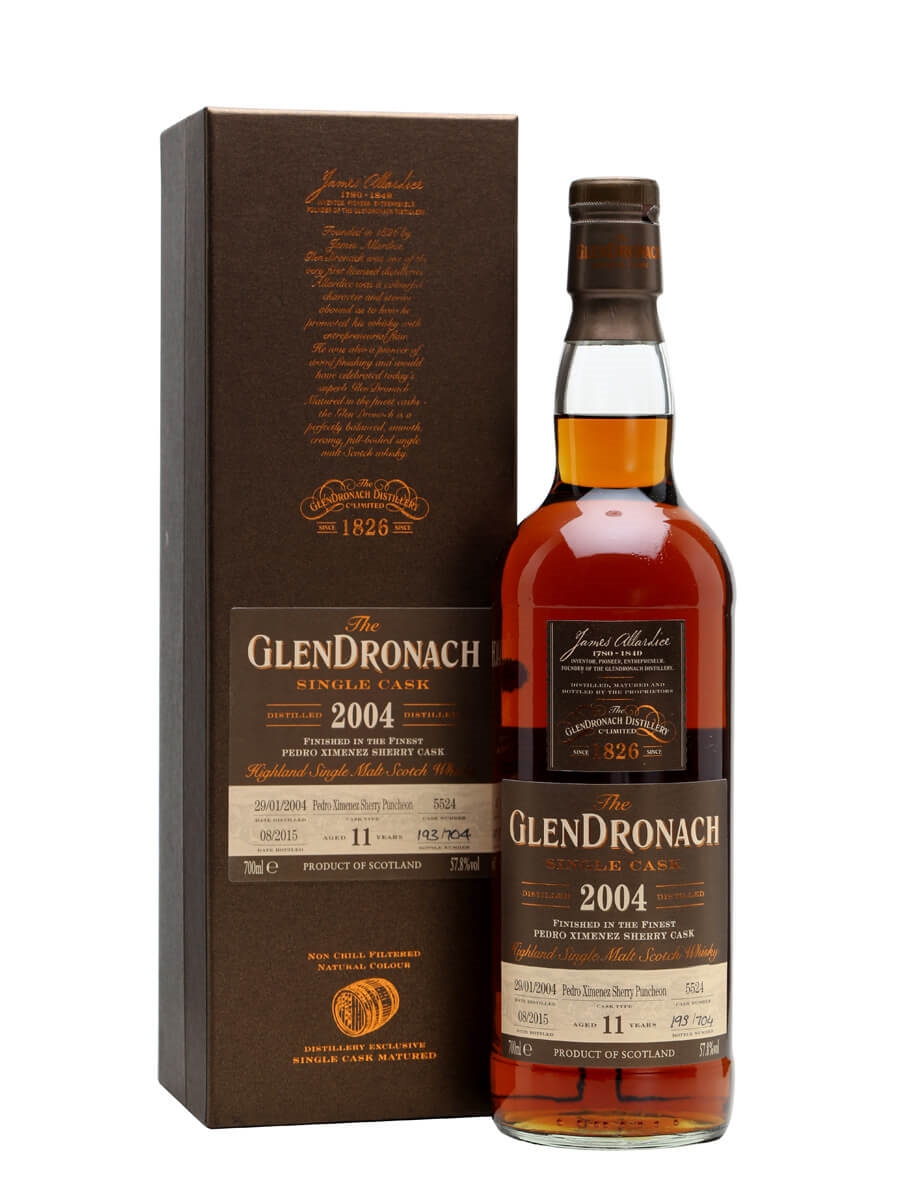
Glendronach Single Cask 11 Year Old Whisky Review!

A cracking young sherry bomb from my favourite sherry bomb distillery. The perfect way to see in Christmas! All single cask whiskies can be a bit of a risk as some are better than others, but this one's definitely a winner.

Glendronach's single cask releases are very popular, and are becoming increasingly difficult to source for a reasonable price in Australia. But every now and then a few stores get their hands on some, and they usually don't last long. Each batch consists of around a dozen casks / releases that are hand-picked by master distiller Billy Walker, mostly consisting of Oloroso and PX sherry casks of varying sizes and ages, although there have also been a few other oddities released over the years. Also adding to their allure is the fact that they are always bottled at cask strength, non-chill filtered and naturally coloured, and of course are very limited as far as availability goes. I've been able to taste a few of these bottlings now, and while a couple have been exceptional, some have been less than spectacular. Still good, but not great. But that's always the risk of any single cask bottling from any distillery.

Prices vary depending on the age and cask type, ranging from whisky distilled in the same cask for 40+ years to younger whiskies that are married together and finished in a single sherry cask. But generally speaking, these are very good whiskies which are deserving of their cult status. It's important to note that a single cask release does not necessarily mean that the entire contents spent its entire life in that one cask, particularly where there was a cask finishing involved, which can be a little confusing. Some of these bottlings from Glendronach will state on the label that they were finished in a particular cask, or that they were fully matured in a single cask, or they may not specify at all. I'm thinking that this bottling came from a few different casks which were finished in a larger cask before bottling (so technically still a single cask bottling), because 702 bottles were released, which equates to 491 litres of whisky without any spillage. That would mean an angel's share of only around 9 litres over 11 years from what I assume was a 500-litre puncheon (the common size), which is far too low. You would expect that sort of evaporation within around two years at most. This doesn't really matter of course, they're still single casks technically, but it is something to be aware of.

This particular bottling, from cask number 5524, was the youngest whisky from batch 12, which first appeared on the Australian market in late 2015. It was finished in a single Pedro Ximenex (PX) Sherry puncheon, at a cask strength of 57.8%. Unfortunately we don't know which cask type/s it was / they were initially matured in, although I would assume ex-Oloroso sherry but it could also have been ex-bourbon casks. As I mentioned above, there may have been a few casks involved here (of at least 11 years of age of course) which were finished in this one puncheon, and subsequently bottled as a single cask release. This one sold for around $200 in Australia when it was available, but is now completely sold out. That may sound a little pricey for an 11-year old whisky (it was the youngest release in this batch), but really isn't too bad for a single cask bottling of this calibre and popularity. And considering that batch 13, which was released not long after this one, sky-rocketed in price in Australia and saw bottlings with roughly the same specs increase in price by around 50% (so a similar bottling to this for $320 and above), this one was a bargain.
Glendronach 11 yo Single Cask, 2004, 57.8%. Highlands, Scotland.
Cask 5524, from batch 12. Finished in a single PX sherry puncheon. Cask Strength, non-chill filtered, natural colour.

Colour: Dark copper with rusty red tinges. Very pretty.

Nose: Sweet & spicy, fresh & youthful. Lovely rich sherry notes - juicy, plump raisins in sweet spiced syrup, warm fresh & spicy oak. Fruit mince pies dusted with icing sugar, mixed fruit peel, cinnamon, nutmeg and some brown sugar. Beautiful.

Texture: Rich & syrupy, but not heavy. Light to medium weight, plenty of flavour and complexity.

Taste: Spicy, fruity & rich. A considerable amount of oak here for what is a young whisky, plus more raisins in syrup, baking spices, and blow-torched orange peel. Plenty of spice with soft clove, some white pepper, ground ginger and nutmeg.  

Finish: Medium length. A little malty-ness initially, then more peppery oak, becoming dryer. More raisins, a little spice. Hint of brown sugar and cinnamon. 

Score: 4 out of 5.

Notes: So good, in fact one of the best single cask Glendronachs I've had so far, especially if you factor in the price. And really a perfect way to see in Christmas! It's young & fresh, but still so flavourful & balanced. There's plenty of sherry influence, but it hasn't overwhelmed either. I'd say the original cask/s were ex-sherry as well, but they've been expertly selected and finished to come up with a result like this. Very impressive, and a great example of what my favourite mainland distillery can do. Some might have turned their noses up at the age statement on this one, but if so they really missed out here. Glad I was able to grab a bottle of this one before they all disappeared, and of course the very nice updated packaging also helps.    

Love your work Mr. Walker & team, please keep it up!

Cheers, and merry Christmas! 

Sunday, 18 December 2016

SMWS 132.2 'Stunning Panorama of Exotic Fruits' Japanese Whisky Review!

Since the short Christmas break is almost upon us, I thought I'd celebrate with a seriously rare bottling from a seriously rare distillery! Before you start googling the SMWS distillery codes, let me save you the trouble: it's a Karuizawa!

Even amongst whisky fans only die hard fans will have heard of this Japanese whisky distillery, as it went silent (ceased production) in 2001 after 45 years of distilling, and was finally closed altogether in 2011. Thanks to this fact, and the fact that it was Japan's smallest distillery, it's also one of the rarest and most sought after Japanese whiskies. The buy-in price for even a mid-range bottling of Karuizawa is well into the thousands, and can usually only be found at auction or specialist rare whisky stores (with pricing to match). A bottle of 52-year old Karuizawa holds the record for the highest amount paid for a Japanese whisky at auction, which went for almost $120,000 USD in Hong Kong in 2015. Absolutely insane. Needless to say Karuizawa bottles are way out of my price range, so this review comes to you via the extreme generosity of an anonymous benefactor.

 Karuizawa's old warehouse buildings. Image courtesy of jpninfo.com

Karuizawa Distillery was located in the town of Miyota, around 3 hours drive north-west of Tokyo, and is near the base of Mount Asama, an active volcano which last erupted just last year in June of 2015. In fact run-off and natural springs from the volcano supplied the water source for the distillery, which also imported Golden Promise barley (arguably a big contributor to the past successes of Macallan) from the UK for distillation in its two pairs of small pot stills, giving an annual production capacity of just 150,000 litres. To help you put that into perspective, the current production capacity of Hakushu Distillery is around 3,000,000 litres, while Yamazaki's maximum capacity is more than twice that. There are some remaining casks of Karuizawa still maturing, although they're now located at Chichibu Distillery and are owned by UK-based No.1 Drinks Company.

This particular bottling that I'm reviewing is an independent bottling from the Scotch Malt Whisky Society, and was released in 2013 with an 'out-turn', which is SMWS speak for release, of 335 bottles. I've covered more details on the SMWS here (along with a review of an amazing Ardbeg bottling), but to recap they sell single cask whiskies, and more recently also other spirits, from a large range of distilleries, and they always bottle at cask strength, without chill filtration or added colouring. This 132.2 bottling is a 22 year old Karuizawa which was matured in a single refill sherry butt (a 500-litre cask), and as the numbering tells us it was the second cask of Karuizawa to be bottled by the SMWS. It was bottled at a cask strength of 62.4%, which is quite massive for a 22-year old whisky, although a number of older Karuizawa bottlings do seem to be surprisingly high strength, so it could be down to the local climate and storage conditions.

SMWS 132.2 (Karuizawa), 22 years old, 62.4%. Miyota, Japan. 
Matured in a refill ex-sherry cask, distilled September 1991. Non-chill filtered, natural colour. 335 bottles released.

Colour: Gold.

Nose: Richly fruity, spicy & sherried. Dried fruits - mango, red apple, orange, red berries and stone fruit. Some dusty toasted oak, and powered spices - sandalwood, cinnamon, roasted nuts, and some dried flowers. A little salty as well. 

Texture: Medium-weight, but quite punchy, spicy and drying.

Taste: Richly fruity & spicy again. More stone fruit, then hot dried chilli flakes. Sweet sherried fruits, oxidised red apple, saw dust, and something a little ashy, like cold ashes. 

Finish: Long, but quite light. Drying and spicy. More sandalwood and chilli flakes, fading to wood spices and more fruit - oxidising red apples, and sweet stone fruit, dried flowers, and more sawdust. A little of that cold ash comes back with more time, which I find surprising.  

Score: 3.5 out of 5.

Notes: As Mr. Vader would say, impressive, most impressive! Very complex and quite challenging as well. Started out a little hot, which you might not expect given the age, but this is definitely the highest ABV old whisky I've ever tasted, so by that degree it wasn't bad at all. And it settled down nicely with more time in the glass anyway. There's a nice amount of rich-yet-slightly-dry sherry influence in here too, which is very pleasant. Certainly completely different to any other Japanese whisky I've tasted, richer and more characterful, and of course more challenging. Granted I don't have much experience in this particular field, but I would guess this to be what an 'old school' Japanese malt would have been like. And thanks to the SMWS, it was unadulterated and most importantly, undiluted in every sense. 

I feel very lucky to have even tasted a Karuizawa of any sort, but even more so to sample one of this calibre and rarity. I'm struggling to understand why this distillery was closed, and even more so why the previous owners declined multiple offers to purchase the distillery before it was too late. Regardless, what an experience, and a fitting way to ease into the last weeks of the year. A big thanks to the aforementioned benefactor for this sample, I owe you one... again!

Cheers!

Hellyers Road Richly Peated 9 Year Old Whisky Review!

A new heavily peated ex-bourbon cask release from Tasmania's Hellyers Road Distillery! Might as well take a quick look at the specifics ...