Sunday, 30 April 2017

Bunnahabhain Eirigh Na Greine Whisky Review!

A relatively new (to Australia) release from Bunnahabhain, which is also now available from Australian duty free stores for an absolute bargain price. So is it worth that small investment, or is it another NAS 'travel exclusive' that is best avoided?

To be fair, this release seems to have been available for longer internationally, but only appeared in Australian duty free / travel retail stores, along with some other Bunnahabhain bottlings, earlier this year. And while all of those bottlings are priced pretty reasonably in those duty free stores, two in particular are absolute bargains. The two I'm referring to are the 1-litre bottlings, one heavily peated and bottled at 50% ABV under the name 'Cruach Mhona' (Gaelic for 'Peat Stack'), and the bottling I'm looking at today, the (basically) un-peated 'Eirigh Na Greine', which is Gaelic for 'Morning Sky'. which sells for a pretty amazing $65 AUD in its 1-litre bottle. And as with all the modern Bunnahabhain bottlings, it's bottled at 46.3%, non-chill filtered and naturally coloured. Seems like an absolute bargain, doesn't it?

I'm a big fan of Bunnahabhain's heavily-peated offerings, in particular the Ceobanach (yes, they do love their unpronounceable names). Being the 'other' Islay distillery that is mainly producing un-peated whisky, although still high in quality, the 'standard' Bunnahabhain releases (peated to a featherweight 3-5 ppm) haven't quite ticked my boxes. So far, anyway. This Eirigh Na Greine (pronounced "Airy-nah-gray-nuh") is a little different to the norm though, with "a significant proportion of high-quality ex-red wine" casks involved, and apparently they were a mix of French & Italian red wine. But that's where the information stops unfortunately, so we can safely assume that the majority of the vatting is still from ex-bourbon casks, and there's also no age statement, so we can safely assume the majority of the contents is on the younger side. It's apparently 'travel retail exclusive' (boo!), but it can be purchased from a couple of regular online stores in Australia, albeit for a significantly higher price. Let's give it a whirl.
Bunnahabhain Eirigh Na Greine, NAS, 46.3%. Islay, Scotland.
A "significant proportion" matured in ex-red wine casks. Remainder unknown. Non-chill filtered, natural colour.

Colour: Copper.

Nose: Fresh & sweet, pleasant. Quite nutty think roasted nuts with a little salt, and malty as well. Some furniture polish, and a candy-like boiled lolly sweetness. 

Texture: Light-medium weight, warming with a slight touch of spirit-y heat. 

Taste: Nutty & malty again, some hints of the wine influence now too. Light sweet red berries and some grapes, and a slight hint of wine tannins. A little citrus zest, and some more furniture polish.  

Finish: Short-medium length. A little honey sweetness and some vanilla cream. Mild baking spices as well. 

Score: 3 out of 5. 

Notes: Pleasant and very drinkable, but not overly complex or challenging, or particularly exciting really. There's no "wow!" moment, but it's nice & easy dramming. Considering the duty free / travel retail price it's not a bad showing at all, there are many worse choices available on those shelves. Having said that, it wouldn't be my choice if I was specifically looking for a red wine-matured whisky, but then again my choices in that category would be at least double the price of this Bunna', and in a 700ml bottle no less, so perhaps that's not a fair statement. 

The obvious comparison would be the standard Bunnahabhain 12-year old, and while they're very different whiskies, I'd have to give the win to the 12. The Eirigh Na Greine just doesn't have that interesting island twist, that unique 'funk' as it's also known. But if you're not a fan of 'funky' whiskies, this might be the one for you. Although definitely not at the local retail prices, if you ask me. It's quite rare for a whisky to actually be significantly cheaper in travel retail these days, especially in Australia, but in this case there's a surprising difference in price that just can't be ignored. And the duty free price is definitely the one to go for here. 

Cheers!

Monday, 24 April 2017

Glenrothes 25 Year Old (Signatory Vintage) Whisky Review!

Glenrothes' whiskies usually fly under my radar a little, mostly due to their official bottlings being very gentle and approachable, by design. But there have been a few independent bottlings of Glenrothes making their way to Australia lately, often bottled at cask strength, which offer a different take on the distillery's style. This 25 year old cask strength bottling from Signatory Vintage should be a perfect example!

Glenrothes (pronounced 'Glen-roth-is') was built in 1878 in the heart of Speyside, near the town of Rothes. It's actually quite a large distillery, with an annual production capacity of over 5 million litres coming from their 5 pairs of very tall stills, although the majority of production goes into blends, mainly Famous Grouse and Cutty Sark. Their malted barley is sourced from nearby Tamdhu Distillery, which has quite a large commercial-style malting facility on-site, with 10 Saladin boxes capable of holding 22 tonnes of barley each, rather than the more traditional and much smaller-scale floor maltings that you will find at a select few distilleries.

Glenrothes' official bottlings do not carry any age statements, with their 'Reserve' releases having no age statement or vintage, while the 'Vintage' releases state the year of distillation, and often the year of bottling. These are not single cask bottlings mind you, they're still vattings or marriages of different casks that were filled in the same year. And confusingly there is also a 'Vintage Reserve' bottling which does not carry an age statement or vintage. The official releases are all bottled at 40 or 43% and are of course chill filtered. The bottlings that I've tried so far have all been pleasant, but very much the gentle, light and crowd-pleasing Speyside style bottling which normally isn't my most preferred style of dram.

This whisky we're looking at here doesn't follow any of those suits, as it's a 25-year old single cask independent bottling from Signatory Vintage's Cask Strength Collection. It was distilled in 1990, and matured in an ex-bourbon hogshead (250-litre cask) for just over 25 years, before being bottled without chill filtration or added colouring at a cask strength of 52.7%. Like many of these older Signatory bottlings, it was also a bit of a bargain at around $220, and although it seems to have sold out everywhere there is a more recent bottling currently available for $210 from Signatory's Australian importer The Whisky Company, who kindly provided this sample for review, which is practically a steal for a 25-year old cask strength single malt.


Glenrothes 25-year old (Signatory Vintage), 52.7%. Speyside, Scotland.
Cask 19014, ex-bourbon hogshead, distilled 9/1990, bottled 1/2016. Natural colour, non-chill filtered. 221 bottles.

Colour: Pale gold. Hardly anything for a whisky that was aged for a quarter of a century. 

Nose: Dusty, slightly waxy sweet fruit - green apples, some citrus and banana, and slightly bitter and meaty old oak. Honeyed cereals, and some raw spirit / solvent notes. 

Texture: Medium weight, sweet but also quite raw and spirit-y.

Taste: Sweet, lots of honey and waxy sweet tropical fruit. Some citrus again, then a raw spirit kick that lasts well into the finish. 

Finish: Short. Still plenty of raw spirit, when it eventually fades we're left with some dusty pear drops, a little banana, and some of that musty & slightly meaty old oak. 

Score: 2 out of 5. 

Notes: There's no way in hell I'd have picked this as a 25-year old whisky. In fact this could almost have passed for new make spirit if not for that musty old oak note. I've had whiskies that were bottled at higher strength and a small fraction of the age that had far more character, finesse and maturity than this one did. This must have been one very tired old cask, or at the very least it just didn't have the strength to tame this spirit. A shame that this one didn't do much to redeem Glenrothes for me, I thought it had all the boxes ticked - considerably older, natural colour, non-chill filtered and cask strength. But it wasn't to be, the sum of the parts just didn't add up. Although the price is very reasonable for the age of this bottling, you're not getting quite what you might expect for a whisky of that age. 

This is honestly the only disappointment I've come across from Signatory's Cask Strength Collection so far, the rest have all been very enjoyable. In fact I'd have to say I prefer the standard official bottlings of Glenrothes to this one, despite the low strength and chill filtration. And I really didn't expect to say that going into this review. For my money, you'd be far better off saving yourself a few dollars and grabbing this one from Signatory (I've reviewed the previous version of it here). It doesn't have the same impressive age statement, but it does have quality and complexity in spades, with a healthy dose of both peat & sherry influence. A truly excellent dram that one. Then again, perhaps that more recent bottling of the Glenrothes mentioned above (which is the currently available one anyway) was more of a success than this one.  

Cheers! 

Monday, 17 April 2017

Springbank 21 Year Old (Hart Brothers) Whisky Review!

Yes, an independent bottling of Springbank. Not an easy thing to come by! And it gets even better, because this is a 21-year old, first-fill sherry cask, cask strength independent bottling of Springbank. How good is that!

Never heard of Hart Brothers? Well they're an independently-owned whisky blender & bottler based in East Kilbride, near Glasgow in Scotland, and have been around in the current form since 1964. They are of course a little more obscure than your big name independent bottlers, but for some reason they are, or at least were, quite easy to come across in Australia. That said, their bottlings receive very mixed reviews, with some being well regarded, and some being despised. There is certainly a bit of risk involved when buying a bottle from a more obscure bottler, particularly when there are no reviews or further information available online. But it seems that taking a chance does pay off every now & then!

There aren't many independent bottlings of Springbank out there, at least in Australia, probably since the vast majority of spirit produced at the distillery is bottled and sold as one of their own single malt, although Springbank do produce their own blended whisky under the name Campbeltown Loch. There are occasional bottlings from Cadenhead's, since they're also owned by Springbank's owners, and the SMWS seem to get their hands on a few casks, but that's pretty much it. But then when the distillery in question is already independently owned, only bottles at 46% and above, non-chill filtered and naturally coloured, does their fair share of experimentation and single cask bottling, and is usually priced pretty fairly, then there isn't really as much need for independent versions in the marketplace.

Unfortunately there's very little information out there on this particular Hart Brothers bottling, other than what is printed on the label. It was distilled in June of 1993, and bottled in October of 2014 at a cask strength of 52% ABV, and was matured in first-fill sherry butts. So we don't know what type of sherry cask was used, and 21 years in a first-fill cask is a long time, so this one is very interesting. At least we do know that all Hart Brothers bottlings are naturally coloured and non-chill filtered, which is good news. Unfortunately there's no mention of whether this is a single cask bottling or not, and there's no cask number/s or number of bottles stated, so I'd assume it wasn't from a single cask. Not that it really matters, of course. Let's get to it!


Springbank 21 year old, Hart Brothers, 52%. Campbeltown, Scotland.
Matured in a first-fill sherry butt. Non-chill filtered, natural colour. 

Colour: Amber.

Nose: Very waxy! Can't say I've found that in a Springbank before. Certainly not to this level. There's loads of orange as well, orange rind specifically, and some light wood spices. Slightly dusty & meaty as well. A little spearmint toothpaste, and some milk chocolate orange (think Terry's choc orange). The orange note becomes more of a sweet orange juice with more time, while the wax subsides a little, and a cherry note appears. Quite a complex nose on this one! 

Texture: Medium-to-heavy weight, a slight touch of heat. 

Taste: Meaty & spicy, more chocolate, and a light dusty earthy-ness. Some malt in the background too. The orange is still there but it's more of a bitter orange now, and it's much less prominent than on the nose. Still quite waxy, and a little more fruity. 

Finish: Medium length. Quite a hot minty-ness now, and more of that dusty earthy note, plus the milk chocolate and orange. Possibly a hint of sulphur here as well, but not in an unpleasant way, at least not to my palate. 

Score: 3.5 out of 5.

Notes: Very interesting! Not like any other Springbank I've ever tasted, but then it's also the oldest Springbank I've tasted. The strong wax and orange notes in particular were very interesting, this is probably the strongest notes that I've experienced of those flavours, particularly since they're both there simultaneously. Very enjoyable though, not unpleasant by any means, just interesting and quite surprising. This is where independent bottlings really shine if you ask me, giving us a totally different and new take on a familiar distillery, and forcing our minds to be a little more open with each sip. Great stuff.

Not at all what I expected from this Hart Brothers, and it's changed my impression of their bottlings for the better, despite there being plenty of negative experience out there. I would recommend trying this one, but to be honest I don't really like your chances of finding a bottle! A big thanks to the generous anonymous donor for the sample of this one. 

Cheers!

Sunday, 9 April 2017

Balblair 1990 Vintage Whisky Review!

Firstly, my apologies for skipping last week's review, I'd just stepped off a plane and was hardly in the right shape to analyse a dram! Hopefully this one makes up for it, because it's time to tick another distillery off the list! I've actually had this sample on the shelf for quite a while (sealed, of course), and had basically forgotten about it. But there's no time like the present!

Balblair Distillery is quite a small distillery in the Scottish Highlands, near the town of Edderton, around an hour's drive North of Inverness. Now owned by Inver House Distillers, who also own Old Pulteney and a few other lesser-known Scottish distilleries, Balblair claim to be the oldest distillery in the Highlands, having been officially founded in 1790, although the entire distillery was moved less than a kilometre in 1872 to be closer to the new railway, so I'm not exactly sure about the validity of that claim. If correct though, this would have made it one of the oldest Scotch whisky distilleries still in existence. Which I'd wager would've been of more benefit than being closer to the since-closed railway, but of course hindsight is 20/20. The distillery was also mothballed for a massive 48 years during the great depression and both world wars, before production re-started in 1949, and it's been going strong since.

Like most of the lesser known distilleries, until relatively recently the vast majority of Balblair's 1.3 million litre annual production capacity went into blended whiskies, most notably Hankey Bannister. Since 2007 though around 15% of production has been officially bottled as single malt, and in a move that seems to be becoming more popular the distillery only labels its bottlings with the vintage, where the label states the year of distillation and usually the year of bottling, rather than giving a clear age statement. Note that these are not single cask bottlings though, they're still vattings of different casks, but coming from the one distillery they are of course still single malts. For a little interesting factoid, Balblair was a filming location for the 2012 Scottish film 'The Angel's Share', serving as the distillery where the unfortunately fictitious cask of Malt Mill was discovered & subsequently auctioned. And another little factoid, the distillery's water source is located in the Wester Ross region of the Highlands, which might sound vaguely familiar to fans of Game of Thrones / A Song of Ice and Fire...

But let's get back on track. This particular bottling was distilled in 1990 and bottled in 2013, after spending 21 years maturing in ex-bourbon casks, and around two years further in Spanish oak ex-sherry casks. This is the second release of the 1990 vintage, the first was released in 2008 and was a 'travel-exclusive' bottling, while this second release was much easier to find, and actually won an award at the Edinburgh Fringe Festival in 2014. It was bottled at 46%, and thankfully is non-chill filtered and naturally coloured, as all of Balblair's official single malt bottlings have been since they launched in 2007. Let's look a bit closer, shall we?

Balblair 1990 Vintage, 2nd release, NAS*, 46%. Edderton, Scotland.
*Distilled 1990, bottled 2013. Matured for 21 years in ex-bourbon casks, and finished for 2 years in Spanish oak ex-sherry casks. Non-chill filtered, natural colour.

Colour: Copper.

Nose: Quite dry, fruity and lightly spicy. Dusty barley, red apple, dry oak. Stewed stone fruit, some old soft leather and vanilla-scented wood polish. Some golden syrup, hint of dried apricot & fig, and a little warm ginger. 

Texture: Medium-heavy weight, rich & warming. No heat at all. 

Taste: Rich, savoury & spicy. Ground ginger, some cinnamon, a little dry oak again. More of that soft leather & wood polish, and savoury & fruity BBQ sauce. More dried stone fruit, and some black cherry. Delicious! 

Finish: Long. Spicy & fruity, and becoming dry with time. Some orange peel, a little peppery oak and warm cinnamon, a little red grape and cherry, dark chocolate and light wine tannins, becoming quite wine-y actually. Very nice. 

Score: 4 out of 5. 

Notes: Impressive... Most impressive! Complex and well balanced, although quite savoury overall, not that that's a bad thing at all. There's plenty of sherry influence from that two year finishing, but it hasn't overwhelmed either, there's plenty going on alongside. I'm not usually a fan of tannins or red wine in general, even in whisky, but I actually really enjoyed the finish on this one, and I still am as I write this, it's quite a long one! I'd normally wish for cask strength in a whisky this old, but I actually think 46% was just about perfect for this one, there's no shortage of flavour or texture here. Can't believe I left this sample on the shelf for so long!

Adding to the allure of this bottling was that it's still around, and is quite reasonably priced, going for $240 AUD here, which isn't exactly cheap in general terms, but for a whisky of this age and quality I'd say that's actually pretty fair. Highly recommended if you like your whiskies on the older and more savoury side. I'm very impressed with this one!

It wouldn't really be fair to use a 23-year old vintage bottling as an example of Balblair's general aptitude as a distillery, but if this is the sort of thing they can do then I'm a believer. And I didn't really expect to say that coming into this review, to be honest, so this was a very pleasant surprise. Which just goes to show that we should never judge a book by its cover. 

Cheers!

Sunday, 26 March 2017

Laphroaig + Oysters = Whisky Heaven!

What's better than Laphroaig? Laphroaig with oysters, of course!

I was lucky enough to be invited to the first 'whisky dinner' recently held at Brisbane bar & eatery Seymour's Cocktails & Oysters, which just by chance happened to be a Laphroaig dinner, hosted by the ever-awesome Dan Woolley from The Exchange / Beam Suntory. For those who haven't yet had the pleasure, this is one seriously cool bar! Located on Caxton Street, Petrie Terrace, a short walk west of Brisbane's CBD, and right next to its sister establishment Lefty's Old Time Music Hall, it's a small speak-easy style bar inspired by early 20th century New Orleans. You'll find a lot of exposed brick, polished wood and hanging soft lighting, and a fantastic range of spirits, wines & beers inside these walls, and as you may be able to guess by the name, they do also dabble in cocktails and oysters!


While there's a full kitchen and clearly a very talented chef on board providing a diverse and very delicious food menu, you'll also find some of Brisbane's freshest and highest quality oysters, with the option of adding a dropper of Laphroaig 10-year old to help take that succulent seafood to an even higher level. They also boast a surprisingly large & diverse whisky range, including some rare & unusual independent bottlings that are well worth checking out. Which makes sense when you consider that the expert bar staff have previously worked at West End whisky-haven Cobbler, and all three gents have recently placed in the Top 100 in the Australian leg of Diageo's prestigious World Class Cocktail Competition. So these guys clearly know what they're doing!


For Seymour's' first whisky dinner, we were treated to 6 different expressions from my beloved Laphroaig. Ranging from the always dependable and always divisive 10-year old, to the phenomenal and extra-special 25-year old, paired with extremely fresh oysters sourced from Coffin Bay in South Australia, plus a phenomenal three-course meal, highlighting the magic that the crew at Seymour's are capable of. We're talking Moreton Bay bug & smoked Barramundi gumbo, Wagyu beef brisket with smoked onion cream, and a Roquefort blue cheese soufflé. I can honestly say this was some of the best food I've ever had at a whisky event, and all were perfectly paired with their associated dram. I'm not an accomplished food photographer as you can probably tell, and my photos really haven't done this meal justice, so you'll have to use your imaginations a little here!

Rather than the usual 'master class' educational style of whisky tasting, this dinner was a more personal and more casual experience, with Dan circulating amongst the eager audience, dropping some whisky knowledge while sharing his love of Laphroaig, and regaling some of his own amazing Islay experiences. The bastard!

We started off with Laphroaig 10-year old, which worked its sweet, peaty and medicinal magic, and when paired with one seriously fresh and creamy Coffin Bay oyster, the whole package was turned up to 11. It's easy to gloss over the venerable 10-year old with fancier and more heavily-marketed whiskies frequently coming along, but it's always fun to rekindle this relationship! And when applied directly to said oyster, the 10-year old didn't divide and conquer, it added an extra boost that was just bloody excellent. I must admit I've personally tried matching other Islay whiskies with natural oysters, and none have worked as magnificently as Laphroaig 10 does, it really is a match made in heaven. If you haven't tried this yourself, I definitely recommend giving it a go; or you could just head to Seymour's and let them do it for you! 


Next up we had the 'Select Cask' (known as 'Select' elsewhere in the world), paired with a magnificent Moreton Bay bug (similar to a crayfish) & smoked Barramundi (white fish) gumbo with smoked sausage. I must admit I'm not the biggest fan of Laphroaig Select, to my tastes it needs a bit more punch, but it's not really designed for my tastes, it's meant to be a more approachable, or more of a beginner's Laphroaig, and one that isn't as divisive as the 10-year old, and it certainly does tick those boxes. I'd not previously tried Select after the 10-year old, it usually goes the other way around, and doing so really highlighted the gentler and fruitier 'breakfast whisky' style of the Select Cask. It also worked incredibly well with the mildly-spicy gumbo, and that magnificent tender & juicy smoked fish and sweet bug, with none of the flavours overpowering the other, all the components worked in tandem and really did compliment each other. Personally I don't usually like pairing even mildly-spicy food with whisky, I find that the alcohol and spice often amplify each other a little too much. But that was definitely not the case here, it was perfectly balanced and perfectly paired.


Next up was the limited edition 'new' 15-year old, which was resuscitated in 2015 after a long hiatus to help celebrate Laphroaig's 200th anniversary, and another incredibly fresh & creamy natural oyster. The 15 is still a lighter and gentler style of Laphroaig, but it's really growing on me, in fact it reminds me of the lovely Highgrove bottling I was lucky enough to try last year, or perhaps it's the other way around. The dried grapefruit and floral sweetness in the 15-year old, with the Laphroaig peat and ash of course, brought out a nice meaty-ness in the oyster, while the oyster amplified those grapefruit notes in the whisky, and they both added up to one amazing taste experience! I should probably grab a bottle of the 15 before it's all gone, although I'm probably too late already...


Next up was a dram of my beloved Laphroaig Quarter Cask, with its higher bottling strength of 48% and smaller cask finishing for extra intensity, paired with a delicious wagyu beef brisket cooked for 12 hours, with an amazing smoked onion cream (that I could easily have devoured an entire plate of) and bitter greens. I've always loved the Quarter Cask, and that hasn't changed at all. So sweet and peaty, and with plenty of sweet vanilla and fresh oak, plus the extra flavour and punch from that higher strength and non-chill filtration, it all makes for a glorious whisky which is still one of the best value peated drams out there, if you ask me. That wagyu brisket was just amazing as well, very tender and full of proper beefy flavour, and I've actually written "must learn how to make smoked onion cream" in my notes, so I think you can guess just how good that stuff was! 
 

Next up we were treated to a dram of one very special whisky, Laphroaig 25-year old, paired with our final natural oyster. This was the 45.1% cask strength bottling released in 2013, and it's still one of the best older whiskies I've ever tasted, and almost the best older Islay whisky I've tasted, only beaten by the incredible Laphroaig 32. The 25-year old spent 18 years in ex-bourbon casks, before being finished for the remaining 7 years (that's a long finishing!) in European oak ex-Oloroso sherry casks, which makes for one amazing whisky. Totally different to any other Laphroaig though, this one is so soft and gentle, with a floral sweetness, light fruit and gentle oak coming to the fore, it's a mature and refined expression that is in my opinion well worth the (admittedly quite high) asking price. I've been lucky enough to try this one a few times now, and if you're in the market for an older whisky I really don't think you could go wrong with the Laphroaig. So how does a 25-year old Laphroaig pair with an oyster? Very, very well! Like you'd expect, it was a totally different experience to the previous pairings, one might have expected the oyster to dominate the older, gentler whisky, but again nothing was overpowered or lost in the background, it was just a delicious flavour experience!


And on to dessert! This course was Laphroaig Triple Wood, paired with a Roquefort blue cheese soufflé, with spiced pear and Lavosh bark (crispy flat-bread). It had been quite a while since I had tasted the Triple Wood bottling, for a time it was actually my least favourite Laphroaig. I'm not sure if my tastes have changed since, or if the whisky has, but it was absolutely delicious. There was much more sherry influence from the ex-Oloroso cask finishing than I remember finding last time, and also more peat influence, and the result of all that was wonderful; richly flavoured, with plenty of red fruits and light spice. I do remember that last time I tried the Triple Wood it was facing off against Lagavulin 16 year old, and as much as the Lagavulin will always be the 'gateway dram' that got me into peated whisky, the Laphroaig absolutely decimated it. The higher bottling strength of 48%, presumably younger age and non-chill filtration certainly helps of course, and it also helped the 'phroaig to pair absolutely perfectly with our dessert, that Roquefort soufflé that filled the room with the delicious aroma of high quality blue cheese. Sherry+peat+blue cheese has always equalled awesome in my book, and that was definitely still the case here. The perfect end to the evening's festivities!

So this was one amazing night of really exceptional food, and really fantastic whisky. This also shows the versatility and adaptability of my beloved Laphroaig, which many presume to be all about the peat, and which many wouldn't dream of pairing with high quality food. And they'd be missing out! What a great way to spend a Tuesday night. I cannot get over the excellent quality of the food that the guys at Seymour's brought to the table, so to speak, and while I'm sure the whisky helped (plus the fact that it was Laphroaig, of course!), the overall package that this relative newcomer presents makes for one hell of a place to spend a night out. I hadn't actually been to that part of town for quite some time, but Seymour's, along with its neighbour Lefty's (which also has an impressive range of whisky, plus regular live music), have changed my perception of the area completely, and I hope to be a more frequent visitor in future!  

A big thanks to Dan Woolley, The Exchange, Laphroaig, and of course the team at Seymour's for having me along, and I hope to see you at the next one!

Cheers! 

Sunday, 19 March 2017

An evening with the SMWS!

St. Patrick's Day was a little different for me this year, partly because it actually didn't fall on a mid-week 'school night', but mainly because I was lucky enough to be invited to attend a full-on whisky tasting with the Scotch Malt Whisky Society!


The SMWS, as they're more commonly known, is in basic terms a combination of a 'members-only' style whisky club, and a single cask independent bottler. Officially established in 1983 in Edinburgh, after the founder convinced a few friends to split the cost of buying and bottling their own cask of Glenfarclas, the Society now boasts over 26,000 members in around 20 different countries, and bottles whisky and now a few other spirits from over 130 different distilleries, all approved by their internal tasting panel. I've covered more of the details on the Society here if you'd like a refresher, and there's also my review of one truly amazing SMWS bottling of Ardbeg in there, just in case you aren't feeling thirsty!

While the Australian branch of the SMWS holds regular tastings in all of the major cities, and they're open to non-members (with a discount for members), this was actually the first that I've attended, and as a bonus it was to be hosted by the Society's Australian cellar-master Andrew Derbidge, who made the trip up from Sydney. Andrew's main duty is the enviable task of selecting (along with a local tasting panel) and organising which SMWS bottlings make the trip from Scotland for the Australian members, and he is also responsible for operations in his home state of New South Wales. He's also the man behind one of Australia's most popular whisky blogs, Whisky & Wisdom, and has been lucky enough to tour Scotland and her distilleries multiple times, even going so far as to import his own private official single cask bottling of Glenfarclas, reviewed here, which is still my favourite Glenfarclas bottling to date.


On the evening in question, held at The Brisbane Club in the CBD, we were treated to six delicious whiskies, plus a welcoming dram of Hyde Irish single grain whiskey (because St. Patrick's Day) and a selection of finger food, along with Andrew's experienced commentary and guidance. Alongside the whisky, of particular interest were a few little bonus experiences that Andrew had brought with him, including some E150a 'spirit caramel', used by many distilleries to artificially colour their whisky prior to bottling, and never used in any SMWS bottlings. I must admit it didn't smell particularly unpleasant, with a strong burnt golden syrup / molasses aroma (which is essentially what it is, of course), but it did have a particularly nasty and bitter taste on the palate, even when sampled in a tiny amount. This was actually a first for me, and it definitely helped to highlight how this unfortunate practice affects the precious whisky that, in my opinion, it tarnishes.

Andrew had also brought along some malted barley for sampling and nosing, and a small sample of new make spirit from Glenmorangie distillery in the Scottish Highlands, a rare experience which was also very impressive. He also complimented his own commentary with a slideshow of his own photos from personal trips to the various Scottish distilleries, which really helped give some perspective and added an extra visual aid to the whiskies in the glass. Aside from the recent arrival of virtual reality distillery tours, admiring some distillery photos while drinking a naturally-presented bottling from said distillery is just about as close as you can get without getting on an aeroplane, and it's a little cheaper to boot...


So, on to the actual tasting! Andrew started off by explaining the perils of adding ice, coke or other mixers to your whisky, and also the common error of choosing to drink it from a tumbler, and he also briefly covers the main points of whisky appreciation: admiring the colour (where it's natural, of course), finding your dominant nostril and alternating between your nostrils while nosing the whisky, holding and swishing the whisky in your mouth before swallowing, and enjoying the finish post-swallow. Naturally these are things that most whisky enthusiasts will have been practising for years, but they're essential tips for the beginner, and it certainly doesn't hurt to have a little reminder of why we do what we do!

Just a reminder before we get into the whisky, the SMWS bottlings do not state the distillery name on the label, they use a numbered system instead, where the first number is the distillery code, and the second number denotes the cask. So the bottling 33.134, for example, is an Ardbeg (code 33), and is the 134th cask of Ardbeg that the SMWS has bottled. An easy reference guide to the distillery codes can be found here. Aside from the highly imaginative bottling names and some extensive and often colloquial tasting notes, you'll also find the cask information and number of bottles on the label. All bottlings are naturally presented with no chill filtration or added colouring, and all are bottled from a single cask at cask strength.


You may have noticed that there are only five bottles pictured above, while there were six glasses in the previous image. Well caught! The sixth whisky, well actually the first after the welcome dram, was a bit of a surprise. Andrew decided to mix things up a bit and catch most of us off-guard by throwing an official bottling into the mix, a Cragganmore 12-year old in fact. Why? Because dram number two was also a Cragganmore, but this time it was an SMWS bottling. So we had a direct comparison between two very differently presented bottlings from the same distillery, one chill filtered, artificially coloured and watered down to 40%, and the other non-chill filtered, naturally coloured and bottled at cask strength. And as you'd expect, they were massively different in just about every way. I must admit these drams were actually my first foray into Cragganmore distillery, and also that the 12-year old official bottling did not drink like one bottled at the minimum strength of 40%, and was actually very pleasant, although also very sweet. The 12-year old official bottling also served as our palate calibrator for the evening, to be referred back to after the food was served to get us back in the mood. Let's get on to the stars of the show!

37.81 "Orange Turmeric Margarita"
A 13-year old Cragganmore, matured in an ex-bourbon cask for the first 12 years, and then finished in a second-fill Sauternes (sweet wine) hogshead. Bottled at 56.6%, with an 'outturn' of 270 bottles. This one was a little hot and seemed a little raw, with some dried green apple, and a dry slightly-sour barley character, and a lot of spice, particularly pepper, and a lot of citrus and under-ripe tropical fruit. Certainly far less sweet than the official bottling, despite the Sauternes finishing. Cragganmore by the way use worm tub condensers rather than the more efficient and modern shell & tube style, which may explain the impressive weight of their spirit.


41.80 "Classic - Barley Meets Oak"
A 9-year old Dailuaine (pronounced "dell-you-in"), matured in a first-fill Oloroso sherry butt. Bottled at 58.2%, with an 'outturn' of 540 bottles. I'd never tried a Dailuaine whisky before, so this was another first for me. Looking at this whisky in the glass, you'd never suspect it was matured in a first-fill Oloroso cask, with a yellow gold colour rather than the expected dark amber. It was much richer (both in flavour and texture) and more savoury and meaty in character, with some golden raisin notes denoting the sherry cask influence. Dailuaine is a large Speyside distillery and is mostly found in owner Diageo's Johnnie Walker and J&B blends, and is quite rare as a single malt.


G8.7 "Caribbean Banana Fritters"
Another curve ball! The 'G' in the code refers to this being a single grain whisky, and the distillery in this case is the Lowland grain distillery Cambus, which closed in 1993. This was a 27-year old bottling, matured for 25 years in a refill ex-bourbon hogshead, and finished in a second-fill Sauternes hogshead. Bottled at 59.7% with an 'outturn' of 240 bottles. This was an excellent whisky, very soft and gentle, and richly flavoured, with a lot of oak influence, spicy and lightly tannic, and a corn flake-like grain note. This is the finest grain whisky I've tasted to date, a seriously impressive whisky that doesn't drink like its strength would suggest. Cambus was a massive grain distillery north of Edinburgh, which was operated by DCL, the precursor to Diageo, prior to its closure.

35.168 "Essence of BFG"
Another curve-ball here, but in a different way. This was a 15-year old Glen Moray, that was matured for 14 years in a first-fill Oloroso sherry butt, before being finished in a heavily-charred virgin oak butt. It was bottled at 60.4%, with an 'outturn' of 594 bottles. Finishing a first-fill sherry matured whisky at all is quite unusual, but even more so if the finishing cask is virgin oak! This one was very, very interesting. The virgin oak finish hadn't overwhelmed the sherry influence, but it had added huge depth of flavour and texture, giving a buttery, oaky result with plenty of wood spice and dark toffee notes. Without question the best Glen Moray I've tasted, this whisky came in at (a very close) second place on the night for me.

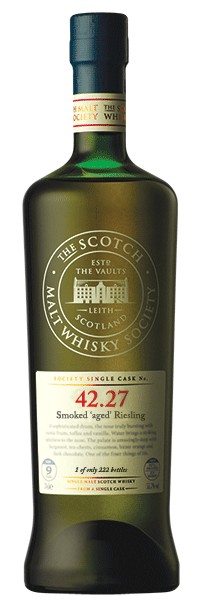
   42.27 "Smoked 'Aged' Riesling"
   The star of the night for me! A 9-year old Ledaig (peated Tobermory), matured in a refill ex-    bourbon barrel. Bottled at 59.4% with an 'outturn' of 222 bottles. Ledaig can be a hard one      to pin down, being so close to its Islay cousins, and I was highly convinced that this was            actually a Laphroaig until it was revealed as having come from the Isle of Mull. I'd also never    have guessed that this was a 9-year old whisky, despite the use of a refill cask it was lovely      and warming, with plenty of damp peat & soft smoke, and a delicious maritime influence as      well. It only had a narrow margin over the previous dram, despite my predilection for                peat, and was far less unusual, but that couldn't stop it from winning me over!


So, we had some extremely interesting drams, and I was lucky enough to tick another three new distilleries off my list in the one sitting! The highly unusual casks used in most of these whiskies was a real highlight for me, I don't think it's likely that I'll see a 27-year old Sauternes-finished single grain whisky again, nor a first-fill sherry cask matured whisky finished in virgin oak. This sort of thing is exactly what the SMWS bring to the table as 'not just another independent bottler'. Rather than just doing what the distilleries already do themselves, they really aim to give a different experience and a new perspective, and this was certainly driven home for us on the night. After a good chat with Andrew during the almost obligatory follow-up session at the nearby Gresham, which also happens to be the official SMWS partner bar for Brisbane (with SMWS bottlings available for purchase by the public, and a discount on those bottlings for members), it was time to call it a night. Although it was more of an early morning by that stage!

I have to say that this was quite a different crowd to what I'd usually expect to see at a whisky tasting these days, with more of an 'old school' vibe, and perhaps a more formal environment, although there were still a few relative beginners present (which is good to see). Andrew did keep things light and jovial though, with just the right mix of refreshing innuendo and banter with the crowd, plus handing out a few mystery samples to some lucky attendees as rewards for astute observations or correct answers. This all made for a very informative and fun tasting, and the afore-mentioned malted barley, new make spirit and E150a sampling really helped to bring a new perspective on the finer points of what the SMWS do differently; or choose not to do, as the case may be. An excellent approach to what is an excellent pursuit!

A big thanks to Andrew Derbidge, Scott Mansfield (QLD manager) and the Scotch Malt Whisky Society for having me along. I had a great time, and it's always great fun to try new whiskies and explore new territory. See you at the next one gents!

Cheers!

Sunday, 12 March 2017

Laphroaig 18 Year Old (Signatory Vintage) Whisky Review!

We don't see independent bottlings of Laphroaig too often, and let's be honest the distillery does a fantastic job with its official bottlings, but there's still something special about a single cask, cask strength, naturally presented independent bottling, and the fact that there aren't too many out there certainly adds to the allure.

The advantages of independent bottlings over their official cousins are often that they're matured in a different or unusual cask, or are bottled at a higher strength or a different age, or are non-chill filtered and naturally coloured, and if you're lucky, they're cheaper than the equivalent official release. In this case, only a couple of those boxes are ticked. This is an 18-year old ex-bourbon hogshead (250-litre cask) matured Laphroaig from Signatory Vintage, bottled at a cask strength of 55.2%, non-chill filtered and naturally coloured. If we compare this to the now sadly discontinued (there are still a few around though - for now) 18-year old official bottling, which is ex. bourbon cask matured, and is bottled at 48%, non-chill filtered and naturally coloured, the only real advantage of the independent bottling is that it's bottled at cask strength. Unfortunately it's twice the price of the official bottling (for now, at least, since the discontinuation), so is it worth the extra money for that 7% extra alcohol? That's a tough call, but that's also quite a big difference!

Let's also consider that there's basically no other way to get a cask strength 18-year old Laphroaig, and that this being a different size ex. bourbon cask, and more than likely from a different bourbon distillery, to those predominantly used at Laphroaig (which would be Maker's Mark), it promises to be a different take on the make. I've had the pleasure of tasting an ex- Jim Beam cask Laphroaig in the past which was amazing, and markedly different to the norm, so this may be a similar experience. But since this hogshead will be a re-sized cask made from standard barrels, we don't really know what distillery the casks or staves came from, so that's just an assumption.

We also need to take the relative rarity (and subsequent demand) into account, since there were only 243 bottles released from this cask, and as mentioned above, any independent bottling of Laphroaig is already a rare thing, so it's not really fair to compare this one to the closest official bottling when it comes to price. I was / am a big fan of the official 18-year old, and thanks to the age it was definitely from the gentler side of Laphroaig, but the higher strength and larger cask used in this Signatory version may have changed that. Time for a closer look, I think...


Laphroaig 18-year old, Signatory Vintage, 55.2%. Islay, Scotland.
Cask number 3371, single ex-bourbon hogshead, 1997-2015, Signatory cask strength collection. Non-chill filtered, natural colour, 243 bottles. 

Colour: Amber.

Nose: Oh Laphroaig, it's been too long! Sweet, fruity and lightly medicinal, with lots of dried grapefruit, and a hint of dusty banana lollies. Some cold wood embers and a little spent gunpowder. Some aniseed as well, and damp rocks on a beach. 

Texture: Lovely. Medium weight, no heat at all, and plenty of flavour. 

Taste: Crumbly, dry and spicy peat, more wood embers, but they're hot now, and there's some ash as well. Hint of that dried grapefruit from the nose, but it's much more subtle now. A hint of iodine and plasticky rubber as well. 

Finish: Medium length, with more fruit & ash, and less peat although it's still there. A little bitterness as well, then some more aniseed and damp rock. Gets subtle and soft quite quickly, but then resurges with more iodine and a gentle coastal peat. 

Score: 3.5 out of 5. 

Notes: Lovely stuff this! There's definitely more punch than you'll find in the official 18 year old, which is to be expected thanks to the extra strength, and a lot of the subdued or missing notes in the official bottling, such as the peaty and medicinal notes, are amplified here. That bitterness on the finish is unusual, but it passes quickly without stopping the fun. Overall though, it's not massively different from the standard style Laphroaig, if you can call it standard, that is! It's a little pricey, but it's a very enjoyable dram, and as usual from Signatory (and also Laphroaig) it's excellent quality.  

If the folks from Signatory are reading, I have a little request that I'm sure many will agree with: please put some more Laphroaig in a sherry cask! Google tells me you've done so a couple of times in special bottlings for The Whisky Exchange and some others, and we know you already do excellent work with these young sherry cask Ledaigs, so if at all possible, please do the same with Laphroaig, we'll all love you for it!   

Thanks to Craig from The Whisky Company, Signatory's Australian distributor, for the sample.

Cheers!

Hellyers Road Richly Peated 9 Year Old Whisky Review!

A new heavily peated ex-bourbon cask release from Tasmania's Hellyers Road Distillery! Might as well take a quick look at the specifics ...