Sunday, 22 May 2016

Laphroaig Cairdeas 2015 Whisky Review!

This is one very special Laphroaig. All the Cairdeas bottlings are special of course, but this one is about as Laphroaig as it gets.

2015 was quite a year for Laphroaig. They celebrated their 200th anniversary, and released a number of special whiskies to commemorate the occasion. They also sent John Campbell, their distillery manager, to Australia for a quick tour, and I was lucky enough to interview the legend himself, which you can read about here. As for the whiskies, there was the revival of the 15 yo, the 16 yo travel-exclusive, the 21 yo Friends of Laphroaig bottling, the incredible sherry-matured 32 yo, and this little baby, the 2015 Cairdeas.

This 2015 release is a very unique bottling, which is highly unlikely to ever be repeated. But to explain why it's unique, we need to go over a few points about the distillery. Laphroaig floor-malts it's own barley, which is cold-smoked using their own local peat, then dried in a separate step. Which results in around 60 ppm of phenols on the malt. But because the floor-maltings can't keep up with the quantities required, they source the majority of their barley from Port Ellen maltings (as do most Islay distilleries). Well, this 2015 Cairdeas has been made using only the floor-malted barley, malted at the distillery!

The next point is that the distillery has a total of seven stills, comprised of three wash stills, and four spirit stills, one of which is around double the size of the other three. In this case, the smaller spirit stills produce a sweeter, fruitier spirit, while the larger still produces a heavier, more oily spirit. The results are then combined to achieve the desired new make spirit. Well, this 2015 Cairdeas has been made using only the smaller spirit stills!

The third point is that the distillery has a number of warehouses on site, some of which are traditional dunnage warehouses (dirt floors, casks stacked 2-3 high, stone walls, largely open to the elements), and some of which are modern racked warehouses (modern materials, casks stacked up to the ceiling), along with some off-site warehouses on the Scottish mainland. Well, this 2015 Cairdeas has been wholly matured in one of the traditional dunnage warehouses, and in particular, the dunnage warehouse no. 1, which sits right on the edge of the Atlantic ocean!

So essentially what we have here is an older-style Laphroaig, produced in the most traditional way possible, to commemorate the distillery's 200th anniversary. And on that note, unlike the last two releases, there's been no cask-finishing here (2013 was finished in port casks, and 2014 was finished in amontillado sherry casks-reviewed here), this Cairdeas has been wholly-matured in first-fill ex-Maker's Mark bourbon casks. And while there's no official age statement, it's spent roughly 11-12 years in those casks, after being distilled in mid-2003. It was then bottled at 51.5%, without chill filtration. Something tells me I'm in for something good... and that song is now stuck in your head. You're welcome!

Laphroaig Cairdeas 2015, 51.5%. Islay, Scotland.
Matured for 11-12 years in first-fill ex-bourbon casks. Produced using only the floor-malted barley from the distillery, using only the smaller spirit stills, and matured in 'no.1' dunnage warehouse. Non-chill filtered, unknown colouring (likely natural).

Colour: Light-ish gold.

Nose: Fresh, light and very coastal. More medicinal and coastal than usual, and there's no smoke at all here. Fresh, sweet peat, becoming more vegetal with time. Citrus as well - fizzy lemonade, a little lime. Marker / nikko pen, some cologne, wet earth (almost a sweet mud - but in a good way!) and salt. Smashing.

Texture: Gorgeous. Medium weight. No heat, well balanced but nice & peaty. 

Taste: Ooooh. Very peaty & ashy, and that's a hot ash. A drier and considerably spicier peat now, and pretty different to the normal peat influence I'd expect from Laphroaig. There's a little subtle smoke in there, mixed with the ash. Plus more magic marker and earth. A salty, lemon-y sweetness behind, and a little cola.

Finish: Long. peaty & ashy, still that hot ash and dry & spicy peat, but with the salt, citrus and also surprising sweetness behind. Becomes sweeter and quite malty as the peat starts to subside. Lovely stuff.

Score: 4.5 out of 5. 

Notes: I nearly gave this one a 4 out of 5, but I've since fallen even deeper in love with it while typing out my notes. So I've amended the score at the last minute. A truly brilliant whisky, without any unnecessary frills or fanciness, just pure, honest, authentic Laphroaig. Certainly a must-have for fans of the distillery, although it is markedly different to what you may expect. More medicinal (but not overwhelmingly so) and peaty, and less smoky than what I would expect from your typical Laphroaig. But it's every bit as beautiful. 

This just goes to show the massive difference Laphroaig's floor-malting and cold-smoking processes have on the finished whiskies, even if it's 'blended in' for the other expressions. What a fitting way to celebrate their 200th birthday. Bravo Mr. Campbell! 

The history and heritage in this one speak volumes, after all this is probably as close as we can get to tasting Laphroaig from a century ago. And boy does it work. Unfortunately it seems to be completely sold out, at least in Australia, and as far as I'm aware only one retailer ever secured stock of it (and thank christ for that). I'm certainly glad I managed to get my hands on it before it was too late.  

Since we're on the subject of Cairdeas, Laphroaig will be releasing their 2016 bottling at Feis Ile shortly, which is back to the previous year's style. This one is finished in Madeira casks, which is a first for Laphroaig as far as I'm aware, and is still uncommon in Scotch in general. That one should be very, very interesting, and no doubt it'll be delicious. Fingers crossed that it shows up in Australia ASAP. 

Cheers!

Sunday, 15 May 2016

Benriach Curiositas Whisky Review!

A very nice peated main-lander, which represents great value for money, and is a worthy competitor for the entry-level peaty beasts from Islay.

Having recently attended an excellent Benriach tasting at Malt Traders, presented by Benriach's brand ambassador Stewart Buchanan, which included the brand-new NAS un-peated cask strength expression (definitely one to look out for when it arrives), it's about time I reviewed another of their peated whiskies. Interestingly, this one surprised a few of the attendees who thought they didn't like peated whisky, until they tasted this one!

I've tried this 10 yo 'Curiositas' expression a few times now, and it never fails to impress. As you can probably guess, the name is Latin for 'curiosity' (most of Benriach's peated malts are given Latin names, to set them apart from the rest of the range), which I believe refers to peated Speyside malts being a little uncommon, although that's not so much the case these days.

Benriach use malt peated to around 55 ppm for their peated expressions, quite a high level for a main-lander, which to my knowledge is beaten only by Benromach's Peat Smoke. This is peat from the mainland of Scotland though, so it doesn't have the medicinal or coastal flavours we'd get from the Islands. Which is probably why it suits the non-'peat head' a little more than some.   

I've reviewed Benriach's PX-finished 'Heredotus Fumosus' and Port-finished 'Solstice' previously, but so far I personally prefer their bourbon cask-matured peated expressions, namely this 10 yo Curiositas, and the 17 yo 'Septendecim'. It should be noted that there is a 40% version of the Curiositas, but as far as I can tell that was only for the UK market, while the rest of us enjoy the that's-more-like-it 46% version. This one is priced at around $90, which puts it near Ardbeg 10, my yard-stick for bang-for-buck peated single malt. How does it stack up?

Benriach Curiositas 10 yo, 46%. Speyside, Scotland. 
Ex-bourbon cask matured, peated to 55 ppm. Non chill-filtered, natural colour.

Colour: Light gold.

Nose: Peaty & ashy initially, which fades slightly with more time. Some flat cola, a nice floral sweetness, vegetal & herbal peat, and a little fresh earth. Hint of sweet tropical fruit, and something a little dusty as well.

Texture: Very nice. Medium-weight, no heat. Phenolic, but nicely balanced. 

Taste: Spicy, chunky peat up front, a little hot ash. Some heathery honey sweetness. The peat dominates, but I don't mind!

Finish: Medium-length, still some spicy peat, and some nuts - cashews, I'd say. A little chilli spice, some buttery oak, and some of that cola from the nose. 

Score: 3.5 out of 5. 

Notes: A great little peated malt from the mainland, without the notes some find offensive in our beloved Islays. It's easy drinking and great value for money, but without sacrificing flavour or texture. Very enjoyable, but I do prefer the 17 year old 'Septendecim'. It's a little more complex, as you'd expect, and it's not priced too far above the 10. But if you're after an affordable and approachable peated mainland whisky, or perhaps if you're not a fan of peated Islay or Island whiskies, this is certainly one to consider. As for how it compares to the Ardbeg, personally I'd give the Ileach the win, but I suspect quite a few folks would swing the other way. It's certainly a close thing, and really just comes down to personal preference.

On a bit of a (potentially) sad note, Billy Walker and his partners in Benriach Distillery Company, who own Benriach, Glendronach and Glenglassaugh distilleries, recently sold their entire business to US company Brown-Forman, owners of Jack Daniels and a couple of other non-Scotch distilleries. Time will tell what effect this has on the brilliant work these three fantastic distilleries have been doing, but apparently at this stage all staff will be staying on, including Walker himself. Personally, I hope these distilleries continue just as they are, and the new owners let them do their thing. They've been very successful so far, and if it ain't broke...

Thanks to Benriach's Australian importer/distributor World of Whisky for the sample of the Curiositas.

Cheers!

Sunday, 8 May 2016

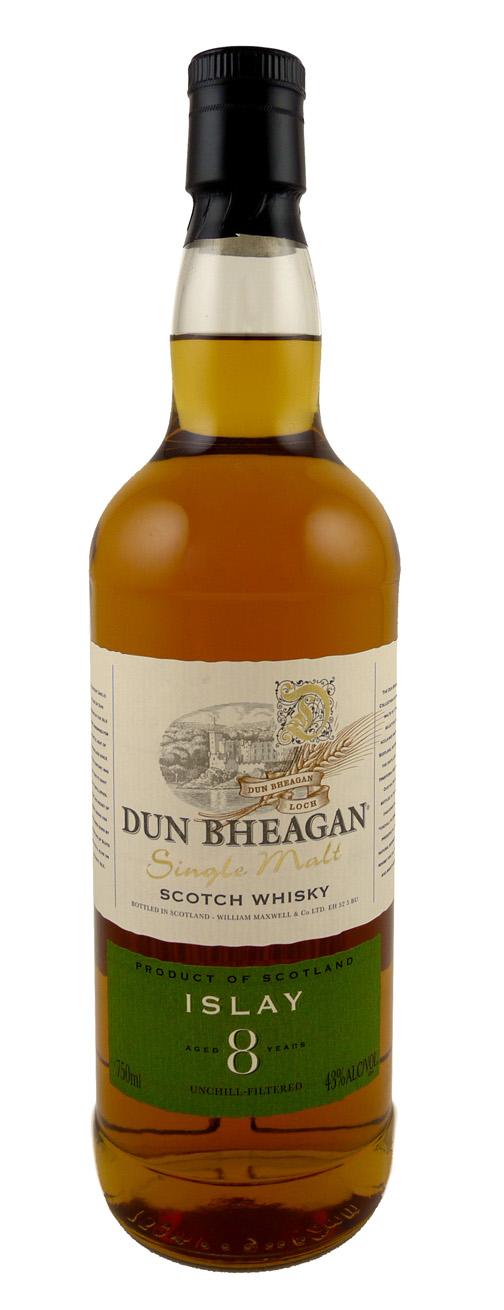
Dun Bheagan Islay 8 yo (Lagavulin) Whisky Review!

No, this isn't the official 8 yo bottling that Lagavulin are releasing to mark their 200th anniversary. Unfortunately that one's not due to hit Australian shores until August. This is an independent bottling from Ian McLeod Distillers, under their Dun Bheagan label.

Unfortunately we don't 100% know this whisky is Lagavulin, because Lagavulin (or rather Diageo, I suspect) don't want their whisky to be seen in independent bottlings, so it's officially known only as Dun Bheagan 'Islay Single Malt 8 yo'. Which also means they can change the source distillery between batches, so all bottlings may not be the same. But I have it on good authority that this bottling came from Lagavulin distillery. Interestingly, Ian McLeod's website states that these bottlings are 'matured at the distillery of origin'. Whether this means Diageo's warehouses on Islay, or those on the Scottish mainland, I can't say.    

The Dun Bheagan range of independent bottlings are all non-chill filtered and naturally coloured, and are bottled at 43% and above. 46% and above would be nice, though! They're quite obscure and hard-to-find in Australia, I'm yet to see one 'in the wild', so this review comes to you thanks to a sample-swap with a fellow whisky nerd.

Dun Bheagan is the Gaelic name of a small town towards the Northern end of the Isle of Skye, which was the historic seat of the chief of Clan McLeod. Ian McLeod Distillers are actually quite a large company, who own Glengoyne and Tamdhu distilleries, and are also behind the 'mystery' whisky brands 'Smokehead' and 'Isle of Skye', among others.

This is the youngest Lagavulin I've tasted so far, and I've put a little aside to compare with the 8 yo official bottling when it finally arrives. Although that one is bottled at a much-better 48% ABV, so it may not be a fair comparison. I'm a massive fan of Lagavulin's brilliant 12 and 16 yo's, and the distiller's edition is good, although a little expensive, and the 2013 Feis Ile bottling is among the greatest whiskies I've ever tasted. So this younger independent bottling should be an interesting experience!
Dun Bheagan Islay Single Malt 8 yo, 43%. Islay, Scotland.
Independent 'mystery' bottling of Lagavulin, from Ian McLeod. Non-chill filtered, natural colour.

Colour: Honey gold.

Nose: Essence of Islay (which should be a unisex aftershave/perfume). Mild sweet peat, a good pinch of salt, some iodine and seaweed. A little wood smoke and some sweet fruit - bananas, stone fruit. Burnt toffee.

Texture: Quite light in weight, but still impressive for just 43% and just 8 years. The beauty of non-chill filtration? I'd like to think so.

Taste: Sweet & ashy peat now, some salt, and more sweet fruit. A little bananas in toffee (banoffee pie?), and a little unexpected bitterness which is a little off-putting.

Finish: Short-medium length, sweet peat and light fruit. A little wooded white wine, some chilli, and a little fruit and sweetness.

Score: 3 out of 5.

Notes: I enjoyed the nose, but the rest, not so much. The bitterness on the palate and the lack of punch and perhaps complexity on the finish. It can't be the strength, because it's the same as the 16yo official bottling, which is excellent. It doubt it'd be the age either, because many Islays are bottled younger without any trouble. It's just missing a few factors for my tastes. The 'wow' factor, perhaps. Maybe if it'd been bottled at 46%, that'd be a different story, but I'm not sure.  

Still enjoyable though, and an interesting spin on Lagavulin which is hardly ever seen in independent bottlings these days. From what I can see it's priced around the same as the 16yo (and the entry-level Ardbeg and Laphroaig OBs), and as much as everyone loves an underdog, it's not even a close fight at that level of competition.

Speaking of which, the aforementioned 8 yo official bottling is looking promising, it's getting positive reviews around the traps, and apparently should be keenly priced to boot. Unfortunately we have to wait until August to find out, although some independent shops have imported it themselves, which of course pushes the price up. There's plenty coming, so my personal advice is to be patient. Regardless, I can't wait to try it.

Cheers!

Sunday, 1 May 2016

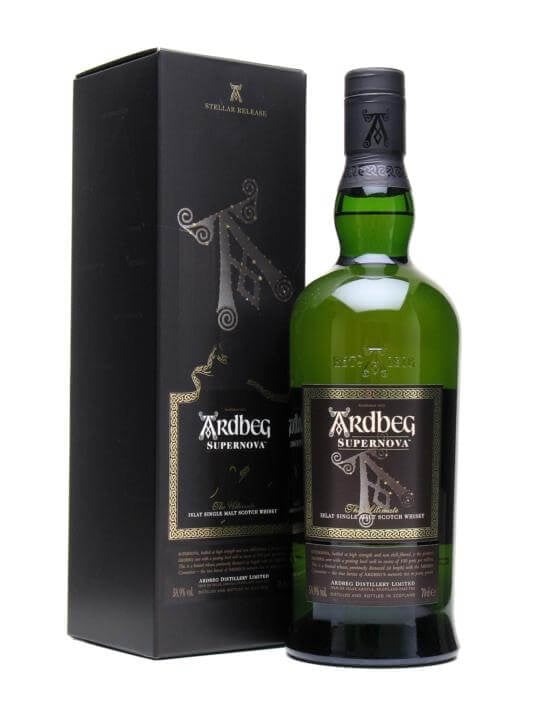
Ardbeg Supernova 2009 Whisky Review!

This is one of my bucket list drams, which is now very rare and worth mega-bucks. Thanks to a very generous fellow whisky geek, I finally have the chance to try it!

This is, or rather was, the original version of Ardbeg's extra-heavily peated Supernova. Hitting the shelves back in April 2009, it was quite a large release at the time, consisting of some 18,000 bottles. But that was seven long years ago, and it is now extremely hard to find, and very expensive. It also won a couple of major awards at the time, including the whisky of the year from the hat wearer (who makes it sound like he built Ardbeg single-handedly back in 1815), which of course added to it's popularity.

The Supernova range is peated to 'well over' 100 ppm on the malt, a big step up from Ardbeg's usual level of around 50 ppm, although in fairness that's still quite high. The recent additions to the Supernova range have gotten a little soft though, with the addition of more sherry-matured whisky in 2014 (reviewed here) and the final 2015 release, and I suspect some slightly older contents as well. And both of those releases were also down to 55% ABV.

But this 2009 version, sometimes referred to as the 'stellar release', and the subsequent 2010 release (reviewed here in the early days) were true peat-monsters; young and high-strength, big and powerful (dare I say explosive?) Islay beasts. 100 ppm may not sound like a lot these days, largely thanks to Bruichladdich's Octomore series, but there are more factors that will influence the actual level of peaty power than that one number. So rest assured, this one is definitely a contender for Octomore's crown.

There's isn't a lot of detailed information about this release around, and you won't find any mention of age, casks or colouring on the packaging. But you will find mention that it is non-chill filtered, plus the slightly ambiguous 'well over 100 ppm'. I don't believe it has had any colouring added, Ardbeg don't do that as far as I'm aware, which is one of the reasons that they use a green bottle. And I would guess that it's ex-bourbon cask matured, most likely in refill casks to retain as much peat influence as possible in the finished product. But I could be wrong there, so we'd better take a closer look. Very excited to finally try this one!
Ardbeg Supernova 2009 'Stellar Release', NAS, 58.9%. Islay, Scotland.
Peated to 'well over 100 ppm', non-chill filtered, likely natural colour. 

Colour: Pale gold. 

Nose: Fantastic. Very Ardbeggian. Lime zest & black pepper, creamy peat, and creamy vanilla ice cream by the sea. Some ash, soil & tar, and a little spirit-y bite. So far not as peat-forward as the numbers might suggest, but oh-so beautiful.  

Texture: Thick & creamy, medium-to-heavy weight. 

Taste: A big peat explosion, as promised! But it's still a lovely creamy peat. Seriously lovely. Some dry, hot ash, a touch of chilli chocolate. Some more lime and black pepper too, and a slight hint of pineapple. 

Finish: Long! Starts with the dry, hot ash and black pepper, then that gorgeous creamy peat comes to the fore. Then some chilli flakes, a little more candied lime, salted potato chips, and a smouldering peat fire. 

Score: 4.5 out of 5. 

Notes: Seriously good stuff, and now I'm kicking myself that I didn't hunt high & low a few years ago and pick one up when they were more available and within reach. It's a proper Ardbeg, un-tamed and un-apologetic, with plenty of complexity and power. Based on my admittedly limited experience in the older whisky field, I'd call it an old-school Ardbeg when compared to today's offerings, and I feel very privileged to have finally tasted it. Although it's now left me wanting more! 

The 2010 'nova was the first mega-peated whisky I tasted (and subsequently bought), so this one also reminded me of those early days. But how do they compare? From that I remember of the '10, it was nowhere near as creamy or lime & pepper-y, and not as complex or balanced. And it was certainly hotter, more than the ~2% difference in strength would warrant. I do definitely prefer the '09 bottling, it's an absolutely beautiful Ardbeg, and I'm smitten with the stuff. Now where did I put that damn time machine...

While we're on the subject, this year's Ardbeg Day is coming up, on the 28th of May. They're actually calling it 'Ardbeg Night' this year, linking it with the marketing theme behind this year's Ardbeg Day special release, Dark Cove. I've reviewed the 55% ABV committee release version here, which has since sold out world-wide. I was very impressed with it, but the general release version which is released on the day is down to 46.5%, and it looks like it'll actually be more expensive than the box-less committee release, at least in Australia. Regardless, if it follows the lead of the 55% version, it'll definitely be one to try.

Cheers!

Sunday, 24 April 2016

Paul John Indian Single Malt Whisky Reviewed & Explored!

A new (to me) Indian Single Malt to explore!

I had noticed Paul John's elegant packaging on the shelves a few times, but had never 'taken the plunge' and bought a bottle, or tasted their whisky. So when Paul John's export manager, Mr. Madhu Kanna, offered to send some samples for review, and to meet up for a chat, I jumped at the chance!


Paul John's Single Malt distillery is located in Goa, on the Western coast of India. Parent company John Distilling, one of India's largest spirits producers, has been around since 1992, and is based in Bangalore. Paul John single malt (named after the company founder) was first launched in Europe in 2012, and has enjoyed wide-spread success since (including multiple major awards). It's now sold in 15 countries world-wide, with more on the way, and is due to launch in the US shortly. There are currently five core expressions available, two un-peated, and three peated (yay!).

Goa has a very hot and humid coastal climate, which among other things means much faster whisky maturation. Around three times faster than in colder climates. Which is why, like most 'world whiskies', Paul Johns' expressions do not carry age statements. Which is absolutely fine, because if they did, the age statement would not reflect the level of maturation, and would therefore be irrelevant. So while Paul Johns' casks are aged for 5-7 years depending on the expression, for comparison's sake they are more equivalent to a much older (roughly 12-15 yo) Scotch in terms of maturity.

That faster maturation does have a downside though, the hot climate results in a considerably higher angel's share (evaporation), which is in the region of 8% per year, far higher than Scotland at around 1-2%. Which means that, on average, almost half of the cask's contents has been lost after just 7 years. Which is one of the reasons why it's unlikely that these whiskies will be matured for much longer than that, or it wouldn't be economical. 


Paul John are really ticking a lot of boxes with their single malts. They're using a pair of Indian-built copper pot stills (spirit still pictured above, with master distiller Michael John - no relation to the founder). All bottlings are naturally coloured and non-chill filtered, and are bottled at 46% and above. And they're only using first-fill or virgin oak casks, of the American oak variety, although there will be sherry cask-matured expressions in the future. They're also using Indian six-row barley in all of their expressions, despite it having a lower yield than the more common two-row variety. And on that note, there's one more point that I'd like to highlight before we get into the malts themselves.

Note that I've said "in all of their expressions" above, and crucially this includes their peated whiskies. There are no peat bogs in India, so then how does one make a peated Indian whisky? The usual thing to do, and this is what the competition does, would be to import peated malted barley from commercial maltings in other countries (e.g. Scotland), 'ready-made', so to speak. This long delay between malting and milling/mashing, and the conditions it's kept in during shipping, can have quite a negative impact on the barley before it even reaches the distillery. And in my opinion, you're then left with a less authentic product, because you're distilling from Scottish, rather than local, barley.

Paul John do it rather differently. They import the peat itself, from two different regions of Scotland, for use at the maltings in India. So they're still distilling from the Indian six-row barley, malted and peated in India, to a level of 30-35 ppm, using Scottish peat. So with Paul John's peated whiskies, you're getting as close to an authentic peated Indian single malt as is geographically possible. I think this is a brilliant idea, and I think more distilleries with no local peat source should be following Paul John's lead!

Now, time to taste some whisky! Rather than comprehensively review all five core expressions, I'm going to give my impressions and brief notes on four, and then focus on my personal favourite of the range for a more in-depth review. All were tasted neat, and spread out over multiple sessions. And as I've mentioned above, all expressions are naturally coloured and non-chill filtered.


Paul John 'Brilliance', 46%.
Un-peated, the entry level expression. Around $85 AUD, available here.
Tasting Notes: Sweet on the nose, with some warm spices and salted butter, and a definite hint of bourbon. On the palate, sweet barley and soft spice, with no (alcohol) heat whatsoever. On the finish, more bourbon and soft spices, plus a hint of oak.
Notes: Sweet & easy-drinking, but still has a great silky texture and pinch of spice. Certainly well-suited to a Speyside Scotch, or perhaps bourbon drinker. Not quite my desired style these days, but not unpleasant by any means.


Paul John 'Edited', 46%. 
Lightly peated, using around 20% peated malt, and 80% un-peated. Around $90, available here.
Tasting Notes: Grassy and herbal on the nose, with a subtle sea-side influence. Warm, soft & silky on the palate, with more spice, and a little sherbet-y fizz on the tongue. A subtle hint of dry peat and a little bitterness on the finish.
Notes: Less sweet than the brilliance, but also with a shorter finish. Very nice nose with those sea-side / coastal notes, and a great subtle pinch of peat on the palate.


Paul John 'Select Cask Classic', 55.2%.
Un-peated, reduced slightly from cask strength for the desired flavour and balance. Around $110, available here. Great value, especially considering the strength.
Tasting Notes: Big and robust, with honey sweetness and tropical fruit on the nose, and sweet barley still shines alongside. Honeyed bourbon and sweet pineapple on the palate, plus a little pepper adding depth. Again, no heat at all, even at 55.2%. A nice balance of sweet and spice on the finish, which is also the longest so far.
Notes: Very nice, and my wife's pick for the winner. Has a great (natural) colour as well, as does the rest of the range.


Paul John 'Bold', 46%.
Peated, using peat from only one of the source regions. A recent addition to the core range. Around $90, great value again. Available here.
Tasting Notes: Peat-forward initially on the nose, a sharp & vegetal peat. Thick toffee sweetness, with plenty of spice, and a hint of aniseed. A little coastal as well, with oily smoked fish, and a hint of dried raspberry. Spicy and peaty on the palate, the peat is the main player here; a dry & spicy peat, with a little black pepper and honey sweetness behind. More of that dry peat on the finish, then becoming quite oily and savoury in flavour.
Notes: Nice and peaty, a great nose, and an interesting finish.


Now on to my personal favourite!


Paul John 'Select Cask Peated', 55.5%. 
Peated, using peat from both source regions. Reduced slightly from cask strength for the desired flavour and balance. Around $110, available here. Excellent value for money again, especially considering the strength.

Colour: Polished copper.

Nose: Lovely. Multi-dimensional peat - dry, sharp and sweet. A wisp of light smoke, sweet bananas fried in brown sugar. Semi-sweet dark chocolate, a little prickly pepper spice, and sweet golden barley.

Texture: Also lovely. Silky and slightly oily, plenty of body, and no heat again.

Taste: Sweet initially, then that sharp, dry peat comes to the fore. More pepper spice, and a little thick, ashy smoke which coats the mouth. A little sugar / toffee sweetness behind.

Finish: Medium-length, with the peat and ashy smoke carried through to the end, and sweet, juicy barley.

Score: 4 out of 5.

Notes: A great whisky, which I'd have no trouble lining up against some of the great Scottish heavyweights, and with a few refreshing points of difference. Peated Scotch drinkers will find the peat influence familiar, as they should given the source of the peat, but it's the Indian barley, the intense maturation, and the authentic production methods that put this peated whisky above many others. I can confidently say that to my tastes, this expression is one of, if not the, best peated non-Scotch / 'world' whiskies that I have tasted so far.

Overall impressions: Very impressive indeed, and I'm particularly impressed by the two Select Cask whiskies. But all expressions are of great quality, well-balanced, well-matured and naturally-presented. The mouth-feel and lack of alcoholic heat in all expressions clearly shows that no corners have been cut, and nothing has been rushed. They're certainly looking for quality here, not quantity. Great stuff.

I suppose the big question everyone will want answered is how Paul John whisky compares to it's closest rival, Amrut. Well comparing like-for-like, since there is no sherry- or port-matured expression of Paul John whisky (yet), I'd say Paul John wins it. Especially in the case of the peated expressions, and even more so in the case of the Select Cask Peated, I'd say Paul John beats it's closest competition by quite a large margin.

Competition notwithstanding though, Paul John are doing some very good work, which they clearly take pride in. There does still seem to be some negative predisposition towards Indian single malts in some members of the whisky world, and the range of Paul John whiskies are an ideal remedy for that, and I predict they'll continue going from strength-to-strength from here on in. So the next time you're looking to try something a little different that also won't break the bank, I highly recommend taking a further look at Paul John Indian Single Malt. I'm very glad I did!

Cheers!

Sunday, 10 April 2016

Laphroaig An Cuan Mor Whisky Review!

Another travel-exclusive Laphroaig! I love the PX expression, which offers brilliant value for money. So how does An Cuan Mor compare?

Well on face value, it can't compete, at least as far as value goes. It's a duty free-only 700ml bottle, selling for $115 AUD, while the PX is a 1L bottle, selling for around $100 AUD. Both are bottled at 48% and are non-chill filtered, and neither carries an age statement. But all is not as it seems, and there's a reason for that higher cost...

There were a few rumours on the interweb that the mysterious An Cuan Mor is actually 18 year old Laphroaig, finished in European Oak casks, with no mention of the previous contents of said casks. But I wasn't so sure. So I asked the venerable and ever-helpful Dan Woolley, Beam Suntory's national brand ambassador for Australia, who checked with the venerable and ever-helpful John Campbell (yes, the John Campbell), who shared a little golden nugget of information:

Laphroaig An Cuan Mor has been matured in first-fill ex-bourbon casks (from Maker's Mark) for around eight years, followed by a second maturation of a further two years in... wait for it... virgin European oak casks! So there's no mention of the previous contents on the label, because there were no previous contents! I wasn't actually planning on reviewing this one for a couple of weeks yet, but after learning this, I couldn't resist bringing it forward in the line-up.

The use of virgin (a.k.a new / fresh) casks of any sort is still rather unusual in the Scotch world, especially for such a relatively long length of time, as the new oak can overpower many spirits if it's given the chance, giving too much wood influence (known as being over-oaked). The use of virgin European oak casks is even more unusual, largely because of the expense involved, with no previous owners helping to offset some of the cost. But Laphroaig is not just any spirit, and these guys definitely know what they're doing. Getting thirsty now...

Laphroaig Select also contains some virgin oak-matured whisky, and the travel-exclusive QA is finished in virgin oak casks, but both use the American Oak variety (hence the name, Quercus Alba), and both of those are down in strength to 40%. An Cuan Mor (Gaelic for 'Big Ocean', as a tribute to the distillery's proximity to the Atlantic) is up in strength to a much-better 48%, and is non-chill filtered. One could interpret the name to suggest more of a coastal influence in this expression than others, but that may not be the case here. So let's find out...
Laphroaig An Cuan Mor, NAS, 48%. Islay, Scotland.
Matured for around 8 years in first-fill ex-bourbon casks, then around 2 years in virgin European oak casks. Non-chill filtered.

Colour: Copper.

Nose: Just gorgeous. Peaty, salty & sweet. Quite mineral-y and a little flinty as well. Sweet, fresh cigar boxes. Burnt sweet apricot jam. Furniture polish, and toasted oak. Becomes more fruity with more time, hint of strawberry lip balm?

Texture: Medium-weight, no heat at all, juicy. Smashing!

Taste: Dry, mineral-y peat, some trademark Laphroaig ash & salt as well. Candied fruits and warm, sweet & spicy oak behind.

Finish: Long, but becoming quite soft. More damp, earthy peat now, and more coastal. Sea salt flakes and seaweed, and more of that warm, buttery oak. Mouth-watering.

Score: 4 out of 5.

Notes: Delicious, and very drinkable. It could certainly pass for an older whisky than it actually is, as the extra oak has tamed it a little, as you would expect. I can see why they went the NAS route with this one, and it's a shame that that may turn some people away. It shouldn't, because An Cuan Mor is well worth giving a go, if you ask me. A very interesting and quite unique expression of my beloved Laphroaig.

But the obvious question is: how does it compare to the PX expression? It's not that easy though, they're basically totally different and thus difficult to compare. It's hard to overlook the excellent value of the PX of course, plus I'd say it's more 'Laphroaig-y', but I'd also say An Cuan Mor is worth the extra because it is a little different to what you'd expect, without straying too far. These guys can do no wrong, in my book!

Speaking of which, there's a new Laphroaig coming! Named 'Lore', it's another NAS expression, but it's bottled at 48% and is non-chill filtered. Supposedly the 'richest of the rich' and 'the richest ever' (big claims there!), it's made up of whisky matured in both European and American oak, including smaller quarter casks, ex-sherry casks and ex-bourbon barrels, of a variety of ages. It won't be cheap though, it's going for 75 GBP from the distillery, so we'll have to wait & see what it sells for in Australia. As usual, I can't wait to try it!

Cheers!

Sunday, 3 April 2016

Glenfarclas 105 Whisky Review!

My first Glenfarclas review, and it's also my pick of their standard range. Next stop, sherry town!

I must admit, given the choice between what are two of the most popular sherry-matured whisky distilleries in Scotland, Glenfarclas and Glendronach, I would usually go for the latter. Some will disagree, but personally, the majority of Glenfarclas whiskies I have tasted so far simply do not measure-up to the current competition from Glendronach. I'm yet to come across any of the 'family cask' single-cask bottlings or 30+ year old expressions from Glenfarclas, so thus far, this '105' expression has come the closest to being an exception to the rule.

But before we get into that, let's have a look at the story behind this Speyside distillery. Officially started in 1836, the distillery was purchased by John Grant roughly thirty years later after the death of the original owner, and it's still independently owned by the Grant family today. The distillery uses six large direct-fired stills, although they are gas-heated rather than coal-heated, and all whisky is matured on-site in traditional dunnage warehouses, before bottling off-site near Edinburgh.


Importantly, Glenfarclas mature the majority of their whisky in Spanish oak ex-sherry casks, mainly Oloroso and Fino sherry, and they age their spirit for a minimum of eight years. So if, like this '105' expression, your Glenfarclas doesn't carry an age statement, it's at least eight years old. Naturally it's quite unusual for a distillery to make a statement like this, as it limits their options somewhat, but it's also great to see!

So, on to this particular expression, which is certainly my personal pick of the standard Glenfarclas range. But why the name '105'? It's named after the bottling strength, in British proof, which equates to 60% ABV in modern terms, which is said to be cask strength. So it's a similar style whisky to Aberlour's brilliant A'Bunadh, or Glendronach's excellent Cask Strength (NAS) series, and we're looking for big sherry influence, high strength and plenty of youthful character.

On the cask strength note though, this is not a single-cask bottling, it's a vatting of selected casks. So I'm wondering how the bottled whisky can consistently come out of said vatting at exactly 60%, without adding any water (which would then not be cask strength), every time? The new-make spirit may go into the casks at a consistent strength (63.5%), but evaporation (the angel's share) is not a precisely predictable thing. I'm not sure how this could be accomplished, unless they're carefully selecting and blending the casks used for this bottling while taking the ABV into account.

Making me even more curious on this point is the fact that there have been 20 yo and 40 yo limited release versions of the 105, which are still bottled at that same 60% strength, despite being aged for at two or four times as long as this expression. But the label says cask strength after all, and I'm not suggesting it isn't, I'm just wondering how they do it. It would seemingly be easier to release it in batches at different strengths, but then that would render the name slightly redundant, I suppose.

Glenfarclas do not add any colouring to their whiskies, and while I couldn't find any official mention of chill filtration, I don't believe it has been chill filtered. What I did find though is a note on the distillery's website, which states the non-age statement (NAS) Glenfarclas 105 is actually 8-10 years old, which is pleasingly honest, although it may have been better served printed on the packaging. Let's see how it goes...
Glenfarclas 105, NAS, 60%. Speyside, Scotland.
Aged 8-10 years, natural colour, believed non-chill filtered.

Colour: Copper

Nose: Semi-dry sherry - slightly musty red grapes and wood spices, and a fresh, bright, sweet malty spirit accompaniment. Well balanced in that regard, actually. A little spicy oak in the background, some dried fruit, and a little spirit-y bite as well. 

Texture: Medium. Some heat, but very nice regardless. 

Taste: Quite a bit of heat initially. Some of that sherry & malty spirit are still there, plus some dry fruit, but they're having to fight against the heat. It could use some water, but that's not normally how I review, so it wouldn't be fair. 

Finish: Medium. Still some prickly heat, which lasts quite a while. A little bitter oak & spice at the end, then the malty spirit comes back to say goodbye. 

Score: 2.5 out of 5. 

Notes: It's definitely young and spirit-y, but that doesn't make it bad. I really enjoyed the nose (it would've scored lower without it), but the palate and finish were disappointing. I did actually add some water to see if it helped, and it didn't make a huge difference, the heat was still bashing everything else into the ground. Adding water killed the nose a bit, too. 

It's important to note this is just my opinion of this particular sample, but for me, the 105 can't compete with the A'Bunadh batches I've tasted, or basically anything from Glendronach. It is quite well priced, though. Having said all that, I'd still love to get my hands on one of Glenfarclas' 'family cask' bottlings, for scientific purposes of course. The distillery is ticking all the boxes otherwise, so maybe I just haven't found the right expression yet. Which calls for more research...

Cheers!

Aberargie Inaugural Release Whisky Review!

The inaugural release from one of the newer breed of Lowland distilleries, albeit one that was founded nearly ten years ago! Aberargie Disti...