Monday, 2 October 2023

Ardbeg Anthology 13 Year Old Whisky Review!

"A sauternes cask influenced Ardbeg! One please! Oh wait, what? It's $240? And 46%? OK, let me call you back..."


Despite the Ardbeg limited releases coming thick & fast in the last couple of years, the excitement surrounding this Ardbeg Anthology "The Harpy's Tale" was significant. Not only does it have an age statement of 13-years, it is the first in a new series of bottlings, and it is influenced by - but not 100% matured in - a cask that Ardbeg have never used before. We all knew it was going to be expensive, and to be fair it could've been worse. The sticking point for many came with the ABV, which is "only" 46%. I have no issue with 46% ABV myself, that's often the sweet spot for many single malts, and of course is also the official threshold that negates the need for chill filtration. But ABV does have to be taken into account when a large chunk of the competition at this price point (e.g. Lagavulin 12, Octomore 13.1, among others) weighs in significantly higher. Even in Ardbeg's own current line-up of semi-limited releases you have the 8-year old 'For Discussion' at 50.8% and the more recent 'BizarreBQ' at 50.9%, both of which are roughly 40-50% cheaper ($115 and $145 respectively) than this 13-year old. They're also very tasty, and arguably offer better value than even the regular core range Uigeadail and Corryvreckan do at their current prices. Let's be realistic, it's 2023 and this new 13-year old is a limited release Ardbeg, it was always going to sell regardless of price or ABV. They could have priced it at $300 or upwards - if it had been bottled at 50% they probably would have - and it still would've sold. Aside from attracting less tax/excise, bottling at the (relatively) lower strength also means there are more bottles to go around. The interesting thing is that despite being released last month, at the time of writing this whisky is still available on the Ardbeg Committee website, and probably in local retailers as well. The same applies to Heavy Vapours, the 2023 Feis Ile/Ardbeg Day bottling which was released back in May, even in the higher strength Committee Release version. Not long ago that would certainly not have been the case, these releases would be be long gone. Perhaps the number of bottles in these releases and/or the local allocations are larger than they used to be. Or maybe it's a sign of the times. Or maybe Ardbeg have alienated some of their fan base with all of these special releases...

Slight digression here; that 8-year old 'For Discussion' at $115 AUD from ardbegcommittee.com.au is an absolute bargain, and if you haven't bought one already then you really should. If memory serves it was $130 when it was first released a couple of years ago, which was already a great buy, but at $115 it's currently less than the local RRP for the core range 10-year old bottling. I wouldn't necessarily say that the 8-year old is a better whisky than the 10, but unlike many of the releases in the last few years it's certainly on par with it, and is nicely differentiated from it - being a higher ABV and being matured solely in sherry casks. I've reviewed it here if you'd like more details. Let's get back on topic!

This 13-year old is the first release in Ardbeg's new 'Anthology' series. They haven't said how many releases there'll be in the series or how often they'll be released, and "anthology" is just a fancy term for collection/compilation, so there aren't any clues there. They have told us that these releases will all be influenced by unusual cask types, meaning unusual for Ardbeg. In this case they've used sauternes wine casks, which can work brilliantly with peated whisky if you ask me, and is certainly something new for an official bottling of Ardbeg. Sauternes is a sweet white wine from the Sauternes region of southern France where the grapes have been affected by the botrytis fungus, which is also known as "noble rot". In basic terms this concentrates the sugars in the fruit, with the resulting sweet wine generally having flavours of sweet white & yellow fruit, balanced with some acidity. Some of these wines can also be quite "funky", particularly with age, and can also get very expensive. The interesting thing with this new Ardbeg is that it hasn't been 100% matured in the sauternes casks, nor has it been finished in them. This whisky is a combination of both ex-bourbon casks and ex-sauternes casks, both matured separately and vatted / blended together for bottling. That's significant to us Ardbeg nerds because it's what they used to do with most of their special / limited releases, up until Ardbeg Drum hit the shelves in 2019 which is when cask finishing became more prominent. In theory the separate maturation method should give us more distillery character and more balance, which does seem to be the case with some of those pre-2019 examples. We don't know the proportions of each cask type that went in to this bottling, nor the number of casks or bottles that were released, but based on smell & taste they haven't been shy with the sauternes influence. 

Oh, and what about the name "The Harpy's Tale"? Well, as we've come to expect from Ardbeg, it's a piece of mythology that has nothing to do with the distillery, or the island, or the whisky. A harpy is a half-bird, half-man creature from Greek or Roman mythology, basically a giant bird with a human torso and head. Supposedly Ardbeg have named this whisky after the harpy because it has a combination of sweet and smoky flavours, and a harpy is a combination of bird and person. Moving right along... Actually no. Dear Ardbeg, why couldn't you just give the marketing department the day off and call this "Ardbeg Sauternes Cask"? Or "Ardbeg Sweet Wine Cask"? Or even "Ardbeg Noble Cask"? I get it, it's supposed to add a bit of fun, but the extra fluff & flannel is totally unnecessary with something like this that actually has a genuine unique selling point. OK, now let's move along...


Ardbeg Anthology 13-Year Old "The Harpy's Tale", 46%. Islay, Scotland.
Fully matured in both ex-bourbon and ex-sauternes sweet wine casks, proportions unknown. Non-chill filtered, natural colour.

Colour: Gold. 

Nose: Sweet, spicy, and a little nippy. Touches of white wine vinegar acidity, sweet honey, and dried woody herbs. Sweet fruit - pineapple, lychee, white peach, touch of sweet banana. Green grapes and white pepper. Tar, hessian (sack cloth), and ashy smoke underneath. 

Texture: Medium weight. Oily, sweet, herbal. Slight heat but pleasant. 

Taste: Sweet fruit again, white peach nectar / juice. Touches of spearmint and white pepper around the edges. Bitter lemon peel, olive oil, more white wine vinegar, and dried woody herbs. Tarry smoke, hessian cloth again, and some fresh cut wood. 

Finish: Medium-long length. Still a little nippy here. Juicy sweet fruit again with that peach nectar, pineapple, and lychees in syrup. Olive oil and lemon peel again, touch of aniseed & powdered ginger. Tarry smoke, more fresh oak, and fruit syrup to finish. 

Score: 3.5 out of 5. 

Notes: Certainly does what it says on the tin (box)! The extra sweetness from the sauternes is immediately obvious, with that "white" fruit in syrup. Nicely oily in texture and taste as well. Seems a little rough though, that nippy heat is unexpected at a decent age and (relatively) lower ABV. Almost like the alcohol isn't fully integrated despite the use of active casks. And the texture isn't quite enough to cover it up. Still, I'd say this was a successful experiment! It's hard to resist comparisons with the two reigning masters of sauternes casks; Bruichladdich - e.g. Port Charlotte SC01, Octomore 4.2/10.2/12.2, and some of the Micro Provenance single casks - and Kilchoman - e.g. the Sauternes Matured from 2016 and the Sauternes Finish from 2018, and countless single cask releases. All of those listed were higher in ABV and are/were similarly priced to this Ardbeg when they were launched, albeit years ago now.

Still, this 13-year old is pleasantly fruity, very sweet but not cloying or overwhelming, and softly peaty & smoky with the distillery signature still intact. Which is what we're all looking for in a sauternes cask peated whisky. I have no doubt that being married with ex-bourbon casks has helped keep the cask influence in check, and if you ask me, it would've become overly sweet had they gone with 100% ex-sauternes. So, recommended, yes. But not entirely sure it's worth $240...

Cheers!

Sunday, 17 September 2023

Bakery Hill Blunderbuss 2022 & Metamorphosis Whisky Reviews!

Two recent additions from Melbourne's quiet achievers, Bakery Hill! We have the second release of Blunderbuss, their stout cask finish, and Metamorphosis, their first Muscat cask finish, which is peated!

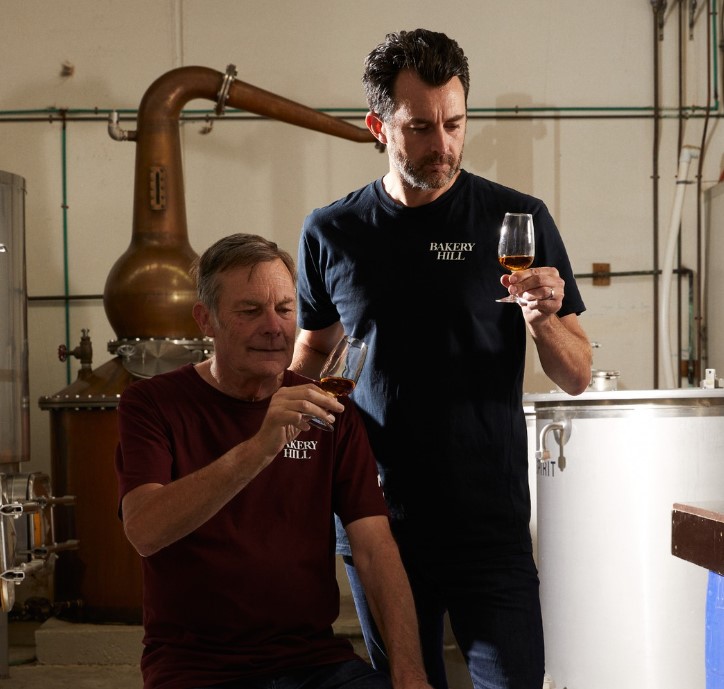
Distillery founder David Baker & son Andrew.

Once largely unknown outside of their home state of Victoria, Melbourne's Bakery Hill is finally starting to make significant waves in the Australian whisky scene after more than 23-years of hard work. I've gone through more of the distillery's origins and points of difference in this recent review, but for many years David Baker and his team were focused on building a solid core range of regular expressions, of consistent quality, at a time when most of the Australian industry were only concerned with the latest limited edition or single cask. Bakery Hill only release single cask bottlings across their entire single malt portfolio, but somehow still manage to keep a level of consistent quality that many larger distilleries would envy! From day one they also focused on retaining the distillery character and spirit character in their whiskies, via the use of larger format ex-bourbon casks, at a time when most of the industry was only concerned with producing the darkest, sweetest - and often youngest - cask driven whisky that they could. Sadly that's still the case for many of our distilleries, where a combination of very clean new make spirits, very active and/or small format wine casks, and of course the Australian climate, deprive their whiskies of any spirit signature or distillery character in no time at all. Thankfully that approach is changing in the wider industry these days! 

Aside from these two important points of difference, this tiny operation has always offered reasonable pricing and solid value for money, despite their tiny production capacity. Even here in 2023 where many Australian & Tasmanian whiskies are selling for (or at least asking for) exorbitant prices, Bakery Hill's three core range whiskies - Classic Malt, Double Wood, and Peated Malt - sit at $170 AUD or less, while the two regular cask strength bottlings - Classic Malt and Peated Malt - are at $220 or less. That may sound like a high figure for those playing overseas, and yes they're 500ml bottes, but here in the great southern tax land that's firmly in the mid- to lower end range of the smaller producers. For comparison's sake, Lark's entry level 'Classic Cask' retails for $200 in a 500ml bottle at only 43%, jumping to $250 for their core range Cask Strength, and both are around 5-year olds of age from a much larger company - they're even listed on the Australian stock exchange. Even Bakery Hill's limited releases, which like the core range are all single cask bottlings, are kept at that $180-220 price level, including the two that we're looking at today. 

First cab off the rank in this two-for-one review is the second release of Bakery Hill Blunderbuss, which is a stout cask finish. I've reviewed the first Blunderbuss release here, which hit the shelves in mid-2020, and once again with the 2022 release there's more to this story than a simple beer cask finish. This unpeated single malt first spent six years in an ex-bourbon barrel - already practically middle-aged for an Australian whisky - before spending two further years in an ex-stout cask from Melbourne's Hop Nation brewery. That would be interesting enough on its own, but the stout cask in this case was an ex-bourbon barrel which had previously matured a batch of Bakery Hill's peated single malt - for over a decade! So this cask was an ex-bourbon barrel which then matured Bakery Hill peated single malt, then matured a batch of Hop Nation's 'Kalash' Imperial Stout, then went back to Bakery Hill where it was filled with six-year old unpeated single malt to give us Blunderbuss. Which brings us to the differences between 2020's first edition and this 2022 second release! While the first spent one year in the stout cask for a total age of seven years, this second iteration has seen that finishing period extended out to two years, giving it a total age of eight. The other difference here is in ABV, with the 2020 coming in at 52.0% and this 2022 weighing in at a hefty 58.0%. While the distillery has sold out of this release it can still be found in a couple of other Australian retailers, and both releases were priced at $220 - it's tough to find anything that hasn't jumped in price between 2020 and 2022, so that's commendable. I definitely enjoyed the 2020 edition, but this one promises to be more intense!


Bakery Hill Blunderbuss 2022 Edition, Stout Cask Finish, 58.0%. Melbourne, Australia.
8-year old unpeated single malt matured in an ex-bourbon barrel for 6-years, finished in an ex-Hop Nation stout cask for 2-years. Stout cask was previously an ex-bourbon barrel which had matured Bakery Hill's peated single malt for over a decade. Non-chill filtered, natural colour, 250 bottles.

Colour: Amber. 

Nose: Malty, rich, toasty & "stouty". Rich burnt caramel, treacle, and fresh double cream. Fresh chocolate porter beer with foamy head. Touches of sweet tropical fruit & honey underneath. Lemon curd, passionfruit cream, and freshly roasted coffee beans. 

Texture: Medium weight. Rich & warming, toasty & roasty. Slight heat but carries it well. 

Taste: More treacle, chocolate porter beer, and a lovely roasted maltiness. Fresh vanilla marshmallow, strong sweetened coffee with cream. Puffs of earthy peat smoke running underneath. 

Finish: Long length. Becoming fruitier with pineapple juice, passionfruit cream, and lemon curd. Dark chocolate mousse, some crystallised ginger, and coffee grounds. 

Score: 3.5 out of 5. 

Notes: Another big, rich, stouty, Blunderbuss of a whisky! There's definitely more stout influence here than in the first release from 2020, which is to be expected since it's spent twice as long in the stout cask. It hasn't gone too far though, there's still that sweet tropical fruit, citrus & honey from the spirit and from the original cask. The higher ABV doesn't seem to have done any damage either, carrying itself nicely at that significantly higher strength. I must admit though, while there's not much between them I have to give the win to the first release, and yes I did try them side-by-side just to be sure. The first release just feels a little rounder and more complete, but they're certainly very similar as far as flavour profile and character. Which is to say, they're both very tasty! Now on to part two...


Next up, the latest limited "seasonal" release from Bakery Hill, titled Metamorphosis. Quite the fancy title, but David was a chemistry teacher after all... The word essentially means "to change physical form or structure", e.g. from a caterpillar to a butterfly, in this case referring to the cask finish completely changing the profile of this whisky. Bakery Hill Metamorphosis is a peated single malt, distilled from heavily peated Scottish barley sourced from Baird's on the mainland. The vast majority of peated Australian whisky is made from imported peated malted barley, often mixed in with unpeated Australian malted barley to reduce the peat level, since our commercial maltsters won't entertain the small volumes required by our distillers and won't risk tainting any future batches of malt intended for their corporate brewery contracts. This Bakery Hill was distilled in 2014 and aged for 6-years in an ex-bourbon barrel before being finished in an ex-muscat fortified wine cask for 2-years, and was bottled in 2023 at 48% ABV without chill filtration or added colour. Muscat is a grape variety, but in Australia the term generally refers to a sweet fortified wine also known as a Liqueur Muscat or Rutherglen Muscat after the main producing region. It's broadly similar to a port or tawny in style, rich & sweet, often aged in French oak for a decade or more and typically bottled at 17-18% ABV. These muscat casks are becoming more commonly used in Australian whisky, with larger producers such as Lark, Starward, and Morris all releasing muscat cask whiskies recently. The cask used for Bakery Hill Metamorphosis was a single French oak muscat cask sourced from an unnamed winery in north-eastern Victoria. This release is still available from the distillery website and from a couple of Australian retailers, going for around $190 AUD. 


Bakery Hill Metamorphosis, Muscat Cask Finish, 48.0%. Melbourne, Australia.
8-year old peated single malt matured in an ex-bourbon barrel for 6-years and finished in a French oak ex-Muscat fortified wine cask for 2-years. Non-chill filtered, natural colour, 290 bottles. 

Colour: Pale gold.

Nose: Big peat! Ashy, dry, bitter, earthy peat with touches of burnt fatty bacon and charcoal briquettes. Nicely acidic too, with lemon zest, white grapes, and a little green banana. Hint of creamy vanilla underneath. Sweet stone fruit coming through with more time. 

Texture: Medium weight. Surprisingly peaty, sweet & fruity. No heat. 

Taste: Big ashy, dry, earthy, bitter peat again. That burnt fatty bacon too, plus a pinch of black pepper now. Green banana and white grape again, but sweeter here with some fairy floss / cotton candy, candied lemon, and sweet dried orange. 

Finish: Medium length. Still peaty, but becomes more creamy, citrusy and fruity here. Touch of salt, and tart green apple around the edges. 

Score: 3.5 out of 5. 

Notes: Very tasty, and surprisingly peaty! It's been a while since I last tasted Bakery Hill's standard peated single malt, but I don't remember it being this peaty, even at cask strength compared to the 48% in this Metamorphosis release. The muscat cask is nicely integrated as well, not over-sweet & wine dominated like some of the other muscat cask Australian whiskies that I've tried. Instead this just adds some extra sweetness and fruitiness without overtaking the spirit or overdoing the sweetness. Not the most complex dram perhaps, but it's firing on all cylinders and will hit the spot for any lover of peated malts - which is not something I'd say about many peated Australian whiskies. Very well done. 

Overall Notes: More great work from this small team of quiet achievers. These two and the first Blunderbuss release are my first experiences of cask finished Bakery Hills, previously I'd only tried the Classic and Peated both at 46% and at cask strength, which are all straight ex-bourbon cask maturation. And I'm very, very impressed! The balance between the finishing cask influence, the original cask influence, and the spirit character is excellent. Which again is not something I'd say about many Australian whiskies where the cask often dominates completely. That shouldn't come as a surprise to anyone though, since Bakery Hill has always been about balance between cask and spirit, patient maturation in more supportive cask types rather than dominant ones, and in larger size formats as well. Which means allowing both aspects to shine, and creating a whisky that is greater than the sum of its parts. And that's the name of the game!

Thanks to the distillery's Andrew Baker for the samples for these reviews, and for all the hard work that he & his father David have put into their whisky over the years. There's a new larger distillery in the works at the moment that is much closer to Melbourne itself, which will certainly help Bakery Hill get more attention. Here's to more of their delicious whiskies in the years to come!

Cheers!

Sunday, 3 September 2023

Glenallachie Future Edition 4-year Old Whisky Review!

4-year old Glenallachie? 60.2% ABV? The first release of a Glenallachie single malt that was distilled during Billy Walker's ownership? And the first-ever distillation of a peated spirit at Glenallachie. This'll very interesting!


Speyside's Glenallachie Distillery is looking like it'll be another Billy Walker success story, much like Benriach, Glendronach, and Glenglassaugh (to a lesser extent) that came before it. This legendary Master Distiller now has his own cult following, having rescued those three distilleries from their previous owners and then brought them out of the shadows, with the once largely-unknown Benriach and Glendronach now sitting comfortably among the most highly regarded distilleries in Scotland. The revival of these two distilleries under Walker & Co. was so successful that American corporation Brown Forman purchased them in a package deal along with third wheel Glenglassaugh, paying a whopping £285-million for the trio of distilleries back in 2016. Billy Walker didn't rest on his laurels for long, purchasing Glenallachie Distillery from Chivas Brothers (Pernod Ricard) in late 2017 with two business partners, and forming The Glenallachie Distillery Company. As you'd expect from Walker's past performance with rescuing neglected workhorse distilleries from corporate blended whisky machines, he did the same here. Glenallachie was largely unknown as a single malt outside of a couple of official bottlings and some scattered independent bottlings, with most of the 3-4 million litre annual production going into Pernod's blended whiskies like Chivas Regal and Clan Campbell. This is a relatively young distillery that was built in 1967, essentially designed to quickly & efficiently produce a light spirit destined to be used as blend filler. With only two pairs of stills that large production capacity was achieved by quick fermentation and quick & efficient distillation, all in the name of pumping out spirit that would be blended into oblivion and reduced to 40% ABV. One interesting point equipment-wise is that the condensers on the stills, which are the modern shell & tube type as you'd expect, are actually mounted horizontally, which is something I've never seen before. This was supposedly done since the distillery was designed to be gravity fed in the name of energy efficiency, and also to give more control over the condenser temperatures. 

Soon after Mr. Walker & Co purchased Glenallachie they extended the fermentation times out to 160 hours and drastically slowed distillation in search of a quality new make spirit. This cut that 3-4 million litre production capacity down to 800,000-litres, with actual production currently sitting at around 500,000. The GlenAllachie brand - note the change to a capital 'A', which is a hallmark of Billy Walker's rescued distilleries - was re-launched as a single malt in mid-2018, with the core range featuring 8-15 year old whiskies and beyond, mostly finished in a number of different cask types ranging from virgin oak to ex-rye whiskey casks and many, many more. As you'd expect from the owners Glenallachie whiskies are now bottled at 46% ABV and above, and are non-chill filtered and natural colour. There's also a range of single cask bottlings and small batch wood finished limited releases, which is another trademark of Billy's. In my experience so far Glenallachie is certainly quite heavy on cask influence, which is no surprise considering these releases were all distilled under the previous owners and probably needed a helping hand to get them up to par. That's often the case with these rescued / resuscitated distilleries. So far I've only tried the flagship 12-year old and a couple of different batches of the 10-year old Cask Strength, which in all honesty haven't exactly wowed me. I do hear that the 15-year old is the highlight of the core range, so I'll keep an open mind as always, but the 10-year old cask strength in particular was surprisingly rough and hot, even after adding water. That track record could be about to change though, since the Glenallachie that we're looking at here is the first release of spirit that was distilled under the current owners, so with the longer fermentation time and slower distillation put into practice. And it's also the first peated spirit ever released by the distillery! 

Glenallachie 'Future Edition' is a 4-year old single malt that was released to celebrate Billy Walker's 50th anniversary in the whisky industry. There was also a 'Present Edition' and a 'Past Edition' released at the same time, both aged for 16-years, with the 'Present' being finished in virgin Mizunara (Japanese oak) casks and the 'Past' being fully matured in sherry casks. This 'Future Edition' was distilled in 2017-2018 and bottled in August 2022 at 4-years of age, and at a cask strength of 60.2% ABV. 10,000 bottles were released, taken from a mix of ex-bourbon, ex-rye, and virgin oak casks that were matured separately and vatted together. Aside from the casks, the long fermentation, and the slower distillation, the obvious point of difference here is the peat. This is the first peated Glenallachie ever released, in this case using mainland peat from St. Fergus on the east coast of Scotland, with the malted barley apparently peated to 80 ppm. That's a surprisingly high figure, but I'm not sure if this release was entirely distilled from that peated barley or if there was some unpeated malt / unpeated spirit included in the vatting. For a 4-year old whisky this bottle was on the expensive side from day one, priced at £80 RRP in Great Britain, which would be the equivalent of around $220-250 AUD once landed here in Australia. But it's the first peated Glenallachie ever, it's taken from the first distillation runs under the new owners, and it's bottled at cask strength, so that's understandable. As you'd expect it sold out quite quickly, and it was never imported into Australia. Some local retailers have parallel imported small quantities, and their attempted pricing is frankly stupid. Circa $550 AUD stupid. Unsurprisingly that retailer still has stock available, and let's hope it stays that way. The sample for this review came from a fellow whisky nerd who imported a bottle straight from Europe, and generously sent me a sample to take a look at. Let's do it!


Glenallachie 'Future Edition' 4-year old, 60.2%. Speyside, Scotland.
First release distilled under Billy Walker ownership, first peated Glenallachie ever released. Mainland peat, 80 ppm but unsure of % of peated malt used. Distilled 2018, matured in ex-bourbon, ex-rye, and virgin oak, bottled August 2022. Non-chill filtered, natural colour, 10,000 bottles.

Colour: Gold. 

Nose: Sweet, smoky & fruity. Quite sweet in fact. Brisket burnt ends, charcoal briquettes, chemical fire starters (hexamine / kerosene). Cold wood smoke, cinnamon sugar, fatty smoked bacon. Touch of rubber bandaids, fried banana drizzled with thin honey. Sweet nutty oak, red apples, and black pepper. 

Texture: Light-medium weight. Syrupy texture, sweet & smoky. Quite hot & sharp. 

Taste: Sharp & hot entry, with burnt bacon and hot ashy wood smoke. Cinnamon flavoured syrup, touch of strong milk coffee, black pepper, and over-roasted nuts. Sweet oak, baking spices, touch of juniper around the edges. 

Finish: Long length. More cinnamon flavoured syrup, over-roasted nuts, and a touch of fresh rye bread. Sweet red apple, maple syrup, black pepper, and burnt bacon. Flashes of those bandaids & charcoal briquettes to finish. 

Score: 3 out of 5. 

Notes: Well it certainly is very interesting. The nose is excellent, although certainly on the sweet side there's a nice balance with burnt BBQ meats and wood smoke. The palate and finish lean away from the BBQ notes a touch but become really very sweet, with those cinnamon flavoured syrup notes bordering on sickly for my palate. It's also rather hot, and even aggressive at times. I know this is only a 4-year old whisky, but I always find the Glenallachie 10-year old Cask Strength to be hot & aggressive so I can't help but draw parallels here. Granted this "Future Edition" is substantially younger but unlike the 10-year old it's substantially peated, which would usually help to calm / hide some rough edges in the spirit. I have no doubt that Billy Walker knows what he's doing with the longer fermentation and slower distillation, so the spirit probably just needs more age to round it off. Which will hopefully negate the perceived need for virgin oak involvement, which has to be responsible for most of that almost-artificial syrupy sweetness that isn't really floating my boat. I'm not being an ageist here though, I've had some brilliant whiskies around this age or even younger - e.g. some Kilchoman single casks, Kilkerran Heavily Peated, even some Octomores - that didn't need another day of maturation. 

This spirit is certainly one to watch though, at least with a few more years under its belt. But for the love of god, don't pay $500 AUD for this 4-year old whisky. It's not worth that in any way, shape or form. Frankly I'm not sure if I'd buy it at the 85 GBP recommended retail either, which would probably equate to $220 AUD or so once it landed here in Australia. I know Billy Walker has his devout following in the whisky enthusiast world, and rightly so given what he pulled off with Benriach and Glendronach. Glenglassaugh too, to a lesser extent. But this 4-year old Glenallachie is really only a progress report, and it should be treated as such - a core range based on this spirit with some decent age should be excellent. Let's see what the future holds!

Cheers!

Sunday, 20 August 2023

Thompson Bros Speyside 30 Year Old Whisky Review!

A cask strength 30-year old single cask from an anonymous Speyside distillery, brought to us by Thompson Bros, the independent bottlers & distillers behind Dornoch Distillery. May as well take a quick look at the state of the independent bottling market while we're at it...

Well, maybe...

Is it just me or are there a lot more mystery distillery malts around these days? And also more "teaspooned" blended malts for that matter. There are certainly a lot more independent bottlers around these days than there were ten years ago, and all of them now have a much harder time when it comes to finding decent casks at reasonable prices. I have no doubt that this explosion in the number of small indy bottlers is a major factor here, but it's not the only factor. Yes, more bottlers probably means more brokers, which is also why we're getting more "mystery malts", but let's not forget the rise of the dastardly "cask investment scheme" which sees often-naïve investors pour their cash into what they're told is the latest hot commodity with guaranteed safe returns. There's a reason they're called investment schemes, people... Not all are treacherous of course, but many have already been proven to be suspicious, or even fraudulent to the point of criminal charges and international press. On top of these factors, more distilleries and distillery owners - including some of the largest in the industry - are now restricting external supply or ceasing it altogether. Many of those distilleries & companies are now happy to sell casks to wealthy private clients instead, at ridiculously exorbitant prices of course. Take Diageo's Prima & Ultima releases for example, or that insane cask of Ardbeg that was sold to a single Asian buyer for a record-settingly stupid sum of money. How anyone could possibly interpret all of those regurgitated press releases as positive is far beyond me. They were a harbinger of doom. When all of those websites clicked their publish buttons they were helping bring on the end-times for reasonably priced casks of aged whisky. The only people who should've been happy with that piece of news were the LVMH shareholders and the company's leadership. That happened over a year ago now, and in hindsight it may have been one of the harbingers of doom for the "traditional" whisky drinker. Just like distilleries and their marketing teams now watch the secondary market and - quite rightly, to a point - want their extra share of the profit pie, upon reading these articles those same distilleries and their marketing teams would've immediately starting seeing dollar signs scrolling behind their eyelids like Neo sees the cascading code in The Matrix. Personally, I hope that cask springs a leak! 

These factors and the continuing boom in single malt whisky means that casks of are becoming vastly more expensive and more difficult to obtain, and none of this is good news for any independent bottler from the latest Taiwanese "hobby bottler" sole operator to the likes of Adelphi and Gordon & MacPhail. Speaking of which, I'm sure we've all seen about three hundred articles about G&M "ceasing independent bottling" recently so I won't go into it too far, but something needs to be clarified in order to avoid a misunderstanding and create a panic. Funnily enough this was not properly discussed in most of the mainstream circles where clicks drive their revenue. G&M is one of the few independent bottlers who solely buy new make spirit from distilleries to fill into their own casks, as opposed to the usual method of buying maturing / mature stock from brokers and/or private cask owners. Yes, G&M is stopping this practice as of next year, but that doesn't mean the independent bottlings will stop anywhere in the near future. They could still have enough casks in their massive warehouses to keep multiple future generations sated. Think of it this way; the final batch of new make spirit that G&M purchase from distillery x in 2024 and then filled into a cask then starts at zero. It must spend three years in cask to even become whisky, so we're already at 2027, and from there it could go on ageing for decades. Both Benromach and The Cairn distilleries are quite small, with a combined annual capacity of less than 2-million litres of spirit, and G&M don't plan to release anything from The Cairn until it reaches twelve years of age, which means roughly 2035. That should give you an idea of the timescale that we're looking at. The company's independent bottlings range from from 7-years to 80-years from a plethora of different distilleries. Remember that record-setting oldest single malt ever, the 81-year old Macallan that broke G&M's record-setting oldest single malt ever, the 80-year old Mortlach? Right, well would you like to guess where Macallan obtained that cask of 81-year old Macallan? It wasn't from their own warehouses... Having been lucky enough to visit the G&M warehouse complex in Elgin, let me assure you that we'll see plenty of their independent bottlings well in to the future. They'll inevitably start to taper off as the mature stock is bottled and isn't replaced with new spirit, but a lot of us won't have to worry about that eventuality, if you catch my meaning... 

But we aren't here to talk about G&M or Ardbeg, we're here to talk about Thompson Bros.! Simon & Phil Thompson started with a whisky bar in the Dornoch Castle Hotel that is owned by their parents, found roughly an hour's drive north of Inverness in the Highlands. The pair quickly establishing the hotel bar as one of the leading whisky bars in the region, which helped them establish their own independent bottling operation. Thompson Bros was founded in 2015, then successfully crowdfunded their own distillery. Housed in the hotel's old fire station, Dornoch Distillery began producing new make spirit in 2017 and released its first single malt in late 2020. With traditional "old school" production - using organic heritage barley varieties, brewer's yeast, and even direct-fired alembic stills - and tiny production volumes of under 20,000 litres per year, this is essentially the new Daftmill, but with a more experimental side. As far as Thompson Bros independent bottlings go, most are cask strength single casks of single malt Scotch whisky, along with some blended malts and blended whiskies, plus some brandy and a few other oddities. Pricing does seem to be quite reasonable, even here in Australia where that's certainly a rarity. Thankfully the local importers Select Spirits - brought to us by the legendary Kelvin & Yao from the brilliant Elysian whisky bar in Melbourne - are very even-handed with their pricing and their stock allocations. 

This particular example is a 30-year old single cask of single malt from an undisclosed Speyside distillery - so not from the actual Speyside Distillery, but from another distillery within the Speyside region of Scotland. It was distilled in 1990 and bottled in 2021 at a cask strength of 50.4% ABV, with a single refill American oak cask yielding 278 bottles. As with everything that Thompson Bros release it's non-chill filtered and natural colour. There are two main rumours regarding which distillery was responsible for this whisky, with most saying Glen Grant, but this is unconfirmed (**edit: Glenlivet has now been added to the list!). Most independent bottlings of Glen Grant - the only Scotch whisky distillery that is owned by Italian company Campari Group - are bottled as anonymous Speysiders, save perhaps those from G&M which has a very long-standing relationship with this distillery. There have been a few independently bottled Glen Grants released at similarly advanced ages recently, which combined with the flavour profile makes me believe those rumours surrounding this bottling from Thompson Bros. Pricing in Australia was $399 AUD, which is extremely reasonable for any single malt in this age bracket here in 2023. To give some perspective for the overseas readers, most 30-year old official bottlings of single malt are priced locally at $1,000 AUD and upwards, and most of those are only bottled at 40% or 43% and are chill filtered. So this Thompson Bros. bottling is something of a bargain! Let's get to it.


Thompson Bros. Speyside 30-year old, 50.4% ABV. Speyside, Scotland.
Undisclosed distillery in Speyside region. Distilled 1990, bottled 2021, matured in a refill American oak cask. Non-chill filtered, natural colour. 278 bottles. 

Colour: Medium gold. 

Nose: Lovely relaxed & mature freshness. Malty, fruity & sweet. Fresh red apple skins, white peaches, beeswax, malt biscuits, touch of white pepper. A little sawdust, vanilla pudding, oat cakes, subtle hint of liquorice. Crystallised ginger, and a touch of leafy green herbs with more time. 

Texture: Medium weight. Nicely oily, slightly waxy, sweet & fruity. Great balance. No heat at all. 

Taste: Delicious malty, sweet, waxy, and fruity entry with waxy red apples, vanilla pudding, malt biscuits, and powdered ginger. Touch of sawdust, white pepper, and powdered ginger. White peaches & beeswax again heading into the finish. 

Finish: Medium length. Tinned orchard fruit in sweet juice (not syrup), white pepper, and powdered ginger again. Then the beeswax, fresh red apples and malt biscuits return. Sweet fruit juices, malty & sweet to the end. 

Score: 4 out of 5. 

Notes: Lovely fruity, waxy, and malty Speysider. Touches of sawdust and ginger from the cask, but on the whole it's delightfully spirit driven after three decades in a refill cask. The nose is nicely complex, less so on the palate and finish, but there's still plenty to keep you entertained in that lovely relaxed, patient, contemplative style that quality old Speyside malts do so well. For the price, given this is a 30-year old cask strength single malt from a single cask, this is a no-brainer. As to the distillery responsible, as said above the two main rumours were Glen Grant and Fettercairn. I'm yet to try any old Fettercairns, and the old Glen Grants that I've tasted were all sherry casks, so I can't be sure, but my money is still on Glen Grant. Particularly when there have been quite a few similarly aged Glen Grants released by other independent bottlers recently, which probably means a broker has gotten their hands on a parcel of 30-year old casks. That lovely malty fruitiness and a near-perfect balance of cask influence & spirit character at this age make this anonymous Speyside single malt a real winner.

I'm yet to taste anything from Thompson Bros that has been anything less than lovely, and this is no exception. Great stuff!

Cheers!

Sunday, 13 August 2023

Deanston 18 Year Old Whisky Review!

I'd been wanting to try Deanston 18 for quite some time, and then I came across an older brown label bottling and was left underwhelmed. Hopefully this more recent redesigned bottling will change my mind!


Despite a slight resurgence recently, Deanston is still wildly underrated by whisky fans. Always playing third fiddle to owner Distell's other two distilleries; Islay's Bunnahabhain and Mull's Tobermory which get more attention. Which is a little odd when you think about it, because Deanston is arguably more "mainstream" in its style of whisky, and also in its marketing approach. Tobermory is better known amongst enthusiasts for its dirty peated alter ego Ledaig, pronounced either "Lay-chig" or "La-chayg" depending on who you listen to, while Bunnahabhain love their beautiful but difficult Gaelic names with whiskies like Toiteach, Stiuireadair, Ceobanach, and Aonadh. No, none of those sound anything like they're written! You won't find any of those Hebridean hijinks over at Deanston on the mainland, located in the namesake village found roughly 40-minutes north of Glasgow. This is a more modern and conventional distillery that was only founded in 1965, making it 167-years younger than Tobermory and 85-years younger than Bunnahabhain. Deanston Distillery didn't even last two decades from its initial birth, becoming one of the many distilleries that shut down during the dark times of the 1980s. It remained that way until 1991 when it was rescued by Burn Stewart Distillers, which would later become part of South African company Distell, the current owners. Deanston is yet to reach its 60th birthday but the site itself isn't short on history, with the distillery and surrounding village dating back to the late-1700s when it served as a cotton mill, with the village initially built as housing for the mill workers and their families. The mill was originally powered by water wheels fed by the River Teith that runs alongside and serves as the distillery's water source, while hydro-electric turbines were installed in the 1940s which still provide the distillery's power today. Which would have to make this one of the earliest sustainable Scotch whisky distilleries to be built in the modern era.

When it comes to the whisky, Deanston is again more modern and more conventional compared to the two other Burn Stewart / Distell distilleries. No dry, nutty, hard-edged characteristics like Bunnahabhain, and no dirty, sulphurous, funky characteristics like Tobermory/Ledaig - aside from the occasional sulphured sherry cask of Deanston, at least, which are generally only seen in older independent bottlings. This is a fruity, malty spirit with a good viscosity which lends itself nicely to ex-bourbon casks of just about any description, although they also use a variety of more exotic casks for both finishing and full maturation. I don't think there's such a thing as a "typical" Highland region style of whisky these days, particularly with the islands included as per the SWA regulations. But if you subscribe to the traditional idea of a Highland malt being a drier, spicier whisky in comparison to the traditional lighter, sweeter & fruitier idea of a Speyside malt, then Deanston doesn't really fit in to the Highland pigeonhole. I suppose it's geographically closer to the Lowlands anyway, so let's just add it to the growing list of flavour outliers in the official Scotch whisky regions. Deanston was in high demand from blenders for quite some time, although there's now much more attention given to single malt official bottlings, with a plethora of limited releases that are often finished in some exotic cask type. I have to say though, in my experience those are very hit & miss, and the expensive older examples should ideally be tried before buying. In some cases there's a waxy quality to Deanston's single malt which seems to be particularly evident in teenaged whiskies that have been matured in active ex-bourbon casks, much like that other waxy distillery in the Highlands region; Diageo's Clynelish. This waxy character in Deanston is attributed to an oily build-up in the feints receiver, again much like it is at Clynelish, and I'd argue that it's actually easier to find the wax in a modern Deanston than it is in a modern Clynelish. Case in point is the 18-year old Deanston that we're looking at today. 

It was initially launched in the previous Deanston line-up with the drab-looking brown labels, then was discontinued for a time, and was re-launched circa 2016 after the brand had undergone a complete redesign. I have to say the new designs are a massive improvement visually, and the whisky seems to have improved considerably as well. The flagship Deanston 12-year old is matured in ex-bourbon casks, but it was never specified whether they were first-fill or refill, or a mix of both. Likewise the previous brown label version of the 18-year old, which was labelled as "bourbon cask finish" - so we can safely assume that it was matured in refill casks and finished in first-fill ex-bourbon casks, or at least finished in more active ex-bourbon casks. As stated above I've tasted that version before and it didn't impress, coming across as both too oaky and also a little under-matured. This more recent white label version, however, states that it was aged in first-fill ex-bourbon casks, and given that wording - and the difference in flavour profile - I'm assuming that means it has been fully matured in those first-fill bourbon casks rather than merely finished. Whatever they changed, it's certainly worked. All Deanston single malts do clearly state that they're non-chill filtered, and their single malts are bottled at a minimum of 46.3% ABV. Let's get to it!


Deanston 18-Year Old, 46.3%. Highlands, Scotland.
Matured in refill ex-bourbon casks, finished in first-fill ex-bourbon casks. Non-chill filtered, natural colour.

Colour: Gold. 

Nose: Soft, malty, fruity, waxy. Some oak spices (mild ginger) as you'd expect, but quite clean and not a "bourbon cask bomb" by any means. Rich freshly malted barley, and waxy orchard fruit - red apples, oranges, touch of brown pear). Some golden syrup / treacle, vanilla bean, black pepper, and sweet ginger biscuits (with the pieces of crystallised ginger in them). 

Texture: Medium weight. Waxy, malty, soft & fruity. No heat at all. 

Taste: Rich malty entry. More of those sweet ginger biscuits, vanilla bean, and waxy oranges & red apples. More ginger & black pepper here, and some dried currants too. Touch of nutty fresh oak, and honeyed nectarine heading into the finish. 

Finish: Medium length. Waxy orchard fruits again, more so the red apples here. Ginger and black pepper still there but easing off into the fruity & malty side. Flashes of green apple and lemon peel as it winds down.

Score: 3.5 out of 5. Close to a 4 though - i.e. 7/10.

Notes: Definitely a massive improvement over the old brown label version that I'd tried previously. This is probably the waxiest Deanston that I've come across so far, I certainly don't remember getting any of that in the 12-year old, so maybe it's a little like Clynelish in that regard where the waxiness seems to come out more in the teenaged years and beyond. Since most modern Clynelish isn't as waxy as it used to be - in fact many contemporary bottlings aren't waxy at all - I'd say Deanston 18-year old is a viable alternative. Especially when you consider the crazy prices people are trying to charge for independent bottlings of Clynelish these days!

At $180-200 this Deanston used to be considered expensive for an 18-year old single malt, but here in 2023 it's not as bad as many of the competitors - ahem, Glengoyne 18 - and at least it's bottled at 46% and non-chill filtered, unlike many of the competitors - ahem again, Glengoyne 18! All in all, this is a very nice waxy Highlander that won't be too "out there" for newcomers, but still has enough character to keep the hardened enthusiasts entertained. 

Cheers!

Sunday, 30 July 2023

Bakery Hill The Blunderbuss Whisky Review!

A unique limited release from one of Australian whisky's quiet achievers, Victoria's Bakery Hill Distillery. This is easily my favourite beer/ale/stout cask influenced whisky to date!


Despite being overshadowed by Melbourne stablemate Starward and the more glamorous Tasmanian brands, Bakery Hill Distillery has been around since the Australian whisky industry was in its infancy. In fact if I'm remembering the timeline correctly this was the first malt whisky distillery to open on the mainland of Australia since the 1980s, and it was only the fourth Australian malt whisky distillery (after Cradle Mountain, Lark, and Sullivan's Cove) to be established after Bill Lark's famous epiphany struck in 1993, kickstarting the Australian whisky industry as we know it. Founded in Melbourne's outer eastern suburbs by chemistry teacher David Baker in 1999, Bakery Hill Distillery's first three expressions were released back in 2003, including the first peated Australian single malt, even attracting attention from a certain infamous hat-wearing whisky writer a couple of years later. Even in those early days Bakery Hill stood apart in our fledgling industry by favouring ex-bourbon casks for maturation, primarily from Jack Daniels (let's just call it bourbon), when the majority of our producers were focussing on ex-wine and ex-fortified wine casks that were much more plentiful on these shores. Just as important was Bakery Hill's use of larger-format and full-size casks, initially 50-litre and then 100-litre, 200-litre, and 225-litre (recoopered) capacity, at a time when our producers were leaning heavily on the 20-litre casks that unfortunately then became synonymous with Australian whisky - thankfully that trend is shifting now. I'd argue that Bakery Hill was ahead of that curve right from the start, and they've only been filling full-size casks for quite some time now, letting the spirit itself have more of a voice. 

Being made from charred American oak rather than French oak, and having previously matured a spirit rather than wine or fortified wine, means that the influence of both the wood and the previous contents on the spirit is more supportive rather than aggressive, and they allow for slower and steadier maturation than a smaller French oak ex-wine cask would. Obviously this is still an Australian whisky so the climate still has a large part to play in the maturation process, particularly in Melbourne where the weather swings from one extreme to the next, but opting for a less aggressive wood type in a relatively large format helps to balance out this effect rather than accelerate it. I'd argue that this more conservative approach to cask types and maturation has kept Bakery Hill out of the spotlight in comparison with some of the louder & larger players in the industry who lean almost entirely on cask types and wood influence for both their flavour profile and their marketing. That's another thing that has unfortunately become synonymous with Australian whisky, but thankfully it's another trend that is slowly changing! Despite a minor expansion and increase in production around 5-years ago, Bakery Hill is still a very small distillery, even by Australian standards. But David and his son Andrew are soon relocating to a new site close to the Melbourne CBD which will also feature a cellar door and tasting bar. It'll also allow for a proper increase in production giving them more scope for limited releases and also more capacity for export.

These days Bakery Hill's whisky is generally aged for 6-7 years in full-sized ex-bourbon casks, and those three initial releases; unpeated ex-bourbon cask Classic Malt, unpeated virgin French oak-finished Double Wood, and ex-bourbon cask Peated Malt, still form the distillery's core range. Interestingly Bakery Hill only bottles single casks, even in these core releases at 46% ABV, so no two batches will ever be exactly the same. There are also cask strength releases of both the Classic Malt and Peated Malt available on a regular basis, and there have been a number of limited releases in the last few years that have finally given this tiny distillery some well-deserved attention. The Bakery Hill release that we're looking at today was one of the first of these limited releases, hitting the market back in mid-2020. Bakery Hill 'The Blunderbuss' was a collaboration with Melbourne brewery Hop Nation, who acquired a freshly emptied ex-bourbon cask that had matured Bakery Hill's Peated Malt for over a decade, and promptly filled it with their 'Kalash' Imperial Stout. After ageing the beer for 3-4 months, the cask was emptied and sent back to Bakery Hill, where it was promptly filled with unpeated 6-year old ex-bourbon cask single malt which was left to mature for another 12-months. So an unpeated Bakery Hill whisky that was finished in an ex-stout cask which had previously matured a peated Bakery Hill whisky!

Stout cask finishes are becoming more popular in whisky production as are ale / beer casks in general, with some big "old world" names like Teeling, Jameson, Glenfiddich, and even Lagavulin dipping their toes in the water recently. Barrel-aged beers are usually filled into refill casks, typically ex-whisky or ex-whiskey, and only for relatively short periods of 1-2 years at most. The lower ABV of the liquid is gentler on the wood than a spirit would be, so in theory the barrels should have plenty of life left in them once the beer is emptied out. Not all stout beers/ales are barrel aged, but all are made from high percentages of heavily roasted barley, which provide the characteristic dark colour and dark / burnt caramel and coffee flavours that tend to come through in the resulting whisky. The term 'Imperial' only refers to a higher alcohol content, typically 9-10% ABV (roughly double that of a typical full strength beer), originally to slow spoilage and prevent freezing during shipping. Since we're talking about names, why "The Blunderbuss"? A Blunderbuss is basically an ancient shotgun with a short barrel and flared muzzle, but what an old gun has to do with this whisky I couldn't say - something to do with the flavour profile perhaps? Or like the guy printed on the label it could be linking back to the Hop Nation 'Kalash' stout which refers to Kalashnikov - as in AK47. There was a second Blunderbuss release from Bakery Hill in 2022 which spent two years in the ex-stout cask rather than one, and it was bottled at 58.0% rather than 52.0% like the first release that we're looking at today. I was lucky enough to nab this 2020 bottling at auction for a very reasonable price, below the original retail pricing in fact. So I had to crack it open!


Bakery Hill The Blunderbuss, NAS (see below), 52.0%. Melbourne, Australia.
7-year old single malt matured in ex-bourbon cask for 6-years, finished in ex-stout cask for 12-months. Stout cask had held beer for 3-4 months, after maturing peated Bakery Hill single malt for 10-years.

Colour: Full gold. 

Nose: Malty, fruity, and rich. A little nippy too. Thick burnt caramel, thick honey, touch of coffee grounds, and passionfruit curd a.k.a. passionfruit butter (sweet & tangy). Brown butter, vanilla cream, under-ripe tropical fruit (banana, guava, pineapple). Heavily roasted malt behind, and a tiny puff of earthy peat. 

Texture: Medium-heavy weight. Rich, malty & creamy. Minor heat, warming. 

Taste: Thick roasted malt again, more coffee grounds and burnt caramel. Dark honey, same under-ripe tropical fruits again, and some mocha (coffee & chocolate) ice cream. 

Finish: Long length. Bitter dark chocolate, more roasted malt, and a touch of that passionfruit curd / passionfruit butter. Touch of spicy wood smoke comes out with the vanilla cream, honey, and coffee grounds. 

Score: 3.5 out of 5. Only just over the line, though.

Notes: Still my favourite stout / ale cask finished whisky to date. It's a little boozy and rough around the edges at times, but the sheer volume of flavour more than makes up for it, as does the balance between the stout cask, the original ex-bourbon cask, and the lovely citrusy & malty unpeated spirit. Worth remembering that this is only a 7-year old whisky too, and it's been matured in large format casks which is not the norm in Australian whisky. While I'm yet to taste the second Blunderbuss release I can guess why they've given it that extra year in cask, although that could mean that it's too heavy on the stout influence, whereas the level of cask influence in this original release is bang-on for my tastes. That mix of bitter chocolate, roasted malt, and burnt caramel from the stout cask, the honey and vanilla from the original cask, and the hint of peat from the original contents of the ex-stout cask, and then the tangy citrus and creamy maltiness from the unpeated whisky all add up to one very flavoursome Bakery Hill! 

Stout drinkers should love this one, including the one-time stout drinkers like myself who can't stomach the stuff anymore! It's a different style of whisky than anything I've tasted before from these shores, which is certainly a breath of fresh air. No more fortified or red wine cask single malts here please, let's cash-in on our massive craft beer industry and put those beer casks to work!

Cheers!

Sunday, 16 July 2023

Adelphi Breath of Islay 12 Year Old 2010 Vintage Whisky Review!

A mysterious "undisclosed" Islay single malt from independent bottlers Adelphi, fully matured in a second-fill ex-sherry quarter cask. And I'm told that, for once, it's one of those rare mystery Islays that is NOT a Caol Ila!


Adelphi has always had a cult following in the world of independent bottlings, even way down here in Australia. Founded thirty years ago in 1993 this relatively small bottler is named after the long-dead Loch Katrine Adelphi Distillery that was located in Glasgow and ran from 1826 to 1932. These days Adelphi remains privately owned and is run by Managing Director Alex Bruce, and like a growing number of independent bottlers now has its own distillery; Highland distillery Ardnamurchan. Considering this remote west coast distillery has only been operating for nine years or so and they took their time with their initial releases, the distillery has already gained a well-deserved cult following. They produce both peated and unpeated spirits with great character and a distinctly coastal edge, and they're also committed to renewable energy, to natural presentation, and to reasonable pricing. Definitely one to watch! As far as Adelphi's independent bottlings things are continuing as normal for now, although like all independent bottlers they're starting to feel the pinch when it comes to sourcing whisky and sourcing casks at reasonable prices, although it should be a little easier in their case with such a long career and such a high reputation. Many distilleries are no longer selling to brokers or independent bottlers due to the massive demand for their official bottlings, or at least drastically reducing the amount that they sell, all of which pushes up the prices of what is available. There are even rumours around that some of the giant "workhorse distilleries" that currently form a large chunk of the independent market will be following suit in future. Scary times ahead? Possibly, but remember that Scotch whisky has always been unpredictable in the long run. Almost all of the large companies have expanded their distillery's production by large amounts in the last few years, and the number of new & upcoming malt whisky distilleries in Scotland today is staggering. It'll be interesting to see what happens once their stock comes of age and hits it stride, and the extra stock from those expanded distilleries becomes available. 

There are plenty of "mystery distillery" bottlings out there, even if you focus solely on Islay. Some are "teaspooned" blended malts - where a cask or casks of a particular single malt has a bottle (sometimes even less) of a different distillery's whisky tipped in, meaning that it's no longer a single malt and can't be labelled as such. Plenty of the mystery Islays are single malts though, and while some are more mysterious than others, sheer mathematics means that these are often undisclosed bottlings of Caol Ila. Don't worry, I haven't forgotten about Johnnie Walker - which is where the vast majority of Caol Ila's production goes - or Diageo's other blends, and there'll also be filling contracts for blended whiskies owned by other companies. But given Caol Ila's 6-million litre production capacity and the relatively tiny number of official bottlings that are released by Diageo, and the abundance of declared / disclosed independent bottlings that are on the market, it stands to reason that their probably responsible for most of these mystery Islays. There's still no shortage of Caol Ila out there - for now.  That aside, just because most of these mystery bottlings are Caol Ila certainly doesn't mean that they're all Caol Ila. And I have it on good authority that this particular Adelphi mystery Islay single malt is actually not a Caol Ila! A few of the island's nine distilleries insist on any independent bottlers abstaining from using their distillery names, which has resulted in some imaginative labels and names over the years, and some non-so imaginative. Sometimes this is because a cask or casks don't fit the distillery's perceived quality standards or flavour profile, but more often these days it's because the distillery's owners do not want the brand to be associated with what is effectively someone else's whisky. And that's probably the case here. 

Adelphi's "Breath of the Angels" series of mystery / undisclosed bottlings first launched in 2007 to accommodate distillery & brand owners who did not want their name used on independent bottlings. This series of sporadic releases is separate into regions, so far being Speyside, Highlands, Isles, and Islay. But that's pretty much all the information that you get, the rest is up to you. As with all Adelphi single malts these are single cask bottlings that are bottled at cask strength, non-chill filtered and natural colour. The 'Breath of Islay' bottling that we're looking at today is a 12-year old that was distilled in 2010, and it was bottled at a cask strength of 51.9% ABV with a yield of only 110 bottles. Why so few? Well that's because it was fully matured in a second-fill Oloroso sherry quarter cask - 125-litres in capacity, a quarter the size of a 500-litre sherry butt - that had previously been used at Glenfarclas Distillery in Speyside. So it was a second-fill cask, meaning less cask influence than a first-fill cask, but a small cask, meaning more cask influence than a larger full-size cask. 12-years is a long time to mature a whisky in a quarter cask, and it's certainly left it's mark on this whisky. Let's see how it goes!


Adelphi 'Breath of Islay' 2010 Vintage, 12-Year Old, 51.9%.
Unknown Islay single malt, fully matured in second fill ex-Glenfarclas ex-Oloroso sherry quarter cask (125-litre). Non-chill filtered, natural colour. 120 bottles. 

Colour: Bronze. 

Nose: Rich and quite sherry forward, with a pinch of gunpowder sulphur and that slight "flatness" that I usually associate with the dread "s word". Thankfully that breathes off, leaving x-mas fruit cake, orange zest, and sweet cherry cola. Touches of salted dark chocolate and fresh seaweed behind that, slight coastal qualities trying to poke through the sherry influence. 

Texture: Medium weight. Richly sherried, sweet, lightly peaty & smoky. No heat at all. 

Taste: That gunpowder sulphur and sweet cherry cola again. More x-mas fruit cake but with extra raisins and some dried figs thrown in. More smoky here than on the nose, a dry ashy peat smoke that helps to balance the sweeter notes from the cask. Touches of sweet plum jam and orange zest around the edges. 

Finish: Long length. Dry ashy peat smoke carries through with a little gunpowder sulphur again, and some buttery toasted oak. Plum jam, orange peel, and sweet cherry cola. Dried stone fruit to finish. 

Score: 3.5 out of 5. 

Notes: Very sherry forward, which is to be expected from 12-years in an ex-sherry quarter cask. But this was a second-fill ex-sherry quarter cask, so it was clearly still packing a punch! The underlying spirit has had a tough time keeping up (or fighting back) over that 12-years. While the peat & smoke are still there they've been beaten down to Bowmore levels, and I have it on good authority that this isn't a Bowmore, and that the spirit was heavily peated. That gunpowder sulphur and the slight "flatness" that I attribute to mild sulphur are something that I do sometimes find in Glenfarclas, and I have to assume that's come from the cask since none of the Islay distillery's spirits are generally particularly sulphurous. I don't mind the gunpowder / struck match side of sulphur in the right whisky, and it suits the style of this heavily sherried Islay. Thankfully it's far away from the god awful vulcanised rubber & rotten egg gas style of sulphur that I absolutely cannot stand. 

Do I have any guesses as to which distillery this Adelphi came from? I don't think it's from the southern three based on smell & taste, and I'm told it's not a Bowmore or a Caol Ila. Which leaves peated Bunnahabhain, Kilchoman, or Port Charlotte/Octomore. I don't think it's a Port Charlotte or Octomore either based on smell & taste, so that narrows it down considerably. Regardless, it doesn't fit right in to any of the distilleries' flavour profiles with that big sherry influence, so it doesn't really matter which distillery it came from. Which is probably why it was allowed to go to Adelphi and be bottled as a mystery malt. And there's nothing wrong with that!

Cheers!

Cadenhead's Glen Elgin 23 Year Old Whisky Review!

A 23-year old cask strength independent bottling from one of Diageo's unsung and oft-forgotten workhorse distilleries. One that shouldn...