Friday, 20 February 2015

Talisker 25yo Whisky Review!

For most of us, it is not very often that we get the chance to taste a whisky which is almost as old as we are. When this whisky in front of me was distilled, it was 1986. I was a toddler. Bob Hawke was the Australian Prime Minister, the Chernobyl nuclear disaster occurred, and Top Gun was released in cinemas. Two of those things are still with us today, and so is this whisky. While age statements aren't the be-all and end-all of good whisky, and neither is age, there's no denying that this is pretty cool.

Slightly less cool however is the price, with Talisker 25yo 2011 release retailing for around $500 here in Australia, and only bottled at 45.8%, not at cask strength (there are older cask strength releases ). I confess I'm only reviewing a sample, which I purchased here, as a bottle of this 25yo is out of my price range. Another reason why samples are awesome! The Talisker 18yo is excellent as well, and is good value comparatively at around $150 locally.  

Being matured for a quarter of a century, you would expect the 'standard' talisker flavour profile to become more subdued, and you would expect there to be more wood influence from all those years spent in casks. The label refers to refill casks being used for the maturation, also known as second-fill, meaning the casks have already been used for whisky maturation once since they held sherry/bourbon/etc. Many older whiskies are matured in this way, because 25 years in a first-fill cask is likely to have a massive influence on the finished product, which may not be desirable. Anyway, let's get into it!

Talisker 25yo, 45.8%, distilled 1986, bottled 2011. Isle of Skye.
Matured in unspecified refill casks, chill filtered, added caramel (assumed, standard practice for Talisker). 

(tasted neat)
Nose: Salt & white pepper, surprisingly fruity though. Stone fruit, paw paw (papaya), maple syrup, hints of smoke and dry sherry. Light and slightly dust peat. Reminds me a little of a lighter Talisker 57 north. Complex & dynamic nose, very nice! 

Texture: Buttery and syrupy. 

Taste: A little sherry, nice sea salt. Quite dry, with some peat, ashy smoke and chilli. Stone fruit and white pepper, and a surprising amount of heat for a whisky of this age. The Talisker profile is there, but it's a little rough around the edges. 

Finish: Medium length, dry spices, mouth-watering. Alternating between chilli, pepper and earthy peat.

Score: 3 out of 5 (adjusted for pricing, 3.5 without)

Notes: Not blown away, unfortunately. I wanted to love this whisky, but it's just not pushing my buttons. I'm sure other releases are better, and the nose on this one was excellent, likewise the texture, but the taste and finish left me disappointed. It's not unpleasant or 'bad' mind you, it's a very decent malt, but it just didn't live up to the hype and anticipation for me.

I don't see how this release could be worth more than 3 bottles of Talisker 18yo or 57 North, both of which I prefer to this 25yo. I found myself reaching for my bottle of '99 Distiller's Edition afterwards, and can't help but think I would choose it over the 25 as well, in a blind tasting. 

I can't help but draw comparison to Laphroaig 25yo, which despite being a little more expensive, is far & away superior to this Talisker bottling. I'd recommend trying the Talisker to satisfy your curiosity, you may be more impressed than I was, but try and taste it before investing in a bottle. 

Cheers!

Thursday, 12 February 2015

Compass Box Peat Monster Whisky Review!

I've been wanting to try Compass Box Peat Monster for quite some time, for obvious reasons, so when I stumbled across it hiding amongst a new range of samples at SM Whisky, I couldn't resist. It's a blended malt whisky, meaning it is a blend of different single malt whiskies, from different distilleries, and does not contain any grain whisky. See here for more information on the different types of blends and classifications.

Compass Box is essentially a blended whisky producer. They source malt whisky and grain whisky from distilleries like an independent bottler would, then blend the distillates together and 'marry' or mature them further in casks, before bottling. They produce a number of different blended whiskies, including some controversial ones like 'Spice Tree', which was essentially ruled 'illegal' by the Scotch Whisky Association. See here for more details.

This 'Peat Monster' expression is stated as being 'made from a marriage of an Islay south shore malt, a peated malt, a peated malt from the Isle of Mull and a smoky Speyside malt'. The Isle of Mull component is obvious, as there is only one peated malt made on the Isle of Mull, which is Ledaig (pronounced 'le-chig'), made by Tobermory distillery, but the other three components are a bit of a mystery. A previous version of Peat Monster was known to contain substantial amounts of Caol Ila single malt, which could be the whisky alluded to with 'a peated malt', and I am confident in my belief that the 'south shore Islay malt' to be Ardbeg. 

Whatever the ingredients, the resulting heavily-peated blend has been 'married together' in American oak, before being bottled at 46%, without added colour or chill filtration. Sounds good, doesn't it?


Compass Box 'The Peat Monster' blended / vatted malt, 46%, NAS, Scotland. 
Non-chill filtered, no added colouring. A blend of four undisclosed peated single malts. 

(tasted neat)
Colour: Pale gold

Nose: Pungent peat & coastal salty air, medicinal, some sweet & sour fruits, and toffee'd bananas. Very light on the smoke, but heavy on the peat. 

Texture: Slightly creamy, clean & warming.

Taste: There's the smoke, but it leaves quickly without saying goodbye. That lovely sweet, coastal peat is in it for the long haul, though. A bit of vanilla sweetness and oak offset the boisterous, punchy peat. 

Finish: Very long, and very peaty. Brine, oak, vanilla and apples. Mouth watering peat alternates between sweet and dry, and clings on until the very end.

Score: 4 out of 5 (blend score)

Notes: Although it lacks the complexity and balance of say, an Ardbeg 10yo, it's a very good 'peat monster' in it's own right. It's tied for the honour of being my favourite blended malt, neck-and-neck with 'Big Peat', another vatted malt / malt blend, but consisting of only Islay whiskies. 

The Peat Monster is also priced similarly to the entry-level Islay single malts, giving Big Peat a bit of an early advantage, but it holds it's own regardless. I picked up my sample here, or it's widely available by the bottle at most on-line stores. Certainly worth giving it a go. 

Cheers!
P.S: A pretty special whisky review coming next, I won't give it away, but let's just say it has matured in a cask for a quarter of a century, and was made on the isle of Skye... Stay tuned!

Sunday, 8 February 2015

Macallan, Highland Park and Laphroaig Masterclass!

I recently had the privilege of attending a masterclass for The Macallan, Highland Park and Laphroaig single malts, at the fantastic Morrison Hotel in Woolloongabba, Brisbane. Presented by the ever-excellent Dan Woolley, brand ambassador for Beam-Suntory, this was the first 'masterclass' I've attended, and I'm sure it won't be the last.

First off, what is a 'masterclass'? Essentially it is a guided tour of a particular brand of whisky, usually presented in a sit-down classroom/lecture setting, often as part of a whisky festival or spirits trade show, and naturally they include a few tastings. They are generally more in-depth and detailed than your typical whisky tasting, containing more distillery background information, and details on production methods and whisky characteristics. In this case, we had a less-formal format with a fantastic five-course meal, and three different brands/distilleries to explore, with two different expressions of each.


I imagine a masterclass would be quite difficult to present, particularly one such as this, not being tied to a whisky festival or trade show, and featuring whisky from three different distilleries. Why? Because your audience is likely to be a mixed bag, consisting of whisky industry professionals, bartenders and bar owners, dedicated whisky enthusiasts, and curious casual drinkers. While that is a good thing, it must make it tougher on the presenter. Some of the audience may not be at all familiar with whisky, or may have never tasted your particular brand, or (and this would be the worst-case scenario) they may only be there to eat food and drink spirits, and may barely pay attention. 

So I imagine it would be difficult to find that balance between not presenting in enough detail for the enthusiast, not presenting from the right angle for the professionals, and presenting in too much detail for the curious. And obviously it would be difficult to choose which whiskies to present to the varied audience. But, as expected, Dan handled this situation just fine, keeping the event light hearted and relaxed, while still engaging the audience and making sure everyone took something away from the evening. 

For a bit of serendipity, this masterclass was originally scheduled for November last year, while I was overseas. It was also scheduled on the day of a massive thunder and hail storm here in Brisbane, and was unfortunately cancelled. Well, Dan blamed the weather, but I'm pretty sure he actually rescheduled just so I could attend!

The venue for the evening was the 'Naked Whisky Bar' at the Morrison Hotel, a slightly eclectic mix of polished wood, whisky, and (tasteful) 'old-time' photos of naked ladies! Their range of whisky (and other drinks) is not to be sneezed at, and Fiasco's steakhouse, in the next room, serves the best steak in Brisbane, in my opinion. Go for the wagyu rump with their you-absolutely-must-have-it mushroom sauce.  

Our room was the spacious art-deco style 'piano bar' function room, complete with thousands of photos of naked ladies substituting for wallpaper. Presented with a five course tasting menu, designed to match our whiskies by Dan himself, and with our six whiskies waiting patiently on the tables (the room smelled pretty damn good), it was time to get stuck in!


Starting with The Macallan distillery, from the Highlands, we had the 'Amber' and 'Sienna' expressions from their '1824' series, representing the year the distillery was founded. All five expressions in the series are matured in ex-sherry casks, and are un-peated. Interestingly, The Macallan do not add any artificial colouring to their whiskies, preferring to let the natural colour from the top-quality casks shine through. Good stuff!
  • The Macallan 'Amber', NAS, 40%. Light and honey-sweet, with a lot of green apple and pear on the nose, lovely medium-dry Oloroso sherry and subtly spicy on the palate, and that light honey sweetness, and a little spirity heat on the finish. Paired with a scallop & chorizo salad, drizzled with a little lemon oil, which matched brilliantly with the whisky. 
  • The Macallan 'Sienna', NAS, 43%. A mix of American and Spanish oak (all ex-sherry). Stone fruit and spiced orange on the nose, syrupy and jam-like on the palate, with some tasty spice coming from that American Oak. Less sweetness than the Amber, and no heat on the finish. Paired with a delicious pulled pork spring roll, and orange & wombok (chinese cabbage) salad. 
 

Next we have Highland Park distillery, from the Isle of Orkney. Starting with their standard 12yo expression, then moving to the 18yo. Highland Park only use ex-sherry casks for the maturation of their whisky, and generally peat their barley to around 20 ppm, using local floral, earthy peat. 
  • Highland Park 12 year old, 40%. A little yeasty/new-make and subtle peat on the nose, nice warm, earthy peat and sweet heathery-honey on the palate. Very light smoke on the finish. Paired with a mildly-spicy seafood and sausage gumbo, which was fantastic. 
  • Highland Park 18 year old, 43%. Considerably more European oak used than in the 12yo, and bottled with no added caramel, making it considerably lighter in colour. Extremely subtle smoke with some dark toffee and molasses on the nose, well balanced toffee and earthy peat on the palate with gentle smoke, building up for the finish. Paired with parmesan-crusted lamb cutlets with pea puree and parsnips. 

Finally we have (for me) the star of the show, Laphroaig distillery from my beloved Islay. It's always interesting to watch peoples' reaction to Laphroaig, with it's very distinctive flavour profile it's a love it/hate it whisky. Personally, I love it, and so did many attending the masterclass. Both of these were paired with our dessert platters, which had freshly roasted honey macadamia nuts, brownies with caramel sauce, a selection of cheeses and more.
  • Laphroaig 10 year old, 40%. Trademark Laphroaig medicinal peat, iodine, seaweed & smoke on the nose, fantastic acrid smoke, salt and disinfectant on the palate, a little salted caramel and vanilla on the finish. I had not tasted Laphroaig 10 in a while, I tend to go for a quarter cask or PX over it, but I really enjoyed this, it's familiar and distinctive, there is nothing quite like it. Well, except the cask strength 10yo, that stuff is awesome! This went especially well with the blue cheese, which seems to be a rule for most peated Islay whiskies.
  • Laphroaig Triple Wood, NAS, 48%. Much less medicinal and salty than the 10yo on the nose, more fruity and spicy from the sherry cask finish, but still with a nice dollop of smoke on the palate. I've reviewed this some time ago here and found it disappointing, it's a little too subdued, too gentle for what I like in a Laphroaig. But it was very popular on the night, and I can see why. It was also the only non-chill filtered whisky of the masterclass, and bottled at the highest strength, which are both good moves. The triple wood matched brilliantly with the chocolate brownie and caramel sauce from our dessert platter, although I had to try the combo a few more times just to be sure!
That was the end of the official masterclass, but I hung around long enough for Dan to break out the big boy, the 25yo cask strength Laphroaig. I have had the privilege of tasting this a few times now, and it never fails to disappoint. So completely different to any other Laphroaig, even the 18 year old. Beautifully balanced and refined, gentle and warming. It's not cheap, but it's excellent stuff.  

So, what was my pick for the winning whisky? Well, they were all enjoyable whiskies, but I'm going to cheat a little bit and pick something which isn't even whisky, technically. John Campbell, distillery manager at Laphroaig, had sent a little care package to Dan, to help present the masterclass, containing a bag of their peated malted barley (which is delicious, they should be marketing it for separate sale!), and one special little bottle of clear liquid...


Yes, a small bottle of Laphroaig 'new make' spirit, meaning it's basically straight out of the stills pictured above, at 68%, with no ageing or maturation, or watering down of any sort. Being un-aged, it cannot legally be called Scotch whisky by the rules of the SWA, which dictate a whisky be aged at least 3 years. I had the absolute privilege of tasting and nosing a small amount of this precious nectar, which is an experience not to be taken lightly, given the chances of even seeing Laphroaig new-make spirit, without travelling to the distillery itself, are slim, let alone the chance of nosing and tasting a little of it. 'Thanks' doesn't quite cover it!  

How was it? In a word, remarkable! You could be forgiven for assuming an un-aged 'whisky', at 68%, would be very harsh, disagreeable or even un-drinkable. And some/most probably are, but certainly not in this case. The Laphroaig new make is amazingly gentle and drinkable for it's strength and youth, it was brilliantly smoky and peaty, even sweet, and is readily identifiable as Laphroaig. This goes to show the absolute quality and integrity of the distillation process at Laphroaig, and the absolute quality of the resulting spirit. Had the distillation been rushed or had any short-cuts been taken, it would show in the new make spirit, and it just doesn't. 

If you're interested, check out the excellent video above, featuring John Campbell himself taking you around the distillery and explaining their production methods. Like Laphroaig's peated malted barley, their new-make spirit could easily be marketed and sold on it's own, albeit as a 'new-make spirit drink' rather than a whisky. That's obviously unlikely to happen, but it is fantastic stuff regardless. 

Having said that, in the interest of fairness, my winning whisky of the masterclass itself would have to be Laphroaig 10. Although it's not my favourite Laphroaig expression, it's such a distinctive whisky, even among it's Islay brethren, and was perfectly matched with our dessert platter. It's also excellent value for money, although I wish it was bottled at a slightly higher strength, given the scarcity of the cask strength releases (I believe the 10yo is bottled at 43% for some overseas markets). A close second would be the Highland Park 18yo, although these are two very different animals. 

All said & done the masterclass was a fantastic evening, the food was exceptional, as I have come to expect from the team at The Morrison, and the masterclass was very well presented by Mr. Woolley, as usual. It was great to see a decent turnout as well, the popularity of whisky is certainly still on the rise, and long may it continue.  

Thanks go to Dan Woolley, The Macallan, Highland Park and Laphroaig distilleries, Beam Suntory, and The Morrison Hotel for making this happen. Be sure not to miss out on the next masterclass folks! I'll see you there.

Cheers!

Monday, 26 January 2015

Benromach 10yo Whisky Review, both 43% and new 57%!

Benromach distillery is quite an interesting one for me, for a number of reasons. The main one, however, is that they use more peat than most Speyside distilleries. Their locally-grown malted barley is thought to be peated to around 10-15 ppm, compared to 0-5 ppm, on average, for most other 'Speysiders' (in standard bottlings).

Benromach do also produce a heavily peated version as part of their standard range, aptly named 'Peat Smoke', which is peated to around 65-70 ppm (higher than most Islay whiskies!) depending on the batch, which I'll be reviewing at a later date, once I get my hands on a bottle. 

On top of that, the distillery only uses first-fill casks for maturation, stored in traditional dunnage warehouses (lower-set buildings with dirt floors and stone walls, for better air circulation and humidity control), they employ slow fermentation and distillation, and use little-to-no technology during production. Interestingly, Benromach distillery is owned by Gordon & MacPhail, one of the largest and oldest independent bottlers in Scotch whisky. 

Benromach 10 year old is their standard bottling, matured in 80% ex-bourbon casks and 20% ex-sherry casks for 9 years, before a final year-long 'marriage' in an Oloroso sherry cask. And remember they're all first-fill casks, and that wouldn't come cheap! They recently released a 57% / 100 proof version of the 10yo, while keeping the age statement, and skipping the (already light) chill filtration altogether. Other distilleries please take note! Usually when a distillery releases a higher-strength or cask-strength version of their whisky, it is either bottled at a younger age, or it loses it's age statement altogether. Kudos to Benromach for not following that trend!


I recently received a sample of the new 57% version of the 10yo, and the standard 43% version, generously sent by Benromach's Australian distributor, Alba Whisky ('Alba' is Gaelic for 'Scotland' or 'Scottish', FYI). Aside from the chance to taste this new, even-more 'craft-oriented' expression of Benromach 10yo, it also give me the rare opportunity to taste this whisky at two different strengths, with all other factors being equal, back-to-back. Excellent! See above for the two contenders.  

Let's start with the new big boy first. 
Benromach 10yo, 57% '100 proof', Forres, Speyside, Scotland. 
Non-chill filtered, matured in 80% bourbon and 20% sherry casks for 9 years, then 1 year 'marriage' in an ex-sherry cask before bottling.  

(tasted neat)
Colour: Light copper. 

Nose: Big, fresh malt, toasted malt biscuits, spicy and a little grassy, mature sherry fruitiness, and slight herbal peat and coastal saltiness, becoming stronger as the glass empties.  

Texture: Fantastic! Thick and buttery, more-ish.

Taste: Lovely big malt and oak, savoury honey and dark toffee. Dry, fruity Oloroso sherry, and a light dab of herbal peat and light smoke. A little initial peppery-heat, but it's nothing for the strength. Very drinkable for 57%, there's no roughness here whatsoever.  

Finish: Very long, more malty biscuits, oak and spices. Toasted walnuts and almonds. 

Score: 4 out of 5. Yummy!

And now for the little brother. 
Benromach 10yo, 43%, Forres, Speyside, Scotland.
Light chill filtration, same cask maturation process as above. 

Colour: Yellow gold. 

Nose: Lighter and sweeter maltiness, green apples, under-ripe berries and tropical fruit. 

Texture: Lighter and brighter, more vibrant. 

Taste: Lightly toasted cereals, slightly earthy, thanks to that light smoke being more upfront here than in the 100 proof. Less oak and spice, more honey, and sweeter honey. Harder to find the sherry influence here, a slightly more 'summery' whisky, with no alcohol or peppery-heat to speak of. 

Finish: Obviously a shorter finish, but still with some lovely sweeter, malty cereal, then drying while that gentle smoke comes back for a last goodbye. 

Score: 4 out of 5.

Results: The new 57% / 100 proof version of the 10yo definitely wins it for me. Yes, I gave both whiskies the same score, because it is a close race, and these whiskies are essentially two different styles. The 43% expression is lighter and sweeter, with more tropical fruit, while the 57% expression is darker and heavier, with more toasted malt, oak and spice. I do prefer the latter, that texture / mouth-feel is fantastic, and it steals the show for me. 

Both of these whiskies are excellent and of unquestionable quality, nothing has been rushed, pushed through or 'close enough', and this shows in the finished product. I'm also impressed with Benromach's new packaging, the older design was a little too subtle, I think, while the new style is more distinctive.  

Both of these are definitely worth trying and buying. Ideally grab one of each, to suit your mood come drinking time! I've found Benromach 10yo 57% online at Oak Barrel in Sydney, but it's sure to be in more stores soon. If you can't find it in your local, ask them to contact Alba Whisky and order it in. The standard 43% version is more easily found, Dan Murphy's have it, but it's considerably cheaper at Nippy Sweetie, albeit in the older packaging, judging by their website. I'd also recommend keeping an eye out for Benromach 'Peat Smoke', for a heavily peated expression. 

On a side note, Ralfy Mitchell, master of YouTube whisky reviews, awarded Benromach 10yo 43% his whisky of the year for 2014, and his only major complaint was that it wasn't bottled at a higher strength. I hope he gets his hands on the new 57% version, because Benromach has definitely met that demand!

Cheers. 

Tuesday, 20 January 2015

Caol Ila 12yo Whisky Review!

Often over-looked in favour of it's 'flashier' southern-Islay cousins, Caol Ila Distillery is actually one of the largest producers on Islay by volume. Around 90% of their production goes into blended whiskies, adding that 'hint of smoke' to the likes of Johnnie Walker and Black Bottle, among others.

There are plenty of different expressions available, with the main expressions being the 12yo, 18yo, and distiller's edition, finished in moscatel wine casks. There is also a cask strength version, which unfortunately loses it's age statement, but is an excellent whisky, and is certainly worth looking out for.

Caol Ila's standard single malt, the 12yo, is a worthy competitor in the Islay arena, with many considering it to be lighter and more approachable than the 'beasties' from Laphroaig, Lagavulin or Ardbeg, for example. Caol Ila forms an essential part of owner Diageo's whisky line, although mainly for it's use in their blends, but the distilleries' single malts are excellent whiskies in their own right.

However, there does appear to be an imbalance in pricing compared to similar whiskies, for example in Australia the 12yo sells for around $100, similar to the older and highly-reputed Lagavulin 16yo, and considerably higher than the 10yo bottlings from Talisker and Ardbeg, both of which are bottled at higher strength (45.8 and 46%, over 43%). Perhaps this is one reason for Caol Ila to be flying under the radar in many cases?
Caol Ila 12yo, 43%, Port Askaig, Islay, Scotland. 
Chill filtered, added colouring (light), matured in ex-bourbon casks.

(tasted neat)
Colour: Pale gold

Nose: Light, herbal peat, grassy, gentle-yet-assertive sweet smoke, hints of seaweed and sea salt. 

Texture: Light and fresh, very slightly oily.

Taste: Bigger sweet smoke than on the nose, still grassy, some herbal peat and barbecued meats. Easy drinking. The smokiness is lovely, delicate and warming, and nicely balanced. 

Finish: A little burst of heat, then light peat and fading smoke. A light but quite long finish.

Score: 3 out of 5. 

Notes: It's Islay for sure, but it's a smaller sibling to the big boys. A nice half-way point between an un-peated and a medicinal / heavier peated Islay, would make a nice introduction to Islay peat. This particular bottle of the 12yo has been open for over a year, so will have lost a bit of punch, but it made a very easy-drinking daily dram. 

I'd love to see Caol Ila lose the chill filtration, that would make such a massive difference to their bottlings. At the moment, one must go for an independent bottling to find out. Having said that, the cask strength Caol Ila is a fantastic whisky, despite losing it's age statement I would happily line it up against other cask strength Islay beasties.

The Caol Ila 12yo is a decent dram, but at the price point it is sold at in Australia, when lined up against the likes of Ardbeg 10, Lagavulin 16, and Laphroaig Quarter Cask, all at a similar price (actually the Ardbeg is 15-20% cheaper), I'm not sure if I'll be replacing this one when it's empty. Nonetheless, if you're not a fan of the bigger Islay's, but would still like a bit of peat & smoke, this is a very good option. 

Cheers!

Sunday, 11 January 2015

Sherry Explained & Tasted!

Most of us whisky enthusiasts are familiar with the use of ex-sherry casks in the maturation of our beloved whisky, but how much do we really know about sherry itself? What exactly is it? How is it made? Isn't it that nasty rubbish your grandparents used to add to their cooking?

Let's have a closer look at sherry, taste a couple of varieties, and ponder it's effect on our beloved whisky!

OK, why should I care?
Well, you should care for a couple of reasons, mainly that a bit of sherry exploration will help you pick the sherry influence, and identify more flavours, more accurately, in your next sherry cask-matured/finished whisky. And I'm going to help you impress your friends by helping you pronounce those weird Spanish words!

Sherry is also quite an interesting drink to explore, with many different styles and varieties, and it can be quite good value for money! 

What is sherry? And how is it made?

Simply put, sherry is a fortified wine, produced in the 'sherry triangle' in Spain, most famously in Jerez (pronounced 'Heh-reth' - see map above). Sherry is made from three main grape varieties, being Palomino ('Pell-oh-Meen-oh'), Moscatel ('Mosk-a-tell') and Pedro Ximenex ('Pay-dro Heem-in-eth') grapes. 

A Fortified wine starts out as wine, and has alcoholic spirit added at some point during production. This was originally done for the purposes of preservation, as the higher alcohol content would help keep the wine stable for a longer period of time. Sherry is fortified with brandy (essentially distilled wine), added to the wine towards the end of fermentation.

50 shades of sherry!

There are quite a few different varieties of sherry produced, depending on things like the region a wine is produced in, the grape variety, and the flavour profile and style (sweet to dry, with grey areas in between).

Sherry cask with transparent lids, showing the air gap and flor layer

Which style the sherry ends up being is dependent on the winemaker's interpretation of it's flavour and texture characteristics, and also something called the 'flor' (pronounced 'floor'). This essentially is a 'cap' or layer of yeast which forms in the intentional air gap at the top of the sherry vessel. The presence and duration of the flor dictates which style of sherry the wine will become, by controlling oxidisation. The flor must be constantly replenished (if it is desired by the winemaker) by adding wine to the vessel, and only it lives under certain conditions.

The main sherry varieties are Fino ('Feen-oh'), Oloroso ('Oll-or-oh-so'), and Pedro Ximenex ('Pay-dro Heem-in-eth'), with a few more in between. The main ex-sherry casks used in whisky maturation are Oloroso and Pedro Ximenex, and some less common styles such as Amontillado ('A-mont-ee-yard-oh') and Manzanilla ('Man-zan-ee-ya'), among others.

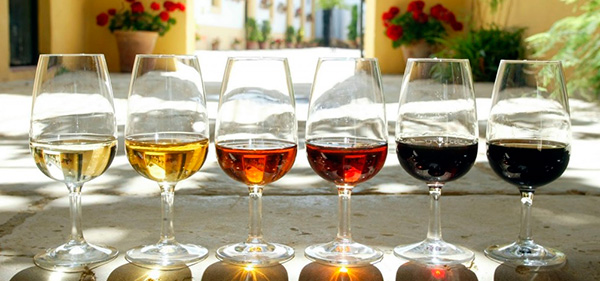
Fino on the left, to Pedro Ximenez on the right

Here are the official styles of sherry, ranked in order of sweetness (in general terms):

Fino ('Feen-oh'): The driest sherry style, produced primarily from Palomino grapes. Bottled at a younger age and lower alcohol to the other styles, and it can only be stored for around a week with refrigeration, once opened. Not often used for whisky maturation, but one example of an ex-Fino sherry cask matured whisky is Oban distiller's edition.

Manzanilla ('Man-zan-ee-ya'): Very similar to Fino but produced in a particular area of Andalusia (in Spain). In this coastal area the flor yeast cap becomes thicker than it would have further inland, affording the wine better protection from oxygen. This results in a paler colour and fresher, lighter, even saline and chamomile flavours in the sherry. Manzanilla has a similar shelf life to Fino, lasting around a week with refrigeration, once opened. One example of an ex-Manzanilla sherry cask matured/finished whisky is Ardbeg Ardbog.

Amontillado ('Ah-mont-ee-yard-oh'): A half-way point between a Fino and an Oloroso, and produced when the flor cap either does not form adequately, or is intentionally killed off during fermentation, whether by fortification (to a certain level of alcohol) or lack of replenishment. This allows slow oxidisation, creating a darker and richer sherry than a Fino or Manzanilla. An Amontillado Lasts up to two weeks with refrigeration, once opened. Another sherry not commonly used for whisky maturation, one example of an ex-Amontillado sherry cask matured/finished whisky is Laphroaig Cairdeas 2014.

Palo Cortado ('Pale-oh-court-ah-dough'): Another half-way point between Fino and Oloroso, but closer to an Oloroso in flavour, being richer and slightly less dry than an Amontillado. Produced when the flor dies off naturally and without apparent cause. A Palo Cortado then begins ageing like an Oloroso (with higher oxygen contact). The only ex-Palo Cortado cask matured/finished whisky I know of is Glengoyne 17 year old.

Oloroso ('Oll-or-oh-so'): The most popular style of sherry, it's dark coloured, with rich fruity and nutty flavours, but remains quite dry. Due to it being aged by oxidisation, and being matured for considerable lengths of time, Oloroso sherry remains stable for quite some time, lasting up to 8 weeks with refrigeration, after opening. The most common cask used for whisky maturation, with a couple of prime examples being Glendronach (review coming soon!) and Glenfarclas, both of which are wholly matured in ex-Oloroso sherry casks.

Pedro Ximenex ('Pay-dro heem-in-eth'), aka PX: The sweetest 'natural' sherry, here the grapes are sun-dried (aka 'raisin-ified') to concentrate the flavours and sweetness. Fruity (mainly raisin) and sweet (molasses or syrup) in taste, very dark in colour and viscous in texture, PX sherry makes for a fantastic dessert wine. Older (30+ years) PX sherries become less sweet and more complex as age increases. A couple of examples of ex-PX sherry cask finished whiskies (and excellent whiskies in their own right) are Lagavulin distiller's edition (review coming soon!), and Laphroaig PX cask.

Moscatel ('Mosk-a-tell'): Similar in style to PX sherry, Moscatel is another dessert wine, made from Moscatel grapes, dried to concentrate the flavours and sugars, resulting in more stone fruit and caramel flavours, and a lighter colour. One example of an ex-Moscatel cask finished whisky is Caol Ila distiller's edition.

Cream sherry ('You-can-work-that-one-out!'): Basically a very sweet blended dessert wine, usually Oloroso sherry sweetened with Pedro Ximinez sherry, or even syrup. There are a number of other names used, but all fall under the cream sherry banner, usually because they contain a blend of different sherry varieties. Harvey's Bristol Cream is a good example, being one of the more famous, and top selling, sherries in the world. Cream sherry casks are not used for whisky maturation, at least to my knowledge.

So let's taste some sherry!

I've chosen three styles of sherry for a quick tasting, all from the same genuine Spanish producer, Barbadillo, to keep some consistency. It's important to note also that only wine produced in Spain can be named Sherry, in the same way that sparkling wine produced outside of France cannot be named Champagne. The stamp pictured below is the mark found on the label of genuine Spanish sherry.


I've also added some notes on food matching with the three sherries I tasted, enjoyed with tapas / snack / finger foods.

There are plenty of other sherry brands out there, I went for Barbadillo because it was easily accessible, had a good range, and was reasonably priced. I've chosen a Manzanilla, an Oloroso, and a Pedro Ximenez, all of which are good value, being around AUD $10 each for the Manzanilla and PX in 375mL, and around AUD $17 for the Oloroso in 700mL. No doubt they're even cheaper in the US or EU.

Barbadillo Manzanilla: Pale in colour and very dry, even salty. Fruity and clean, but I'll be honest and say this was too close to a regular dry wine for my tastes. Manzanilla is very close to a Fino, so I imagine a Fino would be similar in flavour. It didn't really float my boat, so to speak. Matches well with nuts and olives.

Barbadillo Oloroso: Lovely reddish-brown colour, viscous and rich in texture. Dry, but lovely raisin and stone fruit flavours, far more complex than the Manzanilla. Definitely recognisable after tasting an Oloroso-finished whisky. Works very well with cheddar and blue cheeses, pate, and cured meats.

Barbadillo Pedro Ximenez: Very dark brown colour, richer and thicker in texture, luscious. Sweet, but not overwhelming, a natural, light, fruity sweetness. Raisin and sultana notes, with some christmas cake and spice. Works well with strong cheddar or blue cheese, and fruit mince pies, or any savoury pastry I imagine. My pick of the bunch, especially as a dessert wine.


So, should I bother trying sherry? 

I think so! This was an interesting exercise, and certainly helped with picking the sherry influence in an ex-sherry cask matured or finished whisky. The flavours of the Oloroso and PX sherries in particular work very well with whisky, adding a great depth of flavour, and the colour isn't bad either, especially when it's left 'au naturel'!

For further 'reading', try tasting an ex-bourbon cask matured whisky alongside an Oloroso sherry (I chose Glenlivet Nadurra 16yo), and a heavily-peated ex-bourbon cask matured whisky alongside a PX sherry (I chose Laphroaig Quarter Cask). They may not be a perfect match, but it's fun to try, and an excuse to drink more whisky! Speaking of which, here are my top 10 (so far) 'sherry monster' ex-sherry matured whiskies, to keep an eye out for:

My top 10 sherry cask matured / finished whiskies!

Un-peated
Glendronach 15yo 'revival' (100% Oloroso matured, review coming soon)
Glenlivet Nadurra Oloroso (100% Oloroso matured, duty free exclusive, but a cask strength version is coming, and so is my review!)
Glenfarclas 15yo (100% Oloroso matured)
Aberlour A'Bunadh (100% Oloroso matured)

Peated
Ardbeg Uigeadail (Mix of ex-bourbon & undisclosed ex-sherry-not to be missed! Review coming soon)
Laphroaig PX (PX finished, duty free exclusive for the moment) see review
Lagavulin Distiller's Edition (PX finished, review coming soon)
Ardbeg Ardbog (Manzanilla finished) see review
Talisker Distiller's Edition ('Amoroso' sweetened Oloroso finished) see review
Caol Ila Distiller's Edition (Moscatel finished)

So next time you're looking for something different, or want to expand your horizons, whisky or otherwise, take a look at sherry. Just please don't use it for cooking.

Cheers!

Monday, 5 January 2015

Highland Park Dark Origins Whisky Review!

Not to start off on a negative note, but I am not the biggest Highland Park fan. I usually find their whiskies too sweet and light, lacking in peat and punch, usually chill filtered, and usually bottled at only 40 or 43%. Admittedly I've not tried their 25 year old (and older) or NAS (Non-Age Statement) bottlings, of which there are quite a few.

The Highland Park distillery is an interesting one, being located in the Orkney Islands (not in the Highlands, regardless of the name), it is the Northern-most distillery in Scotland. They use local peat, apparently to a level of around 20ppm, which is rather different from most other sources, and they malt their own barley using the traditional floor-malting method. Top marks there.

With the above in mind, I was looking forward to trying this 'Dark Origins' bottling. They seem to have taken a much more craft-friendly approach with this recent addition, being bottled at 46.3%, being non-chill filtered, and apparently being without added colouring. The only not-so-good move, in my book, was to add this one to the growing Non-Age Statement (NAS) sector. It may be relatively young, but that's nothing to be ashamed of!

The Dark Origins bottling, according to the distillery, has been matured in double the amount of sherry casks in comparison to their standard 12yo. Not very revealing is it? Nevertheless, this is the main reason for the name, with the sherry casks giving a darker colour and deeper flavour. Let's have a closer look...


Highland Park Dark Origins, NAS, 46.8%, Orkney Islands, Scotland.
Non-chill filtered, no added colouring, matured in 'double the usual amount of' ex-sherry casks.

(tasted neat)
Colour: Medium bronze.

Nose: Nice dry & rich sherry, quite salty, I'm guessing first fill dry Oloroso sherry casks, or perhaps Amontillado. Toasted and spiced dried fruits. Not getting any real peat or smoke on the nose though.  

Texture: Dry and viscous, thanks for not chill filtering!

Taste: Dry & peaty, more heathery/herbaceous peat, not medicinal, and some dark chocolate. Less salty than on the nose, but much more yummy peat, also less sherry presence than on the nose, but it's there, lovely and dry. No alcohol heat to speak of, a good indicator of good quality, and good maturation.  

Finish: Short-to-medium length, mouth-watering and dry, spicy and peaty, then some dark chocolate bitterness, and light smoke at the end. 

Score: 3.5 out of 5.

Notes: Certainly my favourite Highland Park from those I've tried. Much better than even the more expensive 18yo. It seems to be priced above the 15yo and slightly below the 18, which is about right in my book. The NAS (Non-Age Statement) shadow lurks overhead, meaning you can't quite be sure if it's a fair price or not, but this is becoming unavoidable in the world of whisky. 

Nevertheless, Highland Park Dark Origins passes with ease, and has bumped this distillery up in my head. Unfortunately it's becoming harder to find in Australia, but is still on shelves around the world, and is well worth trying.

How about a more heavily-peated bottling HP? Perhaps with a similar maturation treatment to this one. Pretty please...

Cheers!
P.S On further reading after the review, HP's own website states they use dry Oloroso sherry casks. Win!

Cadenhead's Glen Elgin 23 Year Old Whisky Review!

A 23-year old cask strength independent bottling from one of Diageo's unsung and oft-forgotten workhorse distilleries. One that shouldn...