An Italian whisky! This is a first for me, and something tells me it's going to be an interesting one...
Puni Distillery is the only whisky distillery in Italy, located near the Swiss border in the Italian alpine region in the far north of the country, around four hour's drive north-east of Milan. This family-owned distillery is named after the nearby Puni River, and is housed in the very modern cube-shaped building pictured above (no whitewashed stone here!), which was built in 2010 with production commencing in 2012. But there seem to be a few points of difference in the whisky itself that are a little different from the norm. Puni's whisky is made from a mix of malted barley, malted rye and malted wheat. Yes, rye and wheat can also be malted, but the addition of these two other grains (whether malted or 'green') make this a grain whisky, not a malt whisky, by the Scottish regulations. Italy is not in Scotland of course, and the European Union whisky regulations only state that whisky must be "made from malted cereal grains, with or without whole grains of other cereals" which is very vague, and there is no provision for terms like single malt, malt whisky or grain whisky in their definitions. Puni have chosen to call their product "Italian Malt Whisky", which is obviously fine by the EU definitions, and all of the grain used has been malted, so it does make sense.
The majority of the EU whisky definitions do match those of the Scotch Whisky Association, including the minimum 3 year age and 40% ABV bottling strength, the maximum 94.8% ABV distillation strength and 700-litre cask size, and E150a caramel colouring being the only permitted additive. But those casks are only required to be "wooden", oak is not specified like it is in Scotland and the United States. Many countries around the world have ambiguities like this - and often more - in their definitions and regulations, including Australia & Japan. But many of the quality international producers do choose to follow the Scotch whisky regulations, and it'd be nice to get everyone on a more even playing field, wouldn't it? There's no questioning the massive effect that the use of different grains make to a whisky, with spirits predominantly distilled from rye, wheat, corn and barley being markedly different from one another. I must admit the use of different wood types for whisky maturation would be an interesting thing to explore, and a few "new world" distilleries have started doing just that. But there are already hundreds of different oak species out there, so there's already plenty of room for more exploration and experimentation in that area than seems to be happening at the moment.
Back to the subject at hand. Two of those three different malted grains, the rye and wheat, are sourced locally from northern Italy, while the barley is apparently imported from nearby Austria. The local South Tyrol region was actually part of Austria prior to World War II, to the point where the majority of the population have Austrian names and speak a mix of Italian and Austrian. Aside from the grains used production at Puni is otherwise traditional, being mashed on-site, using wooden washbacks for fermentation and being double distilled in Scottish-built copper pot stills that were built & installed by Forsyths in Speyside. Puni use a number of different cask types for maturation, from virgin oak and ex-bourbon to Marsala and Pinot wine, to PX sherry and refill ex-Islay whisky casks, and some of those casks are actually matured underground in re-purposed WWII-era bunkers. The distillery also benefits from the wide variances in the local climate, from warm temperatures in the mid-twenties in summer to below freezing in winter, which helps give the maturating casks a hurry-up.
The Puni expression we're looking at today is Nero (Italian for "black"), which refers to this whisky being matured in casks that previously held Pinot Nero red wine, which is the Italian term for Pinot Noir, sourced from local wineries. This expression did win the World Whiskies Award for best Italian single malt in 2017, but let's remember that there is only one Italian whisky distillery, and by the most widely-accepted definition of the term this isn't exactly single malt, so let's not get too caught up in that. This sort of situation does highlight the frivolity of some of these international whisky awards, particularly when they're very effective marketing exercises for the entrants and subsequently the awards themselves. Puni Nero is an age-stated (which should be commended) 3-year old whisky bottled at 43% ABV, and is non-chill filtered and naturally coloured. This is the 2016 bottling which is still readily available in Australia for around $140 AUD, with only 3000 bottles released. Let's give it a go...
Puni Nero, 3-years old, 43%. Glorenza, Italy.
Distilled from malted barley, malted rye & malted wheat. Matured in local ex-Pinot Nero (Italian Pinot Noir) casks. 2016 release, 3,000 bottles. Non-chill filtered, natural colour.
Colour: Amber.
Nose: Light & fruity, quite wine (grape) forward to start with. Musty, gamy red grapes, a little mint, some dry herbal honey and light toasted oak. Touch of coconut around the edges. Spicy grain and dark chocolate with more breathing time.
Texture: Light-medium weight, but lightly flavoured. Slight touch of heat on the back end.
Taste: Spicy, quite rye forward here. Toasted grain and a little yeasty rye bread. More gamy and musty red grapes, but much lighter here than it was on the nose. A little powdery dark chocolate as well.
Finish: Short & light. Flashes of coconut and chocolate again, but the rye spices are still the main player. Fades quite quickly with a little musty grape and a touch of prickly heat on the tongue.
Score: 2.5 out of 5.
Notes: A pleasant drop, night and light and fruity, with a refreshing spice to it. And that's coming from someone who doesn't exactly love grain whisky in most cases. I wonder what proportion of each grain were used in this one? This Puni would make for a good summer's day dram I'd say, and it'll be to the liking of fans of spicy red wines as well. It's a little unfamiliar to the malt drinker, but that's not a criticism. Variety is the spice of life, after all.
Overall it's a good showing from a young and very "new world" distillery, and it's well worth a shot when you're looking for something a little lighter and a little refreshing.
Cheers!
Sunday, 24 February 2019
Sunday, 17 February 2019
Tobermory Bordeaux Cask 2008 Whisky Review!
A hand-filled 200ml cask sample, exclusively sold from the distillery shop. So it may not be easy to find, but it's well worth the trip...
The Isle of Mull is a short 30-minute ferry ride from the town of Oban on Scotland's west coast, itself a 3.5-hour drive from Edinburgh. Don't believe Google or your Sat Nav on that trip either, driving in the Highlands is not as easy as it looks on a map! Particularly if you leave your departure a little late and end up spending the latter third of the trip driving in darkness and heavy rain like I did. But it's a beautiful part of the world, and there's plenty to see on the way, particularly if you travel north via Falkirk and Stirling, and you could also take a detour to Glen Coe which looks absolutely incredible. Mull itself is quite large, larger than Islay to the south, and the ferry from Oban doesn't stop at the island's main town of Tobermory, only at Craignure which is around 40 minute's drive away. The attractive little town of Tobermory itself has plenty to offer as well, but let's be honest here, we're mainly interested in the fact that it's home to Mull's only distillery!
Tobermory Distillery sits on the right-hand side of the islands main road as you enter the namesake town, which is an area named Ledaig (pronounced "leh-chaig"), facing the main harbour and its iconic multi-coloured buildings. The distillery was actually named Ledaig up until 1979, and had a tumultuous past until it was purchased by Burn Stewart Distillers in 1993, now owned by South African company Distell. The distillery has just returned to production after a two year shut down for major upgrades to the "visitor experience" and major maintenance which included completely replacing their four stills and four wooden washbacks. My visit last year was in the midst of that shut down, but they were still open for tours and sales and have been releasing new limited edition bottlings from their existing stocks, including a few distillery exclusive bottlings that are well worth a look if you're over that way. Tobermory and sister distilleries Bunnahabhain and Deanston seem to be well aware of the value of rewarding their visitors with interesting expressions of their whiskies, and those whiskies are often quite reasonably priced, which is great to see.
I usually prefer Tobermory's peated bottlings, which are bottled as Ledaig, over the unpeated Tobermory whisky. Particularly at cask strength when it's spent some time in a sherry cask. But during my visit to the distillery I was particularly impressed with two Tobermory whiskies, a 17-year old Madeira finish bottling, and the very interesting 200ml cask sample that we're looking at here. During my visit there was a choice of two of these hand-filled cask strength bottlings, an excellent 14-year old Oloroso sherry-matured Ledaig, and this Bordeaux wine-matured Tobermory. They were selling for 30- and 25-pounds respectively, which may sound expensive for nondescript 200ml bottles, but considering the rarity, exclusivity and quality of these whiskies it's not unreasonable. As good as the full-sized offerings were, particularly that Madeira finish, it was these two hand-filled offerings that promptly stole my attention and took my money. And as usual, I already know that I should've bought two. The Tobermory example that we're looking at today is a 10-year old whisky, distilled in 2008, that has been fully matured in a single red wine cask from the Bordeaux region of Southern France. Unfortunately there's no information on oak type, cask number or number of bottles, in fact these little beauties seem to have a similar approach to Cadenheads' cask samples a.k.a 'cage bottles' in that there're absolutely no frills to be seen! This one was bottled at an impressive cask strength of 62% ABV, and is non-chill filtered and naturally coloured since Tobermory and her sister distilleries don't muck around with that sort of thing anymore. Let's get to it!
Colour: Deep bronze with a few tiny bits of barrel char as a bonus. Awesome!
Nose: Takes a while to relax and open up, but it's well worth the wait. Loads of sweet stewed fruit and berries: strawberry, green (under-ripe) pineapple, guava, raspberry and a little plum. Mild roasted nuts, sweet buttery pastry and golden syrup, like a warm pecan pie. A touch of brine with more time, plus black pepper and juicy charred oak. Fantastic.
Texture: Medium weight, warming and a little astringent with a touch of heat (it's 62%, remember!).
Taste: Lots of fruit again, but considerably less sweet than it was on the nose. More black pepper and a touch of light bitterness, like burnt toffee. Some light tannins as well, but in an enjoyable way (and I'm usually not a fan). A hint of plain (natural-flavour) bubblegum, more pineapple and stewed red berries.
Finish: Long. Very peppery here, and astringent again with a slight zing of chilli thrown in. Some more tannins and a hint of spent coffee grounds, more pastry and burnt toffee. The fruit returns further on, particularly that tasty pineapple note which is now more syrupy.
Score: 3.5 out of 5.
Notes: The nose is just fantastic on this one, once it opens up anyway, and when it does there's so much to explore! The palate is great as well with plenty of complexity, but the finish is a little disappointing after what came before it. It's a little too peppery and drying there, although not in a harsh or rough way, and not only from the high ABV. That pineapple note in this dram is really enjoyable, going from sour under-ripe fruit to naturally flavoured sweet syrup, like you'd find in a high-end ice block / popsicle. The wine cask has definitely had an effect as well, but rather than overwhelm anything else (although the pepper wasn't shy) it's well integrative and has added loads of depth to the whole experience.
A really enjoyable whisky that is just held back by the finish, and it's totally different to any Tobermory I've tasted before, which makes for the ideal distillery exclusive bottling. If you do manage to come across this one, it's well worth a go. And it's a great liquid souvenir from the little Isle of Mull over on the other side of the planet.
Cheers!
The Isle of Mull is a short 30-minute ferry ride from the town of Oban on Scotland's west coast, itself a 3.5-hour drive from Edinburgh. Don't believe Google or your Sat Nav on that trip either, driving in the Highlands is not as easy as it looks on a map! Particularly if you leave your departure a little late and end up spending the latter third of the trip driving in darkness and heavy rain like I did. But it's a beautiful part of the world, and there's plenty to see on the way, particularly if you travel north via Falkirk and Stirling, and you could also take a detour to Glen Coe which looks absolutely incredible. Mull itself is quite large, larger than Islay to the south, and the ferry from Oban doesn't stop at the island's main town of Tobermory, only at Craignure which is around 40 minute's drive away. The attractive little town of Tobermory itself has plenty to offer as well, but let's be honest here, we're mainly interested in the fact that it's home to Mull's only distillery!
Tobermory Distillery sits on the right-hand side of the islands main road as you enter the namesake town, which is an area named Ledaig (pronounced "leh-chaig"), facing the main harbour and its iconic multi-coloured buildings. The distillery was actually named Ledaig up until 1979, and had a tumultuous past until it was purchased by Burn Stewart Distillers in 1993, now owned by South African company Distell. The distillery has just returned to production after a two year shut down for major upgrades to the "visitor experience" and major maintenance which included completely replacing their four stills and four wooden washbacks. My visit last year was in the midst of that shut down, but they were still open for tours and sales and have been releasing new limited edition bottlings from their existing stocks, including a few distillery exclusive bottlings that are well worth a look if you're over that way. Tobermory and sister distilleries Bunnahabhain and Deanston seem to be well aware of the value of rewarding their visitors with interesting expressions of their whiskies, and those whiskies are often quite reasonably priced, which is great to see.
I usually prefer Tobermory's peated bottlings, which are bottled as Ledaig, over the unpeated Tobermory whisky. Particularly at cask strength when it's spent some time in a sherry cask. But during my visit to the distillery I was particularly impressed with two Tobermory whiskies, a 17-year old Madeira finish bottling, and the very interesting 200ml cask sample that we're looking at here. During my visit there was a choice of two of these hand-filled cask strength bottlings, an excellent 14-year old Oloroso sherry-matured Ledaig, and this Bordeaux wine-matured Tobermory. They were selling for 30- and 25-pounds respectively, which may sound expensive for nondescript 200ml bottles, but considering the rarity, exclusivity and quality of these whiskies it's not unreasonable. As good as the full-sized offerings were, particularly that Madeira finish, it was these two hand-filled offerings that promptly stole my attention and took my money. And as usual, I already know that I should've bought two. The Tobermory example that we're looking at today is a 10-year old whisky, distilled in 2008, that has been fully matured in a single red wine cask from the Bordeaux region of Southern France. Unfortunately there's no information on oak type, cask number or number of bottles, in fact these little beauties seem to have a similar approach to Cadenheads' cask samples a.k.a 'cage bottles' in that there're absolutely no frills to be seen! This one was bottled at an impressive cask strength of 62% ABV, and is non-chill filtered and naturally coloured since Tobermory and her sister distilleries don't muck around with that sort of thing anymore. Let's get to it!
(apologies for the photo)
Tobermory 2008 Bordeaux cask, 10-year old, 62%. Isle of Mull, Scotland.
Distillery exclusive hand-filled 200ml cask sample, fully matured in a single Bordeaux red wine cask. Non-chill filtered, natural colour.
Colour: Deep bronze with a few tiny bits of barrel char as a bonus. Awesome!
Nose: Takes a while to relax and open up, but it's well worth the wait. Loads of sweet stewed fruit and berries: strawberry, green (under-ripe) pineapple, guava, raspberry and a little plum. Mild roasted nuts, sweet buttery pastry and golden syrup, like a warm pecan pie. A touch of brine with more time, plus black pepper and juicy charred oak. Fantastic.
Texture: Medium weight, warming and a little astringent with a touch of heat (it's 62%, remember!).
Taste: Lots of fruit again, but considerably less sweet than it was on the nose. More black pepper and a touch of light bitterness, like burnt toffee. Some light tannins as well, but in an enjoyable way (and I'm usually not a fan). A hint of plain (natural-flavour) bubblegum, more pineapple and stewed red berries.
Finish: Long. Very peppery here, and astringent again with a slight zing of chilli thrown in. Some more tannins and a hint of spent coffee grounds, more pastry and burnt toffee. The fruit returns further on, particularly that tasty pineapple note which is now more syrupy.
Score: 3.5 out of 5.
Notes: The nose is just fantastic on this one, once it opens up anyway, and when it does there's so much to explore! The palate is great as well with plenty of complexity, but the finish is a little disappointing after what came before it. It's a little too peppery and drying there, although not in a harsh or rough way, and not only from the high ABV. That pineapple note in this dram is really enjoyable, going from sour under-ripe fruit to naturally flavoured sweet syrup, like you'd find in a high-end ice block / popsicle. The wine cask has definitely had an effect as well, but rather than overwhelm anything else (although the pepper wasn't shy) it's well integrative and has added loads of depth to the whole experience.
A really enjoyable whisky that is just held back by the finish, and it's totally different to any Tobermory I've tasted before, which makes for the ideal distillery exclusive bottling. If you do manage to come across this one, it's well worth a go. And it's a great liquid souvenir from the little Isle of Mull over on the other side of the planet.
Cheers!
Sunday, 10 February 2019
Octomore 8.1 Whisky Review!
Since the final bottling of the Octomore 9-series was just released overseas, it's about time I reviewed 8.1 from the previous series. And it just happens to be one of my favourite _.1 Octomores to date!
Those 9-series bottlings will still be at least a few months away from Australian shores, but all is not lost for Aussie Octomore fans, there are still plenty of the excellent 8-series "Masterclass" bottlings around. Including quite a few of the ridiculously good 309ppm 8.3 Islay Barley (reviewed here)! Which is a real surprise to me, I would've thought that glorious whisky would have flown off the shelves in the blink of an eye! If you're still after one of those I suggest you move quickly, and don't be afraid to shop around. From one Octomore fan to another it's not one you're going to want to miss.
That said, you're probably not going to want to miss this one either, because Octomore 8.1 is my second-favourite _.1 release to date, bettered only by the beastly and long-departed 5.1. 8.1 is still readily available from a number of Australian sellers at reasonable prices, although at $200-210 it's more expensive than previous _.1 releases have been. But that's understandable when you consider that it's 8-years old, as are the travel exclusive wine-matured 8.2 and partly-virgin oak matured 8.4 in the series, whereas the vast majority of other Octomore releases are 5-years old. Older Octomores can be utterly fantastic, with the incredible OBA and 2016's 10-year old Second Release being great examples. That extra age has definitely made a big difference to these 8-series whiskies, they're quite refined and disarming for Octomores, and even at their high strengths and peat levels all are remarkably easy to drink (but so is the 5-year old 8.3). Speaking of peat levels, with the exception of the aforementioned 8.3 the 8-series is 'down' to 167 ppm, which in reality is still a very high number. But as we've covered before that figure doesn't tell the full story since that measurement comes from the malted barley itself which is then milled, mashed, fermented, distilled and matured for years prior to bottling. Bruichladdich's tall stills, slow distillation and narrow spirit cuts will also have a huge effect on the finished product, as will the extra three years that Octomore 8.1 has spent in first-fill casks. So this probably isn't going to be the big beastie that you'd expect if you're only looking at the numbers.
While the more adventurous releases in each series always get more attention, the ex-bourbon cask-only _.1 Octomores are always the purest and clearest way to explore the Octomore spirit itself, since there are no fancy exotic cask influences getting in the way. They're always the lowest priced and most accessible bottling in each series, so they're ideal for newly reborn peat-heads to dip their toes in the (very peaty) water before jumping in head first. And this one is the ideal example of that. Octomore 8.1 was distilled in 2008 from Scottish barley, peated to 167 ppm at Bairds Maltings in Inverness, and spent eight years in first-fill bourbon casks from five different bourbon distilleries: Clermont Springs, Buffalo Trace, Jack Daniels, Four Roses and Heaven Hill. It was bottled at 59.3% ABV without any chill filtration or added colouring, since Bruichladdich don't go anywhere near that nonsense. And we certainly love them for it!
Octomore 8.1, 8-years old, 59.3%. Bruichladdich Distillery, Islay, Scotland.
Distilled from Scottish barley peated to 167 ppm, aged in first-fill ex-bourbon casks. Non-chill filtered, natural colour. 42,000 bottles.
Colour: Full gold.
Nose: Sweet, salty and slightly muddy. A big pile of drying kelp on a stony beach, with some chilled vanilla custard, a little sweetened lemon juice and black pepper. Distant bonfire smoke, and a little salt-washed driftwood. A floral sweetness and lovely dry, earthy peat with more breathing time.
Texture: Lovely. Medium weight, oily and peaty. Slight heat on the back, but in a pleasant way.
Taste: Sweet on entry like a stone fruit syrup, and some vanilla paste before the big earthy, muddy peat comes to the fore. A pinch of dry chilli flakes, a drop of floral honey and black pepper, and some vanilla fudge behind the peat.
Finish: Long. The muddy earthy peat carries through, as does the chilli flakes and black pepper. Then the peat dries out, with some smoked sea salt and a little ginger alongside. Some vanilla custard and more stone fruit syrup, and some drying ashy smoke and wet stone behind the sweetness.
Score: 4 out of 5.
Notes: Very, very good! It may not be the most "out there" or exotic Octomore around, but there's absolutely no shortage of character or flavour and it's very good at what it does. It's very Islay, with some extra earthy peat of course, and it's surprisingly refined and alluring for an Octomore. And there are no off-notes to speak of, it's just pure peat & sweet Islay sexy-ness from start to finish!
This would definitely make for a good introductory Octomore, but any established Islay fan is going to love it as well. Yours truly included. Definitely my second favourite _.1 to date, since that beastly 5.1 holds a special place in my heart as the Octomore that got me hooked on Octomore (talk about jumping into the deep end!). But the extra three years on this 8.1 has worked wonders if you ask me, and I'd say this is actually an Octomore that you can keep going back to, it's not going to wipe out your senses for the rest of the night. Maybe even a "session-able" Octomore! Well done Bruichladdich, as always.
Cheers!
Those 9-series bottlings will still be at least a few months away from Australian shores, but all is not lost for Aussie Octomore fans, there are still plenty of the excellent 8-series "Masterclass" bottlings around. Including quite a few of the ridiculously good 309ppm 8.3 Islay Barley (reviewed here)! Which is a real surprise to me, I would've thought that glorious whisky would have flown off the shelves in the blink of an eye! If you're still after one of those I suggest you move quickly, and don't be afraid to shop around. From one Octomore fan to another it's not one you're going to want to miss.
That said, you're probably not going to want to miss this one either, because Octomore 8.1 is my second-favourite _.1 release to date, bettered only by the beastly and long-departed 5.1. 8.1 is still readily available from a number of Australian sellers at reasonable prices, although at $200-210 it's more expensive than previous _.1 releases have been. But that's understandable when you consider that it's 8-years old, as are the travel exclusive wine-matured 8.2 and partly-virgin oak matured 8.4 in the series, whereas the vast majority of other Octomore releases are 5-years old. Older Octomores can be utterly fantastic, with the incredible OBA and 2016's 10-year old Second Release being great examples. That extra age has definitely made a big difference to these 8-series whiskies, they're quite refined and disarming for Octomores, and even at their high strengths and peat levels all are remarkably easy to drink (but so is the 5-year old 8.3). Speaking of peat levels, with the exception of the aforementioned 8.3 the 8-series is 'down' to 167 ppm, which in reality is still a very high number. But as we've covered before that figure doesn't tell the full story since that measurement comes from the malted barley itself which is then milled, mashed, fermented, distilled and matured for years prior to bottling. Bruichladdich's tall stills, slow distillation and narrow spirit cuts will also have a huge effect on the finished product, as will the extra three years that Octomore 8.1 has spent in first-fill casks. So this probably isn't going to be the big beastie that you'd expect if you're only looking at the numbers.
While the more adventurous releases in each series always get more attention, the ex-bourbon cask-only _.1 Octomores are always the purest and clearest way to explore the Octomore spirit itself, since there are no fancy exotic cask influences getting in the way. They're always the lowest priced and most accessible bottling in each series, so they're ideal for newly reborn peat-heads to dip their toes in the (very peaty) water before jumping in head first. And this one is the ideal example of that. Octomore 8.1 was distilled in 2008 from Scottish barley, peated to 167 ppm at Bairds Maltings in Inverness, and spent eight years in first-fill bourbon casks from five different bourbon distilleries: Clermont Springs, Buffalo Trace, Jack Daniels, Four Roses and Heaven Hill. It was bottled at 59.3% ABV without any chill filtration or added colouring, since Bruichladdich don't go anywhere near that nonsense. And we certainly love them for it!
Octomore 8.1, 8-years old, 59.3%. Bruichladdich Distillery, Islay, Scotland.
Distilled from Scottish barley peated to 167 ppm, aged in first-fill ex-bourbon casks. Non-chill filtered, natural colour. 42,000 bottles.
Colour: Full gold.
Nose: Sweet, salty and slightly muddy. A big pile of drying kelp on a stony beach, with some chilled vanilla custard, a little sweetened lemon juice and black pepper. Distant bonfire smoke, and a little salt-washed driftwood. A floral sweetness and lovely dry, earthy peat with more breathing time.
Texture: Lovely. Medium weight, oily and peaty. Slight heat on the back, but in a pleasant way.
Taste: Sweet on entry like a stone fruit syrup, and some vanilla paste before the big earthy, muddy peat comes to the fore. A pinch of dry chilli flakes, a drop of floral honey and black pepper, and some vanilla fudge behind the peat.
Finish: Long. The muddy earthy peat carries through, as does the chilli flakes and black pepper. Then the peat dries out, with some smoked sea salt and a little ginger alongside. Some vanilla custard and more stone fruit syrup, and some drying ashy smoke and wet stone behind the sweetness.
Score: 4 out of 5.
Notes: Very, very good! It may not be the most "out there" or exotic Octomore around, but there's absolutely no shortage of character or flavour and it's very good at what it does. It's very Islay, with some extra earthy peat of course, and it's surprisingly refined and alluring for an Octomore. And there are no off-notes to speak of, it's just pure peat & sweet Islay sexy-ness from start to finish!
This would definitely make for a good introductory Octomore, but any established Islay fan is going to love it as well. Yours truly included. Definitely my second favourite _.1 to date, since that beastly 5.1 holds a special place in my heart as the Octomore that got me hooked on Octomore (talk about jumping into the deep end!). But the extra three years on this 8.1 has worked wonders if you ask me, and I'd say this is actually an Octomore that you can keep going back to, it's not going to wipe out your senses for the rest of the night. Maybe even a "session-able" Octomore! Well done Bruichladdich, as always.
Cheers!
Sunday, 3 February 2019
Craigellachie 13 Year Old Whisky Review!
My first Craigellachie review! In fact I've only tried one other example, and this is the first official bottling I've taken a close look at!
Craigellachie Distillery is located in the centre of the Speyside region, just up the road from Speyside Cooperage in the small village of Craigellachie. In fact the distillery sits right on the region's main road, with the still house and even the stills themselves easily visible from said road through the retractable glass doors, which are often left open. But visitors are not permitted inside the distillery and there's no visitor's centre, so that's as close as most of us will get. Although the village is home to both The Craigellachie Hotel and the famous Highlander Inn, so there's no shortage of whisky tastings in the vicinity. The name Craigellachie (pronounced "Cray-Gell-ack-ee") means "rocky hill", referring to the rocky bluff that the distillery & the namesake village sits on. It's a medium-sized distillery overall, with an annual production capacity of over four million litres of spirit, but that's actually quite small by Speyside standards, through two pairs of copper stills. Like many of the less-famous distilleries the majority of their production goes into blended whiskies, particularly the Dewars and White Horse brands. Originally founded in 1891, Craigellachie is owned by John Dewar & Sons, which itself is owned by Bacardi, having purchased Craigellachie and four other distilleries (Aberfeldy, Aultmore, MacDuff and Brackla) from United Distillers,a precursor to Diageo, in 1998.
Those four stills are quite large, with capacities of just over 28,000 litres a piece, and the wash & spirit stills are the same size, which is slightly unusual. You won't find any boil bulbs, onions or purifiers here, and you won't find any modern & efficient shell & tube condensers attached to their horizontal lyne arms. Craigellachie is one of the few modern distilleries to retain worm tub condensers! These large plain stills and their old-fashioned worm tub condensers have been designed to give minimal reflux and little copper contact, resulting in a weighty and (intentionally) sulphurous spirit. The un-peated barley is sourced from Glenesk maltings on the east coast, and is dried using an oil-fired heater, which is claimed to add sulphurous notes to the malt itself, to the point where Craigellachie is sometimes referred to as "the bad boy of Speyside". But we can expect those notes to diminish with time in casks, which could be why the youngest official bottling is 13-years old. Speaking of which, the vast majority of Craigellachie spirit is sent to Glasgow for maturation & bottling, partly since like many distilleries situated in the centres of villages or towns, physical space is at a premium.
The expression I'm looking at today is the entry-level Craigellachie, but unusually for an entry-level it's a 13-year old whisky which is bottled at 46% and is non-chill filtered, although I suspect there may be a little E150a artificial colouring involved. With those things considered it's quite reasonably priced, hovering around the $110-130 AUD mark. There's no information out there on the type of casks that were used for this one, so I'd assume it's mostly been matured in refill ex-bourbon casks. But what I don't particularly like is that Bacardi have been referring to their range of single malts, with Craigellachie among them, as "The Last Great Malts". Which is a huge steaming pile of you know what, particularly when it's being used for what were (and largely still are) almost completely unknown distilleries. Maybe I'm being a little sensitive here, but surely they could've found a better tagline to use in their marketing, because that one doesn't leave a pleasant taste in the mouth. How about "the last undiscovered malts" or "the hidden / forgotten gems of Speyside"? And I don't even work in marketing! That said however, I do like the classy and decidedly retro packaging that they've used on the Craigellachie range. Anyway, let's shake all that off and give this one a go...
Craigellachie 13-Year Old, 46%. Craigellachie, Scotland.
Presumed matured in refill ex-bourbon casks. Non-chill filtered, suspected light added colouring.
Colour: Yellow gold.
Nose: There's definitely a vegetal "twang" to it, and it's more dry and savoury than I was expecting, but there's still the typical Speyside notes of honey & apple, and a subtle malty-ness. Some dry wood spices (sandalwood?) and dusty oatmeal, and a little dried spearmint. A hint of tea tree oil with more time in the glass.
Texture: Medium weight, lightly oily. And more than just a vegetal "twang" here! A touch of heat as well.
Taste: That vegetal note straight off, like a newly opened bag of lightly salted potato chips (crisps) that have gone stale. That may not sound particularly appetizing, but it's enjoyable! Some savoury dry honey and a couple of beef stock cubes (meaty). Hint of that dried spearmint around the edges, lightly nutty oak as well.
Finish: Medium length. More spearmint, some green apple, a little white pepper and bitter burnt toffee. More dry wood spices again, and a little salted butter, but it's that vegetal sulphur note that carries on the longest.
Score: 3 out of 5.
Notes: An interesting dram! The nose was quite deceptive in that it gives a prediction of what you can expect to find on the palate, but that prediction falls way short! It's definitely more dry, meaty and savoury than I expected, but that's not a complaint, just a little surprising. In fact it's quite refreshing. There may not be a huge amount of depth to this expression, but let's not forget that this is the entry-level Craigellachie, so we can definitely forgive that. That sulphurous vegetal note may put off some newcomers, and I've found that it increased as the bottle breathed and oxidised, which is also interesting as it's the opposite of what I'd expect to happen. I'd probably put the overall level of sulphur on par with some ex-bourbon cask Mortlachs that I've tried, but the actual effect of that sulphur is quite different and perhaps less pungent in the Craigellachie. Which makes me want to try a sherry cask-matured expression!
There's definitely a sulphurous and lightly rough edge to this 13-year old Speysider, and it's definitely not what you'd typically expect from the region, which is great to see. Those regional flavours are certainly becoming less and less relevant as more distilleries branch out and/or come to light. And this one is certainly worth a try if you'd like a bit more of a challenge in your dram.
Cheers!
Craigellachie Distillery is located in the centre of the Speyside region, just up the road from Speyside Cooperage in the small village of Craigellachie. In fact the distillery sits right on the region's main road, with the still house and even the stills themselves easily visible from said road through the retractable glass doors, which are often left open. But visitors are not permitted inside the distillery and there's no visitor's centre, so that's as close as most of us will get. Although the village is home to both The Craigellachie Hotel and the famous Highlander Inn, so there's no shortage of whisky tastings in the vicinity. The name Craigellachie (pronounced "Cray-Gell-ack-ee") means "rocky hill", referring to the rocky bluff that the distillery & the namesake village sits on. It's a medium-sized distillery overall, with an annual production capacity of over four million litres of spirit, but that's actually quite small by Speyside standards, through two pairs of copper stills. Like many of the less-famous distilleries the majority of their production goes into blended whiskies, particularly the Dewars and White Horse brands. Originally founded in 1891, Craigellachie is owned by John Dewar & Sons, which itself is owned by Bacardi, having purchased Craigellachie and four other distilleries (Aberfeldy, Aultmore, MacDuff and Brackla) from United Distillers,a precursor to Diageo, in 1998.
Those four stills are quite large, with capacities of just over 28,000 litres a piece, and the wash & spirit stills are the same size, which is slightly unusual. You won't find any boil bulbs, onions or purifiers here, and you won't find any modern & efficient shell & tube condensers attached to their horizontal lyne arms. Craigellachie is one of the few modern distilleries to retain worm tub condensers! These large plain stills and their old-fashioned worm tub condensers have been designed to give minimal reflux and little copper contact, resulting in a weighty and (intentionally) sulphurous spirit. The un-peated barley is sourced from Glenesk maltings on the east coast, and is dried using an oil-fired heater, which is claimed to add sulphurous notes to the malt itself, to the point where Craigellachie is sometimes referred to as "the bad boy of Speyside". But we can expect those notes to diminish with time in casks, which could be why the youngest official bottling is 13-years old. Speaking of which, the vast majority of Craigellachie spirit is sent to Glasgow for maturation & bottling, partly since like many distilleries situated in the centres of villages or towns, physical space is at a premium.
The expression I'm looking at today is the entry-level Craigellachie, but unusually for an entry-level it's a 13-year old whisky which is bottled at 46% and is non-chill filtered, although I suspect there may be a little E150a artificial colouring involved. With those things considered it's quite reasonably priced, hovering around the $110-130 AUD mark. There's no information out there on the type of casks that were used for this one, so I'd assume it's mostly been matured in refill ex-bourbon casks. But what I don't particularly like is that Bacardi have been referring to their range of single malts, with Craigellachie among them, as "The Last Great Malts". Which is a huge steaming pile of you know what, particularly when it's being used for what were (and largely still are) almost completely unknown distilleries. Maybe I'm being a little sensitive here, but surely they could've found a better tagline to use in their marketing, because that one doesn't leave a pleasant taste in the mouth. How about "the last undiscovered malts" or "the hidden / forgotten gems of Speyside"? And I don't even work in marketing! That said however, I do like the classy and decidedly retro packaging that they've used on the Craigellachie range. Anyway, let's shake all that off and give this one a go...
Craigellachie 13-Year Old, 46%. Craigellachie, Scotland.
Presumed matured in refill ex-bourbon casks. Non-chill filtered, suspected light added colouring.
Colour: Yellow gold.
Nose: There's definitely a vegetal "twang" to it, and it's more dry and savoury than I was expecting, but there's still the typical Speyside notes of honey & apple, and a subtle malty-ness. Some dry wood spices (sandalwood?) and dusty oatmeal, and a little dried spearmint. A hint of tea tree oil with more time in the glass.
Texture: Medium weight, lightly oily. And more than just a vegetal "twang" here! A touch of heat as well.
Taste: That vegetal note straight off, like a newly opened bag of lightly salted potato chips (crisps) that have gone stale. That may not sound particularly appetizing, but it's enjoyable! Some savoury dry honey and a couple of beef stock cubes (meaty). Hint of that dried spearmint around the edges, lightly nutty oak as well.
Finish: Medium length. More spearmint, some green apple, a little white pepper and bitter burnt toffee. More dry wood spices again, and a little salted butter, but it's that vegetal sulphur note that carries on the longest.
Score: 3 out of 5.
Notes: An interesting dram! The nose was quite deceptive in that it gives a prediction of what you can expect to find on the palate, but that prediction falls way short! It's definitely more dry, meaty and savoury than I expected, but that's not a complaint, just a little surprising. In fact it's quite refreshing. There may not be a huge amount of depth to this expression, but let's not forget that this is the entry-level Craigellachie, so we can definitely forgive that. That sulphurous vegetal note may put off some newcomers, and I've found that it increased as the bottle breathed and oxidised, which is also interesting as it's the opposite of what I'd expect to happen. I'd probably put the overall level of sulphur on par with some ex-bourbon cask Mortlachs that I've tried, but the actual effect of that sulphur is quite different and perhaps less pungent in the Craigellachie. Which makes me want to try a sherry cask-matured expression!
There's definitely a sulphurous and lightly rough edge to this 13-year old Speysider, and it's definitely not what you'd typically expect from the region, which is great to see. Those regional flavours are certainly becoming less and less relevant as more distilleries branch out and/or come to light. And this one is certainly worth a try if you'd like a bit more of a challenge in your dram.
Cheers!
Saturday, 26 January 2019
Black Gate 620s Whisky Review!
A young Australian single malt whisky, with a huge ABV, from a tiny distillery in regional New South Wales that is quickly gaining a serious following. This should be good!
Black Gate Distillery was established back in 2009 by husband & wife team Brian & Genise Hollingworth, near the small town of Mendooran in central New South Wales, around five hour's drive north-west of Sydney. Brian & Genise are both very friendly and very humble people, and they definitely know what they're doing. The cult following that their spirits have garnered is testament to that. While they started off producing a range of different spirits while waiting for their whisky to mature, single malt whisky and aged rum are the current focus. The distillery itself is tiny, even by Australian standards, with an annual production of around 4,000 litres of spirit through two direct-fired (yes, direct-fired - see photo above!) copper pot stills, of 630-litres and 300-litres capacity respectively. The larger of the two was only added in 2017, so at the time of writing all bottled Black Gate single malt was made in the smaller still alone. Most pot stills are heated internally by steam coil, whereas these are externally heated using a gas flame under the base of the stills. And they certainly do make a big difference to the finished product, adding a slight charred or burnt note to the spirit that is very pleasant.
These whiskies are very young by international standards, with all releases to date being between two (the minimum age for whisky in Australia) and four years of age, but they're helped along by the local conditions, with massive variations in temperature, from below freezing in winter to over 40 degrees centigrade in summer, resulting in faster and more aggressive maturation. They're also given an extra shove by the use of smaller casks, predominantly of the Australian sherry (Apera) and port (Tawny) persuasions, although there are now also full-sized casks maturing at the distillery. The majority of Black Gate's whisky releases to date were distilled from unpeated or lightly-peated barley, sourced from Tasmania, Victoria and locally in New South Wales, but there have been a few heavily peated expressions released recently that used peated malted barley sourced from the UK. Which is great to see! Adding to their appeal is the fact that Black Gate do not chill filter or artificially colour any of their single malts, and their bottling strength doesn't go below 46% ABV. The personal touches also help, and many of Black Gate's direct customers receive a hand-written thank you card from Brian & Genise with their purchases. Which is incredible when you think about it, and it's not something I've ever seen before.
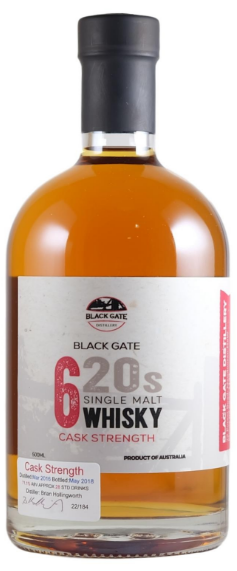
The expression I'm looking at today is Black Gate 620s, which is one of only a few cask strength releases to date. The whisky's name refers to this being a marriage of six re-coopered 20-litre casks, which were left to mature for just 2 years and 2 months, before being vatted together and bottled at a massive 71.1% ABV. If memory serves me correctly this is the third-highest ABV whisky that I've ever tasted, and the two that are in front, both Heartwoods at 72% and 73.5% respectively, were much older than this Black Gate, and were also matured in full-sized casks. So this should be interesting! 620s was distilled from lightly-peated malted barley in March 2016, and was bottled in May 2018 with a yield of just 184 individually numbered 500ml bottles, and as mentioned above no Black Gate whiskies are chill filtered or artificially coloured. It can still be found in specialist retailers for around $220 AUD. That may sound expensive for a 500ml bottle, but when you consider the extra cost of the 20-litre casks, the ridiculous amount of duty (and other taxes) that would have to be paid on a whisky of this strength in Australia, and the very limited nature of this bottling, it's very reasonable! Personally I don't mind the 500ml bottles that are becoming more widely-used in Australian whisky, since as a general rule it keeps the pricing at a more reasonable level, and it also helps with availability. Unfortunately there are plenty of Australian producers that are exceptions to that general rule, but that's certainly not the case with Black Gate. In fact when it comes to offering value for money in Australian single malt whiskies, they're among the contenders for the top prize.
Black Gate Distillery was established back in 2009 by husband & wife team Brian & Genise Hollingworth, near the small town of Mendooran in central New South Wales, around five hour's drive north-west of Sydney. Brian & Genise are both very friendly and very humble people, and they definitely know what they're doing. The cult following that their spirits have garnered is testament to that. While they started off producing a range of different spirits while waiting for their whisky to mature, single malt whisky and aged rum are the current focus. The distillery itself is tiny, even by Australian standards, with an annual production of around 4,000 litres of spirit through two direct-fired (yes, direct-fired - see photo above!) copper pot stills, of 630-litres and 300-litres capacity respectively. The larger of the two was only added in 2017, so at the time of writing all bottled Black Gate single malt was made in the smaller still alone. Most pot stills are heated internally by steam coil, whereas these are externally heated using a gas flame under the base of the stills. And they certainly do make a big difference to the finished product, adding a slight charred or burnt note to the spirit that is very pleasant.
These whiskies are very young by international standards, with all releases to date being between two (the minimum age for whisky in Australia) and four years of age, but they're helped along by the local conditions, with massive variations in temperature, from below freezing in winter to over 40 degrees centigrade in summer, resulting in faster and more aggressive maturation. They're also given an extra shove by the use of smaller casks, predominantly of the Australian sherry (Apera) and port (Tawny) persuasions, although there are now also full-sized casks maturing at the distillery. The majority of Black Gate's whisky releases to date were distilled from unpeated or lightly-peated barley, sourced from Tasmania, Victoria and locally in New South Wales, but there have been a few heavily peated expressions released recently that used peated malted barley sourced from the UK. Which is great to see! Adding to their appeal is the fact that Black Gate do not chill filter or artificially colour any of their single malts, and their bottling strength doesn't go below 46% ABV. The personal touches also help, and many of Black Gate's direct customers receive a hand-written thank you card from Brian & Genise with their purchases. Which is incredible when you think about it, and it's not something I've ever seen before.
The expression I'm looking at today is Black Gate 620s, which is one of only a few cask strength releases to date. The whisky's name refers to this being a marriage of six re-coopered 20-litre casks, which were left to mature for just 2 years and 2 months, before being vatted together and bottled at a massive 71.1% ABV. If memory serves me correctly this is the third-highest ABV whisky that I've ever tasted, and the two that are in front, both Heartwoods at 72% and 73.5% respectively, were much older than this Black Gate, and were also matured in full-sized casks. So this should be interesting! 620s was distilled from lightly-peated malted barley in March 2016, and was bottled in May 2018 with a yield of just 184 individually numbered 500ml bottles, and as mentioned above no Black Gate whiskies are chill filtered or artificially coloured. It can still be found in specialist retailers for around $220 AUD. That may sound expensive for a 500ml bottle, but when you consider the extra cost of the 20-litre casks, the ridiculous amount of duty (and other taxes) that would have to be paid on a whisky of this strength in Australia, and the very limited nature of this bottling, it's very reasonable! Personally I don't mind the 500ml bottles that are becoming more widely-used in Australian whisky, since as a general rule it keeps the pricing at a more reasonable level, and it also helps with availability. Unfortunately there are plenty of Australian producers that are exceptions to that general rule, but that's certainly not the case with Black Gate. In fact when it comes to offering value for money in Australian single malt whiskies, they're among the contenders for the top prize.
Image from oakbarrel.com.au
Black Gate 620s, 71.1% ABV cask strength. Mendooran, NSW, Australia.
Distilled March 2016, bottled May 2018, aged 2 years & 2 months. Vatting of six re-coopered 20-litre casks, yielded 184 500ml bottles. Non-chill filtered, natural colour.
Colour: Light copper.
Nose: It's a fire-y beast to start with, but it settles down quickly. Lots of dark lightly-burnt caramel and medium-dark chocolate, sweetened coconut, and a little dry toasted malt. A little dark rum-like, and there's still a bit of nose prickle to it, but for a 2-year old whisky at 71% that's to be expected! A little charred eucalyptus / gum forest and some thick vanilla paste with more breathing time.
Texture: Medium weight, rich & syrup-thick. Quite punchy with a bit of heat too, but again, that's to be expected.
Taste: Big hit of chilli chocolate, more lightly-burnt caramel and dry toasted malt. Some savoury / dry herbal honey, more thick vanilla paste and some thick stone fruit syrup.
Finish: Short-medium length. Toasted spices, more burnt caramel and sweetened coconut, and that stone fruit syrup and thick vanilla paste again. A little herbal and slightly vegetal, that eucalyptus / gum forest note coming through again. Something slightly lactic & slightly burnt towards the end as well, which is interesting.
Score: 3 out of 5.
Notes: This is a big intense whisky, and it's a little rough around the edges, but there's plenty to like! There's a lot of flavour, and it's very concentrated and condensed, and quite punchy of course. But for such a young whisky at such a high strength it's clearly very well made, and there's loads of character to explore. Even 20-litre casks couldn't completely hide bad spirit, and they definitely haven't had to here. It may not be the most complex whisky out there, and you'd hardly call it subtle, but for its age its very impressive, and high ABV fans will definitely enjoy it. That toasted malt & burnt caramel would have to be down to those direct-fired stills, which is a unique and very intriguing touch. That uniqueness and those interesting flavours do help Black Gate stand out from the pack, which is very important in the booming and fast-expanding Australian whisky industry.
This one probably would've benefited from a little water to be fair, but that's not how I do things for these reviews, so I waited until afterwards to try that. And a few drops did soften everything out without losing anything at all, and it boosted the sweetness and vanilla as well. Well worth trying! Brian & Genise are putting out great stuff down at Black Gate without following anyone's lead, and they're amassing a well-deserved following as a result. Keep up the good work guys!
Cheers!
This one probably would've benefited from a little water to be fair, but that's not how I do things for these reviews, so I waited until afterwards to try that. And a few drops did soften everything out without losing anything at all, and it boosted the sweetness and vanilla as well. Well worth trying! Brian & Genise are putting out great stuff down at Black Gate without following anyone's lead, and they're amassing a well-deserved following as a result. Keep up the good work guys!
Cheers!
Sunday, 20 January 2019
Two Kilchoman Machir Bay Cask Strength Whisky Reviews!
Yes, cask strength Machir Bay from Islay's smallest distillery, and it's another two-for-one review!
On face value you might look at that title and think that these are just regular cask strength versions of Kilchoman's entry-level whisky, like a few other distilleries offer, but it's not quite that simple. These cask strength versions of Machir Bay are special bottlings for what Kilchoman call their 'tours', when the distillery sends representatives on road trips across either Britain, Europe or the United States, where they visit retailers and bars, conduct tastings and of course sell their wares. From what I can find the first of these was bottled in 2014 for their UK tour, followed by another in the same year for a European tour, then one in 2015 for another European tour, one in 2016 for the east coast of the U.S., another for the U.S. in 2017 for the west coast, and now one in 2018 for another European tour. The distillery has also started offering cask strength vattings of Machir Bay as exclusive bottlings for retailers & distributors, but to my knowledge only a couple of those have been bottled to date.
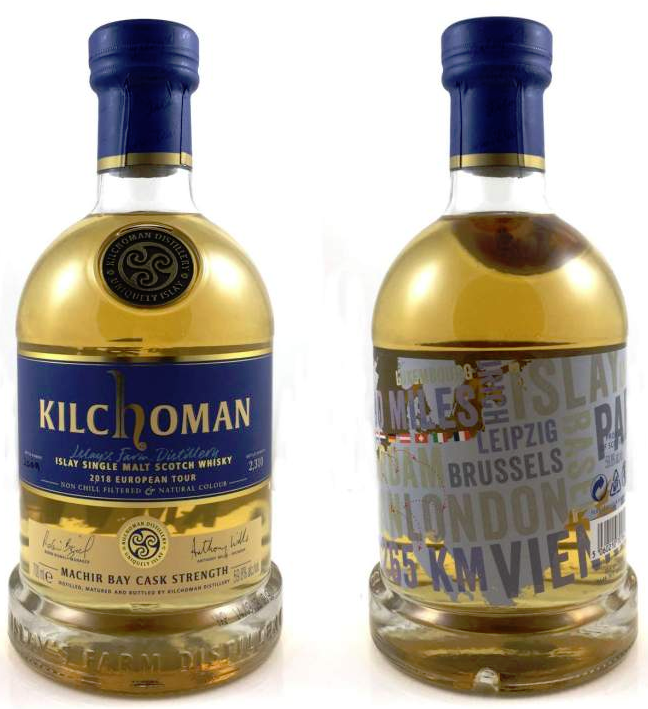
I've reviewed a few batches of Laphroaig's 10 Year Old Cask Strength to date, and I've definitely mentioned just how scarce and therefore expensive it is in Australia, but these two Kilchomans are far harder to find, the number of bottles released is positively minuscule in comparison to the Laphroaig. And these are quite reasonably priced if you do manage to find one - but that'll most likely be at overseas auction if you're not based in Europe or America. Rather confusingly they alternate between the red packaging & labels of the distillery's single cask bottlings, and the blue packaging & labels of the regular Machir Bay and vintage releases, so they don't always immediately stand out from the standard release. The two bottlings that I'm reviewing here are from 2015 and 2018, the first being the 2015 bottling for the UK tour which a fellow Kilchoman fan picked up from overseas auction, and the second being the 2018 bottling for the European tour that I picked up myself from Milroy's in London during my pilgrimage. The 2015 bottling was one of the smallest releases so far, consisting of only 648 bottles, while the 2018 bottling is the largest so far with 2,310 bottles. The 2018 bottling is also the first that is not presented in a box, and it has been given a unique printed plastic label rather than the old paper versions. That's still quite a small release of course, but then everything that Islay's only farm distillery does is on a small scale when compared with their neighbours, and even when the currently-under way expansion is complete they'll still be far smaller than the vast majority of all Scottish distilleries.
Like the regular Machir Bay expression (older batch reviewed here) these are vattings of roughly 85-90% ex-bourbon casks and 10-15% ex-sherry casks, but rather than the 46% ABV of the entry-level Kilchoman (nothing to sneeze at of course) they're closer to 60%. They're a similar age as well to the regular version, which is a vatting of casks from 4-6 years of age, but Kilchoman fans will be aware of how these young whiskies often defy their ages. Always remember that age and maturity are two very different things (in whisky, and also in people!) and if you ask me Kilchoman produce some of the best examples of what young whisky can be. That's certainly helped by the distillery bottling all of their whisky at a minimum strength of 46% ABV, without ever chill filtering or adding colouring, and careful production, good casks and natural & honest presentation seem to be the winning recipe. Let's get to it!
On face value you might look at that title and think that these are just regular cask strength versions of Kilchoman's entry-level whisky, like a few other distilleries offer, but it's not quite that simple. These cask strength versions of Machir Bay are special bottlings for what Kilchoman call their 'tours', when the distillery sends representatives on road trips across either Britain, Europe or the United States, where they visit retailers and bars, conduct tastings and of course sell their wares. From what I can find the first of these was bottled in 2014 for their UK tour, followed by another in the same year for a European tour, then one in 2015 for another European tour, one in 2016 for the east coast of the U.S., another for the U.S. in 2017 for the west coast, and now one in 2018 for another European tour. The distillery has also started offering cask strength vattings of Machir Bay as exclusive bottlings for retailers & distributors, but to my knowledge only a couple of those have been bottled to date.
I've reviewed a few batches of Laphroaig's 10 Year Old Cask Strength to date, and I've definitely mentioned just how scarce and therefore expensive it is in Australia, but these two Kilchomans are far harder to find, the number of bottles released is positively minuscule in comparison to the Laphroaig. And these are quite reasonably priced if you do manage to find one - but that'll most likely be at overseas auction if you're not based in Europe or America. Rather confusingly they alternate between the red packaging & labels of the distillery's single cask bottlings, and the blue packaging & labels of the regular Machir Bay and vintage releases, so they don't always immediately stand out from the standard release. The two bottlings that I'm reviewing here are from 2015 and 2018, the first being the 2015 bottling for the UK tour which a fellow Kilchoman fan picked up from overseas auction, and the second being the 2018 bottling for the European tour that I picked up myself from Milroy's in London during my pilgrimage. The 2015 bottling was one of the smallest releases so far, consisting of only 648 bottles, while the 2018 bottling is the largest so far with 2,310 bottles. The 2018 bottling is also the first that is not presented in a box, and it has been given a unique printed plastic label rather than the old paper versions. That's still quite a small release of course, but then everything that Islay's only farm distillery does is on a small scale when compared with their neighbours, and even when the currently-under way expansion is complete they'll still be far smaller than the vast majority of all Scottish distilleries.
Like the regular Machir Bay expression (older batch reviewed here) these are vattings of roughly 85-90% ex-bourbon casks and 10-15% ex-sherry casks, but rather than the 46% ABV of the entry-level Kilchoman (nothing to sneeze at of course) they're closer to 60%. They're a similar age as well to the regular version, which is a vatting of casks from 4-6 years of age, but Kilchoman fans will be aware of how these young whiskies often defy their ages. Always remember that age and maturity are two very different things (in whisky, and also in people!) and if you ask me Kilchoman produce some of the best examples of what young whisky can be. That's certainly helped by the distillery bottling all of their whisky at a minimum strength of 46% ABV, without ever chill filtering or adding colouring, and careful production, good casks and natural & honest presentation seem to be the winning recipe. Let's get to it!
Kilchoman Machir Bay Cask Strength 2015, NAS, 59%. Islay, Scotland.
Bottled for UK Tour 2015, 85-90% ex-bourbon casks, 10-15% ex-sherry casks. Natural colour, non-chill filtered, 648 bottles.
Colour: Pale gold.
Nose: Very nice. A little Ardbeg-y in fact but slightly darker and meatier, and more fruity. Sweet lemon & lime, under-ripe tart pineapple, vanilla frosting and some meaty drying seaweed. Light chunky peat, some warm chalky sand and a dusting of sea salt.
Texture: Excellent. Medium weight, sweet and peaty syrup. No heat at all.
Taste: Sweet fruit syrup on entry, sweet ripe pineapple and more lemon & lime. Then a lovely crumbly, slightly sharp peat with loads of fruity sweetness underneath. A little chewy toffee and vanilla custard as well.
Finish: Long. Peaty and salty, a little astringent and drying. Some aniseed, dry chilli flakes and a little cocoa powder. More sea salt, seaweed and a little hessian sacking (sandbags, potato sacks etc.). A slight bitterness to finish, like citrus pith (the white spongy stuff), and soft earthy peat.
Score: 3.5 out of 5. Almost a 4 in fact.
Notes: Very good! The mouthfeel on this one is fantastic, a really syrupy texture with that dry chunky peat mixed in. Great stuff. The spice and bitterness in the finish are a little unexpected, but not entirely unpleasant and they definitely add depth. It's still recognisable as Machir Bay as well, which isn't always the case with some cask strength versions of other distilleries' regular expressions. Not a massively complex dram perhaps, but it's very enjoyable and very tasty.
Kilchoman Machir Bay Cask Strength 2018, NAS, 59.8%. Islay, Scotland.
Bottled for European Tour 2018, 85-90% ex-bourbon casks, 10-15% ex-sherry casks. Non-chill filtered, natural colour, 2,310 bottles.
Colour: Pale gold, slightly paler than the 2015.
Nose: Immediately very different. Younger, brighter and sweeter, but also more angular and much less rounded. Orchard fruit this time (apple & a few pears), more chunky earthy peat, and some fresh seafood-like sweetness. A little more spirit- and alcohol-forward than the 2015, almost mezcal-like in comparison. A slightly vegetal sweetness and some dirty engine oil with more time.
Texture: Very nice. Medium weight, syrupy again with plenty of peat. Not as sharp or angular as the nose suggested, and only a slight touch of heat.
Taste: Syrupy again, lots of fried sweet banana and a little ripe pineapple this time. A spicy, chunky, sharp peat with a good pinch of dried chilli and black pepper spice alongside. Some sour lemon juice and ashy wood smoke, and a flash of vanilla around the edges.
Finish: Medium length. Shorter, a little sharper and more angular. More lemon juice, turning slightly bitter, some chalky peat and more ashy smoke. Light vanilla cream and a little fried banana.
Score: 3.5 out of 5. But only just.
Notes: Another reminder that I should've gone with a 10-point scoring system! Oh well. This one is very different, much less rounded and a little sharper, with more spice and sweet mezcal-like vegetal notes. And it definitely feels younger overall. But it's still very enjoyable, there's a nice fruity sweetness mixed in with that chunky peat that is very much in the 'spirit' of the regular Machir Bay releases. I do prefer the 2015 bottling personally, but I can see the 2018 version ticking a lot of boxes for Islay fans as well.
Both of these whiskies are proof of what Kilchoman can do at such young ages, even at these high strengths. And both drink well below their nearly-60% ABVs. Good value for money too, particularly if you're lucky enough to be in Europe. Great stuff from Islay's underdog!
Cheers!
Sunday, 6 January 2019
Kilchoman Feis Ile 2014 Whisky Review!
Cask strength Kilchoman finished in a Fino sherry cask? Yes please!
Kilchoman do more than their fair share of playing around with cask maturation and finishing, most commonly in their annual releases such as the recent Port cask and Sauternes Cask Finish, and their single cask bottlings. Their Feis Ile bottlings are often more experimental, and of course are much harder to find. These one-off bottlings (for the annual Islay festival) are some of the hardest to source of all the Islay distilleries, which is largely down to the small number of bottles released and the ever-increasing popularity of this brilliant little distillery. This Feis Ile bottling from 2014 would have to be one of the most unusual cask finishes that they've released to date, where two ex-bourbon casks at around 4.5 years of age were then filled into a single Fino sherry butt (500-litre cask) for three months. A three month finishing may not sound like much, particularly in a 500-litre cask, and it isn't really. But with the quality of casks that Kilchoman are using it's bound to have had an effect. Fino sherry casks are still very seldom seen in the Scotch whisky world, particularly in heavily peated whisky, with only a few distilleries dabbling in their use. You could point at Laphroaig's 2018 Cairdeas bottling as the most high-profile Fino finish to date, but Islay's smallest distillery - and its only farm distillery - lead the way four years ago back in early 2014.
Fino, which is Spanish for "refined", is the driest style of sherry with almost zero sugar content (less than 0.5%), and it must be aged for a minimum of two years in wooden casks. The casks are only filled to around 80% to allow the natural 'flor' yeast layer to form on top of the wine, which protects it from oxygen contact and consumes most of the residual sugars and also some of the ethanol in the wine. Fino sherries are pale, dry and delicate fortified wines with a yeasty, salty, nutty flavour, and they are very fragile once bottled since that protective flor layer is filtered out prior to bottling. They also oxidise very quickly once opened. I imagine this would make using the emptied casks a little challenging since they would need to be kept extremely fresh, which is probably part of the reason that we don't see too many Fino casks used in the whisky industry. Which is also why it was seldom shipped in casks traditionally, making those casks much harder to come by in Scotland in comparison with other sherry styles. In 1981 the Spanish regulations were altered and sherry could no longer be shipped in casks, resulting in the scarcity and increased cost of 'traditional' sherry casks that we still deal with today, and also the more recent advent of sherry-seasoned casks that are destined for the whisky industry from day one.
Finding any older Feis Ile bottling is no easy task, let alone a very small-scale bottling from a small-scale but popular distillery. The sample for this review came from a generous fellow-Kilchoman fan who purchased the bottle at overseas auction, and while it wasn't exactly cheap it was definitely on the reasonable side considering its scarcity. Only 525 bottles were released at a cask strength of 58.7%, and of course there's no chill filtration or added colouring since Kilchoman never dabble in those dark arts. One interesting observation here is that they haven't labelled this bottling as a single cask, because it came from two bourbon barrels which were then combined in the single sherry butt for the short finishing. Technically that finishing in a single cask would make this a single cask bottling, and quite a few other distilleries have been known to use the term in such cases, so it's interesting that Kilchoman haven't. I'd assume that's for the sake of extra transparency, which of course is no bad thing! Being a lighter style of sherry means the sherry cask won't have had as much of an effect as an Oloroso or PX cask would, but Kilchoman's sweet, peaty & fruity young spirit should work very well the Fino cask. There's really only one way to find out...
Colour: Yellow gold.
Nose: Fresh & coastal, but also sweet & creamy. Nose-tingling to start with but settles down quite quickly. Chunky, earth peat with a big pinch of salt, some warm roasted nuts and lightly-sweetened fresh cream. Some meaty fresh seaweed, and a little yeasty tang behind like a slice of crusty sour dough bread. Some lighter tropical fruit in the background.
Texture: Medium-heavy weight, rich & full flavoured. Creamy, peaty and syrupy. A little heat but pleasant.
Taste: Sweet creamy entry, then tropical fruit syrup, milk chocolate and a blast of chunky, earthy peat with a big pinch of hot chilli salt following afterwards. A slight floral sweetness and some fresh bitter lemon around the edges.
Finish: Long, and quite bold. Thick acrid smoke, more chilli salt, some more zesty bitter lemon and melted milk chocolate. More roasted nuts, mostly almond with a few cashews and chalky walnuts thrown in. Smoked chilli salt, brine and some drying bitter oak to finish.
Score: 4 out of 5.
Notes: Delicious! It's not shy, and there is a slight roughness to it, but that only adds to its character. A really excellent texture / mouth feel to this one, it's very rich and syrupy despite that peat and chilli spice. In fact it's one of the weightier Kilchomans that I've tasted, and it carries plenty of flavour along with it. Very much like tropical fruit syrup with some heavily smoked chilli salt mixed through. Those nutty and yeasty notes would be down to the Fino cask, and it's given Kilchoman's usual salty tang a good boost as well, while dampening the usual fruity-ness a touch. Kilchoman really excel at making young peaty whiskies that drink well beyond their years. And more power to them!
This is a fresh and zesty young whisky that won't take any prisoners, but in the company of cask strength Islay fans it won't have any trouble making friends either. I think we need to see more heavily peated whisky that has spent some time in lighter & dryer sherry casks, because it really seems to work brilliantly. Look at Ardbeg Ardbog (partly matured in Manzanilla casks), Laphroaig Cairdeas Fino, Ledaig Amontillado, and now this Feis Ile Kilchoman (if you can find it) for some truly excellent examples.
Cheers!
Kilchoman do more than their fair share of playing around with cask maturation and finishing, most commonly in their annual releases such as the recent Port cask and Sauternes Cask Finish, and their single cask bottlings. Their Feis Ile bottlings are often more experimental, and of course are much harder to find. These one-off bottlings (for the annual Islay festival) are some of the hardest to source of all the Islay distilleries, which is largely down to the small number of bottles released and the ever-increasing popularity of this brilliant little distillery. This Feis Ile bottling from 2014 would have to be one of the most unusual cask finishes that they've released to date, where two ex-bourbon casks at around 4.5 years of age were then filled into a single Fino sherry butt (500-litre cask) for three months. A three month finishing may not sound like much, particularly in a 500-litre cask, and it isn't really. But with the quality of casks that Kilchoman are using it's bound to have had an effect. Fino sherry casks are still very seldom seen in the Scotch whisky world, particularly in heavily peated whisky, with only a few distilleries dabbling in their use. You could point at Laphroaig's 2018 Cairdeas bottling as the most high-profile Fino finish to date, but Islay's smallest distillery - and its only farm distillery - lead the way four years ago back in early 2014.
Fino, which is Spanish for "refined", is the driest style of sherry with almost zero sugar content (less than 0.5%), and it must be aged for a minimum of two years in wooden casks. The casks are only filled to around 80% to allow the natural 'flor' yeast layer to form on top of the wine, which protects it from oxygen contact and consumes most of the residual sugars and also some of the ethanol in the wine. Fino sherries are pale, dry and delicate fortified wines with a yeasty, salty, nutty flavour, and they are very fragile once bottled since that protective flor layer is filtered out prior to bottling. They also oxidise very quickly once opened. I imagine this would make using the emptied casks a little challenging since they would need to be kept extremely fresh, which is probably part of the reason that we don't see too many Fino casks used in the whisky industry. Which is also why it was seldom shipped in casks traditionally, making those casks much harder to come by in Scotland in comparison with other sherry styles. In 1981 the Spanish regulations were altered and sherry could no longer be shipped in casks, resulting in the scarcity and increased cost of 'traditional' sherry casks that we still deal with today, and also the more recent advent of sherry-seasoned casks that are destined for the whisky industry from day one.
Finding any older Feis Ile bottling is no easy task, let alone a very small-scale bottling from a small-scale but popular distillery. The sample for this review came from a generous fellow-Kilchoman fan who purchased the bottle at overseas auction, and while it wasn't exactly cheap it was definitely on the reasonable side considering its scarcity. Only 525 bottles were released at a cask strength of 58.7%, and of course there's no chill filtration or added colouring since Kilchoman never dabble in those dark arts. One interesting observation here is that they haven't labelled this bottling as a single cask, because it came from two bourbon barrels which were then combined in the single sherry butt for the short finishing. Technically that finishing in a single cask would make this a single cask bottling, and quite a few other distilleries have been known to use the term in such cases, so it's interesting that Kilchoman haven't. I'd assume that's for the sake of extra transparency, which of course is no bad thing! Being a lighter style of sherry means the sherry cask won't have had as much of an effect as an Oloroso or PX cask would, but Kilchoman's sweet, peaty & fruity young spirit should work very well the Fino cask. There's really only one way to find out...
Kilchoman Feis Ile 2014, 4 Year Old, 58.7%. Islay, Scotland.
Distilled July 2009, matured for 4.5 years in two ex-bourbon casks, finished in a single Fino sherry butt for 3 months, bottled May 2014. 525 bottles. Non-chill filtered, natural colour.
Colour: Yellow gold.
Nose: Fresh & coastal, but also sweet & creamy. Nose-tingling to start with but settles down quite quickly. Chunky, earth peat with a big pinch of salt, some warm roasted nuts and lightly-sweetened fresh cream. Some meaty fresh seaweed, and a little yeasty tang behind like a slice of crusty sour dough bread. Some lighter tropical fruit in the background.
Texture: Medium-heavy weight, rich & full flavoured. Creamy, peaty and syrupy. A little heat but pleasant.
Taste: Sweet creamy entry, then tropical fruit syrup, milk chocolate and a blast of chunky, earthy peat with a big pinch of hot chilli salt following afterwards. A slight floral sweetness and some fresh bitter lemon around the edges.
Finish: Long, and quite bold. Thick acrid smoke, more chilli salt, some more zesty bitter lemon and melted milk chocolate. More roasted nuts, mostly almond with a few cashews and chalky walnuts thrown in. Smoked chilli salt, brine and some drying bitter oak to finish.
Score: 4 out of 5.
Notes: Delicious! It's not shy, and there is a slight roughness to it, but that only adds to its character. A really excellent texture / mouth feel to this one, it's very rich and syrupy despite that peat and chilli spice. In fact it's one of the weightier Kilchomans that I've tasted, and it carries plenty of flavour along with it. Very much like tropical fruit syrup with some heavily smoked chilli salt mixed through. Those nutty and yeasty notes would be down to the Fino cask, and it's given Kilchoman's usual salty tang a good boost as well, while dampening the usual fruity-ness a touch. Kilchoman really excel at making young peaty whiskies that drink well beyond their years. And more power to them!
This is a fresh and zesty young whisky that won't take any prisoners, but in the company of cask strength Islay fans it won't have any trouble making friends either. I think we need to see more heavily peated whisky that has spent some time in lighter & dryer sherry casks, because it really seems to work brilliantly. Look at Ardbeg Ardbog (partly matured in Manzanilla casks), Laphroaig Cairdeas Fino, Ledaig Amontillado, and now this Feis Ile Kilchoman (if you can find it) for some truly excellent examples.
Cheers!
Subscribe to:
Comments (Atom)
Ardbeg 10 Cask Strength Whisky Review!
The first cask strength Ardbeg 10 Year Old Since 2008's Renaissance! Are the distillery's corporate overlords finally listening to A...
-
A travel-exclusive Bunnahabhain with a difference - Cruach Mhona in Gaelic translates to 'Peat Stack' in English. Yes, as you've...
-
A reasonably priced 15-year old single malt from an often-overlooked Highland distillery - although it could also pass for Speyside geograph...
-
A liquid souvenir from the trip to Japan last year, which included a visit to Yamazaki! Peated, 48% ABV and non-chill filtered, and a reason...