My first Craigellachie review! In fact I've only tried one other example, and this is the first official bottling I've taken a close look at!
Craigellachie Distillery is located in the centre of the Speyside region, just up the road from Speyside Cooperage in the small village of Craigellachie. In fact the distillery sits right on the region's main road, with the still house and even the stills themselves easily visible from said road through the retractable glass doors, which are often left open. But visitors are not permitted inside the distillery and there's no visitor's centre, so that's as close as most of us will get. Although the village is home to both The Craigellachie Hotel and the famous Highlander Inn, so there's no shortage of whisky tastings in the vicinity. The name Craigellachie (pronounced "Cray-Gell-ack-ee") means "rocky hill", referring to the rocky bluff that the distillery & the namesake village sits on. It's a medium-sized distillery overall, with an annual production capacity of over four million litres of spirit, but that's actually quite small by Speyside standards, through two pairs of copper stills. Like many of the less-famous distilleries the majority of their production goes into blended whiskies, particularly the Dewars and White Horse brands. Originally founded in 1891, Craigellachie is owned by John Dewar & Sons, which itself is owned by Bacardi, having purchased Craigellachie and four other distilleries (Aberfeldy, Aultmore, MacDuff and Brackla) from United Distillers,a precursor to Diageo, in 1998.
Those four stills are quite large, with capacities of just over 28,000 litres a piece, and the wash & spirit stills are the same size, which is slightly unusual. You won't find any boil bulbs, onions or purifiers here, and you won't find any modern & efficient shell & tube condensers attached to their horizontal lyne arms. Craigellachie is one of the few modern distilleries to retain worm tub condensers! These large plain stills and their old-fashioned worm tub condensers have been designed to give minimal reflux and little copper contact, resulting in a weighty and (intentionally) sulphurous spirit. The un-peated barley is sourced from Glenesk maltings on the east coast, and is dried using an oil-fired heater, which is claimed to add sulphurous notes to the malt itself, to the point where Craigellachie is sometimes referred to as "the bad boy of Speyside". But we can expect those notes to diminish with time in casks, which could be why the youngest official bottling is 13-years old. Speaking of which, the vast majority of Craigellachie spirit is sent to Glasgow for maturation & bottling, partly since like many distilleries situated in the centres of villages or towns, physical space is at a premium.
The expression I'm looking at today is the entry-level Craigellachie, but unusually for an entry-level it's a 13-year old whisky which is bottled at 46% and is non-chill filtered, although I suspect there may be a little E150a artificial colouring involved. With those things considered it's quite reasonably priced, hovering around the $110-130 AUD mark. There's no information out there on the type of casks that were used for this one, so I'd assume it's mostly been matured in refill ex-bourbon casks. But what I don't particularly like is that Bacardi have been referring to their range of single malts, with Craigellachie among them, as "The Last Great Malts". Which is a huge steaming pile of you know what, particularly when it's being used for what were (and largely still are) almost completely unknown distilleries. Maybe I'm being a little sensitive here, but surely they could've found a better tagline to use in their marketing, because that one doesn't leave a pleasant taste in the mouth. How about "the last undiscovered malts" or "the hidden / forgotten gems of Speyside"? And I don't even work in marketing! That said however, I do like the classy and decidedly retro packaging that they've used on the Craigellachie range. Anyway, let's shake all that off and give this one a go...
Craigellachie 13-Year Old, 46%. Craigellachie, Scotland.
Presumed matured in refill ex-bourbon casks. Non-chill filtered, suspected light added colouring.
Colour: Yellow gold.
Nose: There's definitely a vegetal "twang" to it, and it's more dry and savoury than I was expecting, but there's still the typical Speyside notes of honey & apple, and a subtle malty-ness. Some dry wood spices (sandalwood?) and dusty oatmeal, and a little dried spearmint. A hint of tea tree oil with more time in the glass.
Texture: Medium weight, lightly oily. And more than just a vegetal "twang" here! A touch of heat as well.
Taste: That vegetal note straight off, like a newly opened bag of lightly salted potato chips (crisps) that have gone stale. That may not sound particularly appetizing, but it's enjoyable! Some savoury dry honey and a couple of beef stock cubes (meaty). Hint of that dried spearmint around the edges, lightly nutty oak as well.
Finish: Medium length. More spearmint, some green apple, a little white pepper and bitter burnt toffee. More dry wood spices again, and a little salted butter, but it's that vegetal sulphur note that carries on the longest.
Score: 3 out of 5.
Notes: An interesting dram! The nose was quite deceptive in that it gives a prediction of what you can expect to find on the palate, but that prediction falls way short! It's definitely more dry, meaty and savoury than I expected, but that's not a complaint, just a little surprising. In fact it's quite refreshing. There may not be a huge amount of depth to this expression, but let's not forget that this is the entry-level Craigellachie, so we can definitely forgive that. That sulphurous vegetal note may put off some newcomers, and I've found that it increased as the bottle breathed and oxidised, which is also interesting as it's the opposite of what I'd expect to happen. I'd probably put the overall level of sulphur on par with some ex-bourbon cask Mortlachs that I've tried, but the actual effect of that sulphur is quite different and perhaps less pungent in the Craigellachie. Which makes me want to try a sherry cask-matured expression!
There's definitely a sulphurous and lightly rough edge to this 13-year old Speysider, and it's definitely not what you'd typically expect from the region, which is great to see. Those regional flavours are certainly becoming less and less relevant as more distilleries branch out and/or come to light. And this one is certainly worth a try if you'd like a bit more of a challenge in your dram.
Cheers!
Sunday, 3 February 2019
Saturday, 26 January 2019
Black Gate 620s Whisky Review!
A young Australian single malt whisky, with a huge ABV, from a tiny distillery in regional New South Wales that is quickly gaining a serious following. This should be good!
Black Gate Distillery was established back in 2009 by husband & wife team Brian & Genise Hollingworth, near the small town of Mendooran in central New South Wales, around five hour's drive north-west of Sydney. Brian & Genise are both very friendly and very humble people, and they definitely know what they're doing. The cult following that their spirits have garnered is testament to that. While they started off producing a range of different spirits while waiting for their whisky to mature, single malt whisky and aged rum are the current focus. The distillery itself is tiny, even by Australian standards, with an annual production of around 4,000 litres of spirit through two direct-fired (yes, direct-fired - see photo above!) copper pot stills, of 630-litres and 300-litres capacity respectively. The larger of the two was only added in 2017, so at the time of writing all bottled Black Gate single malt was made in the smaller still alone. Most pot stills are heated internally by steam coil, whereas these are externally heated using a gas flame under the base of the stills. And they certainly do make a big difference to the finished product, adding a slight charred or burnt note to the spirit that is very pleasant.
These whiskies are very young by international standards, with all releases to date being between two (the minimum age for whisky in Australia) and four years of age, but they're helped along by the local conditions, with massive variations in temperature, from below freezing in winter to over 40 degrees centigrade in summer, resulting in faster and more aggressive maturation. They're also given an extra shove by the use of smaller casks, predominantly of the Australian sherry (Apera) and port (Tawny) persuasions, although there are now also full-sized casks maturing at the distillery. The majority of Black Gate's whisky releases to date were distilled from unpeated or lightly-peated barley, sourced from Tasmania, Victoria and locally in New South Wales, but there have been a few heavily peated expressions released recently that used peated malted barley sourced from the UK. Which is great to see! Adding to their appeal is the fact that Black Gate do not chill filter or artificially colour any of their single malts, and their bottling strength doesn't go below 46% ABV. The personal touches also help, and many of Black Gate's direct customers receive a hand-written thank you card from Brian & Genise with their purchases. Which is incredible when you think about it, and it's not something I've ever seen before.
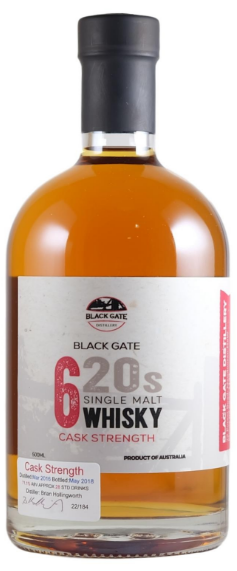
The expression I'm looking at today is Black Gate 620s, which is one of only a few cask strength releases to date. The whisky's name refers to this being a marriage of six re-coopered 20-litre casks, which were left to mature for just 2 years and 2 months, before being vatted together and bottled at a massive 71.1% ABV. If memory serves me correctly this is the third-highest ABV whisky that I've ever tasted, and the two that are in front, both Heartwoods at 72% and 73.5% respectively, were much older than this Black Gate, and were also matured in full-sized casks. So this should be interesting! 620s was distilled from lightly-peated malted barley in March 2016, and was bottled in May 2018 with a yield of just 184 individually numbered 500ml bottles, and as mentioned above no Black Gate whiskies are chill filtered or artificially coloured. It can still be found in specialist retailers for around $220 AUD. That may sound expensive for a 500ml bottle, but when you consider the extra cost of the 20-litre casks, the ridiculous amount of duty (and other taxes) that would have to be paid on a whisky of this strength in Australia, and the very limited nature of this bottling, it's very reasonable! Personally I don't mind the 500ml bottles that are becoming more widely-used in Australian whisky, since as a general rule it keeps the pricing at a more reasonable level, and it also helps with availability. Unfortunately there are plenty of Australian producers that are exceptions to that general rule, but that's certainly not the case with Black Gate. In fact when it comes to offering value for money in Australian single malt whiskies, they're among the contenders for the top prize.
Black Gate Distillery was established back in 2009 by husband & wife team Brian & Genise Hollingworth, near the small town of Mendooran in central New South Wales, around five hour's drive north-west of Sydney. Brian & Genise are both very friendly and very humble people, and they definitely know what they're doing. The cult following that their spirits have garnered is testament to that. While they started off producing a range of different spirits while waiting for their whisky to mature, single malt whisky and aged rum are the current focus. The distillery itself is tiny, even by Australian standards, with an annual production of around 4,000 litres of spirit through two direct-fired (yes, direct-fired - see photo above!) copper pot stills, of 630-litres and 300-litres capacity respectively. The larger of the two was only added in 2017, so at the time of writing all bottled Black Gate single malt was made in the smaller still alone. Most pot stills are heated internally by steam coil, whereas these are externally heated using a gas flame under the base of the stills. And they certainly do make a big difference to the finished product, adding a slight charred or burnt note to the spirit that is very pleasant.
These whiskies are very young by international standards, with all releases to date being between two (the minimum age for whisky in Australia) and four years of age, but they're helped along by the local conditions, with massive variations in temperature, from below freezing in winter to over 40 degrees centigrade in summer, resulting in faster and more aggressive maturation. They're also given an extra shove by the use of smaller casks, predominantly of the Australian sherry (Apera) and port (Tawny) persuasions, although there are now also full-sized casks maturing at the distillery. The majority of Black Gate's whisky releases to date were distilled from unpeated or lightly-peated barley, sourced from Tasmania, Victoria and locally in New South Wales, but there have been a few heavily peated expressions released recently that used peated malted barley sourced from the UK. Which is great to see! Adding to their appeal is the fact that Black Gate do not chill filter or artificially colour any of their single malts, and their bottling strength doesn't go below 46% ABV. The personal touches also help, and many of Black Gate's direct customers receive a hand-written thank you card from Brian & Genise with their purchases. Which is incredible when you think about it, and it's not something I've ever seen before.
The expression I'm looking at today is Black Gate 620s, which is one of only a few cask strength releases to date. The whisky's name refers to this being a marriage of six re-coopered 20-litre casks, which were left to mature for just 2 years and 2 months, before being vatted together and bottled at a massive 71.1% ABV. If memory serves me correctly this is the third-highest ABV whisky that I've ever tasted, and the two that are in front, both Heartwoods at 72% and 73.5% respectively, were much older than this Black Gate, and were also matured in full-sized casks. So this should be interesting! 620s was distilled from lightly-peated malted barley in March 2016, and was bottled in May 2018 with a yield of just 184 individually numbered 500ml bottles, and as mentioned above no Black Gate whiskies are chill filtered or artificially coloured. It can still be found in specialist retailers for around $220 AUD. That may sound expensive for a 500ml bottle, but when you consider the extra cost of the 20-litre casks, the ridiculous amount of duty (and other taxes) that would have to be paid on a whisky of this strength in Australia, and the very limited nature of this bottling, it's very reasonable! Personally I don't mind the 500ml bottles that are becoming more widely-used in Australian whisky, since as a general rule it keeps the pricing at a more reasonable level, and it also helps with availability. Unfortunately there are plenty of Australian producers that are exceptions to that general rule, but that's certainly not the case with Black Gate. In fact when it comes to offering value for money in Australian single malt whiskies, they're among the contenders for the top prize.
Image from oakbarrel.com.au
Black Gate 620s, 71.1% ABV cask strength. Mendooran, NSW, Australia.
Distilled March 2016, bottled May 2018, aged 2 years & 2 months. Vatting of six re-coopered 20-litre casks, yielded 184 500ml bottles. Non-chill filtered, natural colour.
Colour: Light copper.
Nose: It's a fire-y beast to start with, but it settles down quickly. Lots of dark lightly-burnt caramel and medium-dark chocolate, sweetened coconut, and a little dry toasted malt. A little dark rum-like, and there's still a bit of nose prickle to it, but for a 2-year old whisky at 71% that's to be expected! A little charred eucalyptus / gum forest and some thick vanilla paste with more breathing time.
Texture: Medium weight, rich & syrup-thick. Quite punchy with a bit of heat too, but again, that's to be expected.
Taste: Big hit of chilli chocolate, more lightly-burnt caramel and dry toasted malt. Some savoury / dry herbal honey, more thick vanilla paste and some thick stone fruit syrup.
Finish: Short-medium length. Toasted spices, more burnt caramel and sweetened coconut, and that stone fruit syrup and thick vanilla paste again. A little herbal and slightly vegetal, that eucalyptus / gum forest note coming through again. Something slightly lactic & slightly burnt towards the end as well, which is interesting.
Score: 3 out of 5.
Notes: This is a big intense whisky, and it's a little rough around the edges, but there's plenty to like! There's a lot of flavour, and it's very concentrated and condensed, and quite punchy of course. But for such a young whisky at such a high strength it's clearly very well made, and there's loads of character to explore. Even 20-litre casks couldn't completely hide bad spirit, and they definitely haven't had to here. It may not be the most complex whisky out there, and you'd hardly call it subtle, but for its age its very impressive, and high ABV fans will definitely enjoy it. That toasted malt & burnt caramel would have to be down to those direct-fired stills, which is a unique and very intriguing touch. That uniqueness and those interesting flavours do help Black Gate stand out from the pack, which is very important in the booming and fast-expanding Australian whisky industry.
This one probably would've benefited from a little water to be fair, but that's not how I do things for these reviews, so I waited until afterwards to try that. And a few drops did soften everything out without losing anything at all, and it boosted the sweetness and vanilla as well. Well worth trying! Brian & Genise are putting out great stuff down at Black Gate without following anyone's lead, and they're amassing a well-deserved following as a result. Keep up the good work guys!
Cheers!
This one probably would've benefited from a little water to be fair, but that's not how I do things for these reviews, so I waited until afterwards to try that. And a few drops did soften everything out without losing anything at all, and it boosted the sweetness and vanilla as well. Well worth trying! Brian & Genise are putting out great stuff down at Black Gate without following anyone's lead, and they're amassing a well-deserved following as a result. Keep up the good work guys!
Cheers!
Sunday, 20 January 2019
Two Kilchoman Machir Bay Cask Strength Whisky Reviews!
Yes, cask strength Machir Bay from Islay's smallest distillery, and it's another two-for-one review!
On face value you might look at that title and think that these are just regular cask strength versions of Kilchoman's entry-level whisky, like a few other distilleries offer, but it's not quite that simple. These cask strength versions of Machir Bay are special bottlings for what Kilchoman call their 'tours', when the distillery sends representatives on road trips across either Britain, Europe or the United States, where they visit retailers and bars, conduct tastings and of course sell their wares. From what I can find the first of these was bottled in 2014 for their UK tour, followed by another in the same year for a European tour, then one in 2015 for another European tour, one in 2016 for the east coast of the U.S., another for the U.S. in 2017 for the west coast, and now one in 2018 for another European tour. The distillery has also started offering cask strength vattings of Machir Bay as exclusive bottlings for retailers & distributors, but to my knowledge only a couple of those have been bottled to date.
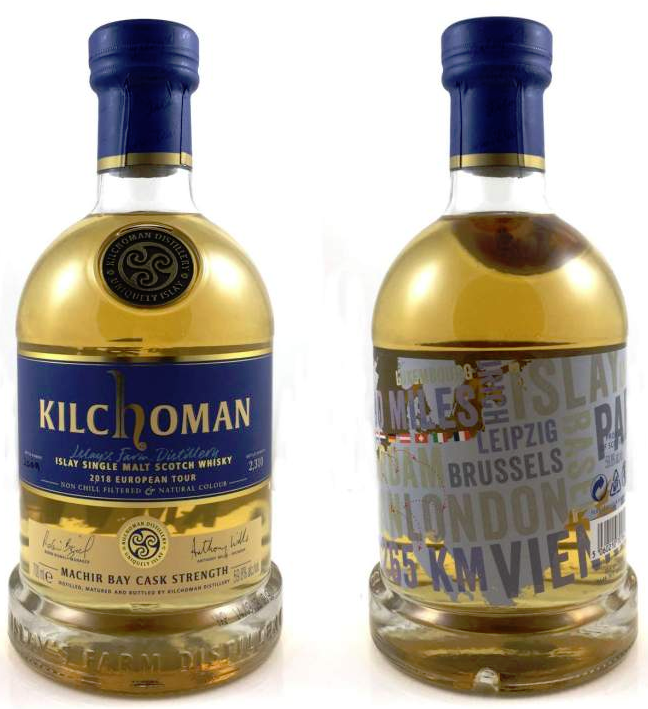
I've reviewed a few batches of Laphroaig's 10 Year Old Cask Strength to date, and I've definitely mentioned just how scarce and therefore expensive it is in Australia, but these two Kilchomans are far harder to find, the number of bottles released is positively minuscule in comparison to the Laphroaig. And these are quite reasonably priced if you do manage to find one - but that'll most likely be at overseas auction if you're not based in Europe or America. Rather confusingly they alternate between the red packaging & labels of the distillery's single cask bottlings, and the blue packaging & labels of the regular Machir Bay and vintage releases, so they don't always immediately stand out from the standard release. The two bottlings that I'm reviewing here are from 2015 and 2018, the first being the 2015 bottling for the UK tour which a fellow Kilchoman fan picked up from overseas auction, and the second being the 2018 bottling for the European tour that I picked up myself from Milroy's in London during my pilgrimage. The 2015 bottling was one of the smallest releases so far, consisting of only 648 bottles, while the 2018 bottling is the largest so far with 2,310 bottles. The 2018 bottling is also the first that is not presented in a box, and it has been given a unique printed plastic label rather than the old paper versions. That's still quite a small release of course, but then everything that Islay's only farm distillery does is on a small scale when compared with their neighbours, and even when the currently-under way expansion is complete they'll still be far smaller than the vast majority of all Scottish distilleries.
Like the regular Machir Bay expression (older batch reviewed here) these are vattings of roughly 85-90% ex-bourbon casks and 10-15% ex-sherry casks, but rather than the 46% ABV of the entry-level Kilchoman (nothing to sneeze at of course) they're closer to 60%. They're a similar age as well to the regular version, which is a vatting of casks from 4-6 years of age, but Kilchoman fans will be aware of how these young whiskies often defy their ages. Always remember that age and maturity are two very different things (in whisky, and also in people!) and if you ask me Kilchoman produce some of the best examples of what young whisky can be. That's certainly helped by the distillery bottling all of their whisky at a minimum strength of 46% ABV, without ever chill filtering or adding colouring, and careful production, good casks and natural & honest presentation seem to be the winning recipe. Let's get to it!
On face value you might look at that title and think that these are just regular cask strength versions of Kilchoman's entry-level whisky, like a few other distilleries offer, but it's not quite that simple. These cask strength versions of Machir Bay are special bottlings for what Kilchoman call their 'tours', when the distillery sends representatives on road trips across either Britain, Europe or the United States, where they visit retailers and bars, conduct tastings and of course sell their wares. From what I can find the first of these was bottled in 2014 for their UK tour, followed by another in the same year for a European tour, then one in 2015 for another European tour, one in 2016 for the east coast of the U.S., another for the U.S. in 2017 for the west coast, and now one in 2018 for another European tour. The distillery has also started offering cask strength vattings of Machir Bay as exclusive bottlings for retailers & distributors, but to my knowledge only a couple of those have been bottled to date.
I've reviewed a few batches of Laphroaig's 10 Year Old Cask Strength to date, and I've definitely mentioned just how scarce and therefore expensive it is in Australia, but these two Kilchomans are far harder to find, the number of bottles released is positively minuscule in comparison to the Laphroaig. And these are quite reasonably priced if you do manage to find one - but that'll most likely be at overseas auction if you're not based in Europe or America. Rather confusingly they alternate between the red packaging & labels of the distillery's single cask bottlings, and the blue packaging & labels of the regular Machir Bay and vintage releases, so they don't always immediately stand out from the standard release. The two bottlings that I'm reviewing here are from 2015 and 2018, the first being the 2015 bottling for the UK tour which a fellow Kilchoman fan picked up from overseas auction, and the second being the 2018 bottling for the European tour that I picked up myself from Milroy's in London during my pilgrimage. The 2015 bottling was one of the smallest releases so far, consisting of only 648 bottles, while the 2018 bottling is the largest so far with 2,310 bottles. The 2018 bottling is also the first that is not presented in a box, and it has been given a unique printed plastic label rather than the old paper versions. That's still quite a small release of course, but then everything that Islay's only farm distillery does is on a small scale when compared with their neighbours, and even when the currently-under way expansion is complete they'll still be far smaller than the vast majority of all Scottish distilleries.
Like the regular Machir Bay expression (older batch reviewed here) these are vattings of roughly 85-90% ex-bourbon casks and 10-15% ex-sherry casks, but rather than the 46% ABV of the entry-level Kilchoman (nothing to sneeze at of course) they're closer to 60%. They're a similar age as well to the regular version, which is a vatting of casks from 4-6 years of age, but Kilchoman fans will be aware of how these young whiskies often defy their ages. Always remember that age and maturity are two very different things (in whisky, and also in people!) and if you ask me Kilchoman produce some of the best examples of what young whisky can be. That's certainly helped by the distillery bottling all of their whisky at a minimum strength of 46% ABV, without ever chill filtering or adding colouring, and careful production, good casks and natural & honest presentation seem to be the winning recipe. Let's get to it!
Kilchoman Machir Bay Cask Strength 2015, NAS, 59%. Islay, Scotland.
Bottled for UK Tour 2015, 85-90% ex-bourbon casks, 10-15% ex-sherry casks. Natural colour, non-chill filtered, 648 bottles.
Colour: Pale gold.
Nose: Very nice. A little Ardbeg-y in fact but slightly darker and meatier, and more fruity. Sweet lemon & lime, under-ripe tart pineapple, vanilla frosting and some meaty drying seaweed. Light chunky peat, some warm chalky sand and a dusting of sea salt.
Texture: Excellent. Medium weight, sweet and peaty syrup. No heat at all.
Taste: Sweet fruit syrup on entry, sweet ripe pineapple and more lemon & lime. Then a lovely crumbly, slightly sharp peat with loads of fruity sweetness underneath. A little chewy toffee and vanilla custard as well.
Finish: Long. Peaty and salty, a little astringent and drying. Some aniseed, dry chilli flakes and a little cocoa powder. More sea salt, seaweed and a little hessian sacking (sandbags, potato sacks etc.). A slight bitterness to finish, like citrus pith (the white spongy stuff), and soft earthy peat.
Score: 3.5 out of 5. Almost a 4 in fact.
Notes: Very good! The mouthfeel on this one is fantastic, a really syrupy texture with that dry chunky peat mixed in. Great stuff. The spice and bitterness in the finish are a little unexpected, but not entirely unpleasant and they definitely add depth. It's still recognisable as Machir Bay as well, which isn't always the case with some cask strength versions of other distilleries' regular expressions. Not a massively complex dram perhaps, but it's very enjoyable and very tasty.
Kilchoman Machir Bay Cask Strength 2018, NAS, 59.8%. Islay, Scotland.
Bottled for European Tour 2018, 85-90% ex-bourbon casks, 10-15% ex-sherry casks. Non-chill filtered, natural colour, 2,310 bottles.
Colour: Pale gold, slightly paler than the 2015.
Nose: Immediately very different. Younger, brighter and sweeter, but also more angular and much less rounded. Orchard fruit this time (apple & a few pears), more chunky earthy peat, and some fresh seafood-like sweetness. A little more spirit- and alcohol-forward than the 2015, almost mezcal-like in comparison. A slightly vegetal sweetness and some dirty engine oil with more time.
Texture: Very nice. Medium weight, syrupy again with plenty of peat. Not as sharp or angular as the nose suggested, and only a slight touch of heat.
Taste: Syrupy again, lots of fried sweet banana and a little ripe pineapple this time. A spicy, chunky, sharp peat with a good pinch of dried chilli and black pepper spice alongside. Some sour lemon juice and ashy wood smoke, and a flash of vanilla around the edges.
Finish: Medium length. Shorter, a little sharper and more angular. More lemon juice, turning slightly bitter, some chalky peat and more ashy smoke. Light vanilla cream and a little fried banana.
Score: 3.5 out of 5. But only just.
Notes: Another reminder that I should've gone with a 10-point scoring system! Oh well. This one is very different, much less rounded and a little sharper, with more spice and sweet mezcal-like vegetal notes. And it definitely feels younger overall. But it's still very enjoyable, there's a nice fruity sweetness mixed in with that chunky peat that is very much in the 'spirit' of the regular Machir Bay releases. I do prefer the 2015 bottling personally, but I can see the 2018 version ticking a lot of boxes for Islay fans as well.
Both of these whiskies are proof of what Kilchoman can do at such young ages, even at these high strengths. And both drink well below their nearly-60% ABVs. Good value for money too, particularly if you're lucky enough to be in Europe. Great stuff from Islay's underdog!
Cheers!
Sunday, 6 January 2019
Kilchoman Feis Ile 2014 Whisky Review!
Cask strength Kilchoman finished in a Fino sherry cask? Yes please!
Kilchoman do more than their fair share of playing around with cask maturation and finishing, most commonly in their annual releases such as the recent Port cask and Sauternes Cask Finish, and their single cask bottlings. Their Feis Ile bottlings are often more experimental, and of course are much harder to find. These one-off bottlings (for the annual Islay festival) are some of the hardest to source of all the Islay distilleries, which is largely down to the small number of bottles released and the ever-increasing popularity of this brilliant little distillery. This Feis Ile bottling from 2014 would have to be one of the most unusual cask finishes that they've released to date, where two ex-bourbon casks at around 4.5 years of age were then filled into a single Fino sherry butt (500-litre cask) for three months. A three month finishing may not sound like much, particularly in a 500-litre cask, and it isn't really. But with the quality of casks that Kilchoman are using it's bound to have had an effect. Fino sherry casks are still very seldom seen in the Scotch whisky world, particularly in heavily peated whisky, with only a few distilleries dabbling in their use. You could point at Laphroaig's 2018 Cairdeas bottling as the most high-profile Fino finish to date, but Islay's smallest distillery - and its only farm distillery - lead the way four years ago back in early 2014.
Fino, which is Spanish for "refined", is the driest style of sherry with almost zero sugar content (less than 0.5%), and it must be aged for a minimum of two years in wooden casks. The casks are only filled to around 80% to allow the natural 'flor' yeast layer to form on top of the wine, which protects it from oxygen contact and consumes most of the residual sugars and also some of the ethanol in the wine. Fino sherries are pale, dry and delicate fortified wines with a yeasty, salty, nutty flavour, and they are very fragile once bottled since that protective flor layer is filtered out prior to bottling. They also oxidise very quickly once opened. I imagine this would make using the emptied casks a little challenging since they would need to be kept extremely fresh, which is probably part of the reason that we don't see too many Fino casks used in the whisky industry. Which is also why it was seldom shipped in casks traditionally, making those casks much harder to come by in Scotland in comparison with other sherry styles. In 1981 the Spanish regulations were altered and sherry could no longer be shipped in casks, resulting in the scarcity and increased cost of 'traditional' sherry casks that we still deal with today, and also the more recent advent of sherry-seasoned casks that are destined for the whisky industry from day one.
Finding any older Feis Ile bottling is no easy task, let alone a very small-scale bottling from a small-scale but popular distillery. The sample for this review came from a generous fellow-Kilchoman fan who purchased the bottle at overseas auction, and while it wasn't exactly cheap it was definitely on the reasonable side considering its scarcity. Only 525 bottles were released at a cask strength of 58.7%, and of course there's no chill filtration or added colouring since Kilchoman never dabble in those dark arts. One interesting observation here is that they haven't labelled this bottling as a single cask, because it came from two bourbon barrels which were then combined in the single sherry butt for the short finishing. Technically that finishing in a single cask would make this a single cask bottling, and quite a few other distilleries have been known to use the term in such cases, so it's interesting that Kilchoman haven't. I'd assume that's for the sake of extra transparency, which of course is no bad thing! Being a lighter style of sherry means the sherry cask won't have had as much of an effect as an Oloroso or PX cask would, but Kilchoman's sweet, peaty & fruity young spirit should work very well the Fino cask. There's really only one way to find out...
Colour: Yellow gold.
Nose: Fresh & coastal, but also sweet & creamy. Nose-tingling to start with but settles down quite quickly. Chunky, earth peat with a big pinch of salt, some warm roasted nuts and lightly-sweetened fresh cream. Some meaty fresh seaweed, and a little yeasty tang behind like a slice of crusty sour dough bread. Some lighter tropical fruit in the background.
Texture: Medium-heavy weight, rich & full flavoured. Creamy, peaty and syrupy. A little heat but pleasant.
Taste: Sweet creamy entry, then tropical fruit syrup, milk chocolate and a blast of chunky, earthy peat with a big pinch of hot chilli salt following afterwards. A slight floral sweetness and some fresh bitter lemon around the edges.
Finish: Long, and quite bold. Thick acrid smoke, more chilli salt, some more zesty bitter lemon and melted milk chocolate. More roasted nuts, mostly almond with a few cashews and chalky walnuts thrown in. Smoked chilli salt, brine and some drying bitter oak to finish.
Score: 4 out of 5.
Notes: Delicious! It's not shy, and there is a slight roughness to it, but that only adds to its character. A really excellent texture / mouth feel to this one, it's very rich and syrupy despite that peat and chilli spice. In fact it's one of the weightier Kilchomans that I've tasted, and it carries plenty of flavour along with it. Very much like tropical fruit syrup with some heavily smoked chilli salt mixed through. Those nutty and yeasty notes would be down to the Fino cask, and it's given Kilchoman's usual salty tang a good boost as well, while dampening the usual fruity-ness a touch. Kilchoman really excel at making young peaty whiskies that drink well beyond their years. And more power to them!
This is a fresh and zesty young whisky that won't take any prisoners, but in the company of cask strength Islay fans it won't have any trouble making friends either. I think we need to see more heavily peated whisky that has spent some time in lighter & dryer sherry casks, because it really seems to work brilliantly. Look at Ardbeg Ardbog (partly matured in Manzanilla casks), Laphroaig Cairdeas Fino, Ledaig Amontillado, and now this Feis Ile Kilchoman (if you can find it) for some truly excellent examples.
Cheers!
Kilchoman do more than their fair share of playing around with cask maturation and finishing, most commonly in their annual releases such as the recent Port cask and Sauternes Cask Finish, and their single cask bottlings. Their Feis Ile bottlings are often more experimental, and of course are much harder to find. These one-off bottlings (for the annual Islay festival) are some of the hardest to source of all the Islay distilleries, which is largely down to the small number of bottles released and the ever-increasing popularity of this brilliant little distillery. This Feis Ile bottling from 2014 would have to be one of the most unusual cask finishes that they've released to date, where two ex-bourbon casks at around 4.5 years of age were then filled into a single Fino sherry butt (500-litre cask) for three months. A three month finishing may not sound like much, particularly in a 500-litre cask, and it isn't really. But with the quality of casks that Kilchoman are using it's bound to have had an effect. Fino sherry casks are still very seldom seen in the Scotch whisky world, particularly in heavily peated whisky, with only a few distilleries dabbling in their use. You could point at Laphroaig's 2018 Cairdeas bottling as the most high-profile Fino finish to date, but Islay's smallest distillery - and its only farm distillery - lead the way four years ago back in early 2014.
Fino, which is Spanish for "refined", is the driest style of sherry with almost zero sugar content (less than 0.5%), and it must be aged for a minimum of two years in wooden casks. The casks are only filled to around 80% to allow the natural 'flor' yeast layer to form on top of the wine, which protects it from oxygen contact and consumes most of the residual sugars and also some of the ethanol in the wine. Fino sherries are pale, dry and delicate fortified wines with a yeasty, salty, nutty flavour, and they are very fragile once bottled since that protective flor layer is filtered out prior to bottling. They also oxidise very quickly once opened. I imagine this would make using the emptied casks a little challenging since they would need to be kept extremely fresh, which is probably part of the reason that we don't see too many Fino casks used in the whisky industry. Which is also why it was seldom shipped in casks traditionally, making those casks much harder to come by in Scotland in comparison with other sherry styles. In 1981 the Spanish regulations were altered and sherry could no longer be shipped in casks, resulting in the scarcity and increased cost of 'traditional' sherry casks that we still deal with today, and also the more recent advent of sherry-seasoned casks that are destined for the whisky industry from day one.
Finding any older Feis Ile bottling is no easy task, let alone a very small-scale bottling from a small-scale but popular distillery. The sample for this review came from a generous fellow-Kilchoman fan who purchased the bottle at overseas auction, and while it wasn't exactly cheap it was definitely on the reasonable side considering its scarcity. Only 525 bottles were released at a cask strength of 58.7%, and of course there's no chill filtration or added colouring since Kilchoman never dabble in those dark arts. One interesting observation here is that they haven't labelled this bottling as a single cask, because it came from two bourbon barrels which were then combined in the single sherry butt for the short finishing. Technically that finishing in a single cask would make this a single cask bottling, and quite a few other distilleries have been known to use the term in such cases, so it's interesting that Kilchoman haven't. I'd assume that's for the sake of extra transparency, which of course is no bad thing! Being a lighter style of sherry means the sherry cask won't have had as much of an effect as an Oloroso or PX cask would, but Kilchoman's sweet, peaty & fruity young spirit should work very well the Fino cask. There's really only one way to find out...
Kilchoman Feis Ile 2014, 4 Year Old, 58.7%. Islay, Scotland.
Distilled July 2009, matured for 4.5 years in two ex-bourbon casks, finished in a single Fino sherry butt for 3 months, bottled May 2014. 525 bottles. Non-chill filtered, natural colour.
Colour: Yellow gold.
Nose: Fresh & coastal, but also sweet & creamy. Nose-tingling to start with but settles down quite quickly. Chunky, earth peat with a big pinch of salt, some warm roasted nuts and lightly-sweetened fresh cream. Some meaty fresh seaweed, and a little yeasty tang behind like a slice of crusty sour dough bread. Some lighter tropical fruit in the background.
Texture: Medium-heavy weight, rich & full flavoured. Creamy, peaty and syrupy. A little heat but pleasant.
Taste: Sweet creamy entry, then tropical fruit syrup, milk chocolate and a blast of chunky, earthy peat with a big pinch of hot chilli salt following afterwards. A slight floral sweetness and some fresh bitter lemon around the edges.
Finish: Long, and quite bold. Thick acrid smoke, more chilli salt, some more zesty bitter lemon and melted milk chocolate. More roasted nuts, mostly almond with a few cashews and chalky walnuts thrown in. Smoked chilli salt, brine and some drying bitter oak to finish.
Score: 4 out of 5.
Notes: Delicious! It's not shy, and there is a slight roughness to it, but that only adds to its character. A really excellent texture / mouth feel to this one, it's very rich and syrupy despite that peat and chilli spice. In fact it's one of the weightier Kilchomans that I've tasted, and it carries plenty of flavour along with it. Very much like tropical fruit syrup with some heavily smoked chilli salt mixed through. Those nutty and yeasty notes would be down to the Fino cask, and it's given Kilchoman's usual salty tang a good boost as well, while dampening the usual fruity-ness a touch. Kilchoman really excel at making young peaty whiskies that drink well beyond their years. And more power to them!
This is a fresh and zesty young whisky that won't take any prisoners, but in the company of cask strength Islay fans it won't have any trouble making friends either. I think we need to see more heavily peated whisky that has spent some time in lighter & dryer sherry casks, because it really seems to work brilliantly. Look at Ardbeg Ardbog (partly matured in Manzanilla casks), Laphroaig Cairdeas Fino, Ledaig Amontillado, and now this Feis Ile Kilchoman (if you can find it) for some truly excellent examples.
Cheers!
Sunday, 30 December 2018
Lagavulin Jazz Festival 2017 Whisky Review!
Something special for the last review of 2018. As I mentioned once or twice in Part 2 of my pilgrimage write-up from 2017, I just happened to be lucky enough to be on Islay during the annual Islay Jazz Festival, and Lagavulin just happen to release a commemorative whisky each year to celebrate the occasion! What a happy coincidence...
The 2016 bottling was also still available from the distillery shop during my visit, and it was a mix of first-fill ex-bourbon casks and re-fill American oak casks (presumably also ex-bourbon), bottled at a cask strength of 54.5%. While a tasty whisky (duh, it's a Lagavulin!) I felt it was a little tame compared to the Feis Ile and Distillery Exclusive bottlings, possibly because of those first-fill casks, so I held off and waited to see what the 2017 version would have to offer when it was released a few days later. And I'm glad I did, because it turned out to be an extremely delicious mix of re-fill American oak hogsheads (250-litre casks) and re-fill European oak butts (500-litre casks) bottled at a hefty 57.6% ABV. So it could be refill ex-bourbon and refill ex-sherry casks (of various styles), or it could be all refill sherry casks, we don't really know, but the resulting whisky is fantastic. It sold from the distillery shop for 99 pounds including the VAT, which is really quite reasonable. For the readers in Europe, that's roughly what the annual Lagavulin 12-year old limited release sells for in Australia (when it's officially imported). While these are limited bottlings, being exclusive to the distillery shop means that those 3000 or 6000 bottles tend to last for a reasonable amount of time, which is brilliant for visitors who have made the pilgrimage, so you do actually have a chance of still finding one of these bottles a fair while after the festival has come & gone.
Like I mentioned back in Part 2 of my pilgrimage, my visits to Lagavulin (there were three, in the end) were easily one of the highlights of the entire trip. Despite it being a relatively large corporate-owned distillery, you'd never guess it when you're actually there. The excellent visitor's centre, the very warm, friendly & helpful staff, and the very reasonably priced tastings and exclusive bottlings all add up to one amazing experience. But without doubt one of the best experiences was attending a warehouse tasting with Ian McArthur, who as I mentioned above personally selected the casks that make up this 2017 Jazz Festival bottling. Tasting this one transports me straight back to the distillery on that cold and wet Saturday morning, which is the sign of a great whisky and a good purchase. I was also lucky enough to have Ian sign a bottle for me! Which meant that I had to pick up a second bottle that was just begging to be opened as soon as I was home, and it's now dearly departed. So let's get to it!
Known as Jazz Festival bottlings, they are usually different ages and/or different cask types to the norm, generally personally selected by Islay legend Ian McArthur himself. The last few year's releases have been no age statement bottlings, but they're always bottled at cask strength without any added colouring or chill filtration, so I can certainly make do without that other number on the label. Like many limited edition bottlings these days they aren't packaged in a box, but in Lagavulin's case they do come in a nice cloth or heavy paper bag with a bit of artwork on the front, which I think is a nice touch. They can only be purchased from the distillery, until they surface on secondary auction sites at least, and the more recent releases have been limited to either 3000 or 6000 individually numbered bottles. All of which makes them very collectible and widely lusted after, and very hard to come by on the other side of the world.
The 2016 bottling was also still available from the distillery shop during my visit, and it was a mix of first-fill ex-bourbon casks and re-fill American oak casks (presumably also ex-bourbon), bottled at a cask strength of 54.5%. While a tasty whisky (duh, it's a Lagavulin!) I felt it was a little tame compared to the Feis Ile and Distillery Exclusive bottlings, possibly because of those first-fill casks, so I held off and waited to see what the 2017 version would have to offer when it was released a few days later. And I'm glad I did, because it turned out to be an extremely delicious mix of re-fill American oak hogsheads (250-litre casks) and re-fill European oak butts (500-litre casks) bottled at a hefty 57.6% ABV. So it could be refill ex-bourbon and refill ex-sherry casks (of various styles), or it could be all refill sherry casks, we don't really know, but the resulting whisky is fantastic. It sold from the distillery shop for 99 pounds including the VAT, which is really quite reasonable. For the readers in Europe, that's roughly what the annual Lagavulin 12-year old limited release sells for in Australia (when it's officially imported). While these are limited bottlings, being exclusive to the distillery shop means that those 3000 or 6000 bottles tend to last for a reasonable amount of time, which is brilliant for visitors who have made the pilgrimage, so you do actually have a chance of still finding one of these bottles a fair while after the festival has come & gone.
Like I mentioned back in Part 2 of my pilgrimage, my visits to Lagavulin (there were three, in the end) were easily one of the highlights of the entire trip. Despite it being a relatively large corporate-owned distillery, you'd never guess it when you're actually there. The excellent visitor's centre, the very warm, friendly & helpful staff, and the very reasonably priced tastings and exclusive bottlings all add up to one amazing experience. But without doubt one of the best experiences was attending a warehouse tasting with Ian McArthur, who as I mentioned above personally selected the casks that make up this 2017 Jazz Festival bottling. Tasting this one transports me straight back to the distillery on that cold and wet Saturday morning, which is the sign of a great whisky and a good purchase. I was also lucky enough to have Ian sign a bottle for me! Which meant that I had to pick up a second bottle that was just begging to be opened as soon as I was home, and it's now dearly departed. So let's get to it!
Lagavulin Jazz Festival 2017, NAS, 57.6%. Islay, Scotland.
Mix of refill American oak hogsheads (presumably ex-bourbon) and refill European oak ex-sherry butts. Natural colour, non-chill filtered. Distillery exclusive. 6000 bottles.
Colour: Pale gold.
Nose: Lovely. Lots of tar, oily, dirty & sweet diesel, and caked sea salt. Some charred driftwood, drying kelp, ground black pepper and lightly bitter licorice. Sweet dried raspberry and fresh lemon juice, a vegetal and earthy peat and some sweet herbal / leafy smoke. Some sweet & creamy vanilla comes out with more time.
Texture: Heavy weight, very oily and full-flavoured. Plenty of peat and pepper, and a very slight heat that is very pleasant.
Taste: Massively oily, loads of dank earthy peat and cracked black pepper, and a buttery sweetness. Pepper-crusted smoked bacon, more dirty diesel & charred oak, more kelp and a light medicinal balm note that could be lanolin ointment.
Finish: Long. Black pepper & dank, oily, earthy peat again. Then softens with a nice salted root vegetable note like salted potato chips / crisps. Flashes of creamy vanilla, sweet banana, dried raspberry and more lemon juice. Salt-laden peat and that balm / ointment note carry on for quite some time.
Score: 4.5 out of 5.
Notes: Fantastic. So dirty and peaty, with so much tar, pepper and buttery sweetness. An excellent Lagavulin with loads of character and complexity for what I would think is a reasonably young whisky. It has most of the classic Lagavulin notes that are found in the 12-year old, but with extra pepper, more sweetness and even more peat. Plus that refreshing sweet dried raspberry note and the typical Lagavulin lemon & brine. It was released at a similar price to what we Australians pay for the 12-year old, and it's a no-brainer for that sort of money. In my opinion it's significantly better than the 2017 Feis Ile bottling was, despite the latter always getting more attention than the Jazz Festival release that follows it. This one is right up my alley, and I do wish I'd bought an extra bottle. Or an extra case...
Having tried the 2018 bottling on this year's pilgrimage I do prefer this one. The '18 is sweeter and lighter, probably due to the addition of some first-fill casks and apparently also some older stock going into the mix, although it was still offered at the same price point. This 2017 Jazz Festival would have to be one of my favourite Lagavulin official bottlings from what I've tasted to date. I think we need to start a petition against Ian McArthur being allowed to retire in a couple of years' time, we can't afford to lose him. Truly delicious, and highly recommended!
Cheers, and here's to a great new year!
Monday, 24 December 2018
Kilchoman Feis Ile 2016 Whisky Review!
As soon as you step outside of Ardbeg's releases, and to a lesser extent also Laphroaig's, Feis Ile bottlings are not easy to come by. This is in fact my first Feis Ile Kilchoman, so this one is very exciting!
Feis Ile (pronounced "faysh eela") is the Islay festival of music & malt, which occurs around May/June each year. All of the Islay distilleries have their own 'open day' during the festival, which usually involves copious amounts of whisky, music, food, and large crowds of people. But the highlight of the festival for most whisky enthusiasts are the special bottlings that each distillery releases specifically for the festival. Aside from the aforementioned Ardbeg and Laphroaig releases, these bottlings can only be purchased from the relevant distillery shop during the festival, and/or until sold out. Well, until you visit the usual auction websites a few days later and come across the masses of bottle flippers that inhabit those dark corners, but that's another story. While the Bowmore, Bruichladdich and Lagavulin releases usually get a lot of collector attention and subsequently fly off the shelves very quickly, the other distilleries' efforts tend to be a little less... ostentatious.
Being the young upstart on Islay by more than 100 years (at least until Ardnahoe start distilling), Kilchoman tend to do things differently. Production began in late 2005, and their oldest whisky to date is 12-years old with most considerably younger than that, but their commitment to quality and very careful production has produced some outstanding whiskies at much younger ages. Aside from growing their own barley for use in their 100% Islay bottlings, which they also floor malt at the distillery, everything else is also done on-site, including maturation and bottling. The distillery's core range is quite diverse these days, with the entry-level Machir Bay and Sanaig bottlings, plus the annual Loch Gorm, "vintage" release and 100% Islay bottling. They also produce a large amount of single cask releases for private buyers, bottle shops, bars and importers, as well as their own distillery exclusive bottlings which tend to be exceptional. Kilchoman's Feis Ile bottlings are not always single casks, but are very small releases (usually 2-3 cask's worth), and they are always bottled at cask strength.
The 2016 Feis Ile release that we're looking at today is an 8-year old single Oloroso sherry butt (500-litre cask). It was distilled in December 2007, before being bottled in May 2016 just in time for the festival, with a yield of 634 bottles. Since bottling is carried out on-site, there's no need for Kilchoman to worry about the massive lead times at centralised bottling plants that most distilleries need to account for. If I'm not mistaken, at the time of release this 2016 Feis Ile was the oldest sherry-matured official release (not a private bottling) to date, and it was also the oldest Feis Ile bottling to date, only beaten by the 2018 Feis Ile 11-year old bottling. Cask strength in this case was 56.6%, and being a Kilchoman it is of course non-chill filtered and naturally coloured. Obviously it's not an easy whisky to find, and you'll need to look to the overseas auctions, which is where this bottle's owner found his. And I'm lucky enough to have a sample to review!
Colour: Amber.
Nose: Very nice. Fresh & bright to start with, but also rich & quite deep. There's a lovely salty, medicinal tang to it like fresh sea salt & drying kelp with a touch of iodine, and a deep butter toffee sweetness. Some dank spicy oak and stewed stone fruit, dark cocoa powder and fresh black pepper.
Texture: Medium weight, rich and very warming. Lightly peaty and quite spicy. A little spirit-y heat as well.
Taste: Rich dark toffee and burnt stewed stone fruit, then damp earthy peat and black pepper, followed by sea salt and more stone fruit. A nice puff of oily wood smoke, and a good pinch of chilli flakes.
Finish: Medium length. More black pepper and charred chilli flakes, and a nice dirty engine oil note with some drying kelp and spicy oak alongside. Flashes of dark rum-soaked raisins, vegetal peat and burnt toffee behind.
Score: 3.5 out of 5.
Notes: Very nice stuff. It's a darker, danker, spicier dram than I'd usually expect from Kilchoman, even in a sherry cask, but there's still plenty of character & plenty of flavour to be found here. It is quite spicy though, not in a harsh alcohol way but more spicy oak, chilli and pepper, and there isn't a huge amount of peat to it either. But that's not a bad thing, there's still plenty to enjoy in this whisky. Just don't go into this expecting a higher strength version of Loch Gorm, it's quite different in style. Which is the beauty of single cask whiskies after all, and is also what Feis Ile bottlings should aim for if you ask me. If you somehow manage to stumble across a bottle of this one, it's well worth a buy or at least a try.
Another very tasty young whisky from Kilchoman, that is a different take on their usual style. Is there anything they can't do? Well, no, of course there isn't!
Cheers & merry Xmas / happy holidays!
Feis Ile (pronounced "faysh eela") is the Islay festival of music & malt, which occurs around May/June each year. All of the Islay distilleries have their own 'open day' during the festival, which usually involves copious amounts of whisky, music, food, and large crowds of people. But the highlight of the festival for most whisky enthusiasts are the special bottlings that each distillery releases specifically for the festival. Aside from the aforementioned Ardbeg and Laphroaig releases, these bottlings can only be purchased from the relevant distillery shop during the festival, and/or until sold out. Well, until you visit the usual auction websites a few days later and come across the masses of bottle flippers that inhabit those dark corners, but that's another story. While the Bowmore, Bruichladdich and Lagavulin releases usually get a lot of collector attention and subsequently fly off the shelves very quickly, the other distilleries' efforts tend to be a little less... ostentatious.
Being the young upstart on Islay by more than 100 years (at least until Ardnahoe start distilling), Kilchoman tend to do things differently. Production began in late 2005, and their oldest whisky to date is 12-years old with most considerably younger than that, but their commitment to quality and very careful production has produced some outstanding whiskies at much younger ages. Aside from growing their own barley for use in their 100% Islay bottlings, which they also floor malt at the distillery, everything else is also done on-site, including maturation and bottling. The distillery's core range is quite diverse these days, with the entry-level Machir Bay and Sanaig bottlings, plus the annual Loch Gorm, "vintage" release and 100% Islay bottling. They also produce a large amount of single cask releases for private buyers, bottle shops, bars and importers, as well as their own distillery exclusive bottlings which tend to be exceptional. Kilchoman's Feis Ile bottlings are not always single casks, but are very small releases (usually 2-3 cask's worth), and they are always bottled at cask strength.
The 2016 Feis Ile release that we're looking at today is an 8-year old single Oloroso sherry butt (500-litre cask). It was distilled in December 2007, before being bottled in May 2016 just in time for the festival, with a yield of 634 bottles. Since bottling is carried out on-site, there's no need for Kilchoman to worry about the massive lead times at centralised bottling plants that most distilleries need to account for. If I'm not mistaken, at the time of release this 2016 Feis Ile was the oldest sherry-matured official release (not a private bottling) to date, and it was also the oldest Feis Ile bottling to date, only beaten by the 2018 Feis Ile 11-year old bottling. Cask strength in this case was 56.6%, and being a Kilchoman it is of course non-chill filtered and naturally coloured. Obviously it's not an easy whisky to find, and you'll need to look to the overseas auctions, which is where this bottle's owner found his. And I'm lucky enough to have a sample to review!
Kilchoman Feis Ile 2016, 56.6%. Islay, Scotland.
Distilled 12/2007, matured in a single Oloroso sherry butt, bottled 5/2016. Cask number 429/2007, 634 bottles, only available from the distillery. Natural colour, non-chill filtered.
Colour: Amber.
Nose: Very nice. Fresh & bright to start with, but also rich & quite deep. There's a lovely salty, medicinal tang to it like fresh sea salt & drying kelp with a touch of iodine, and a deep butter toffee sweetness. Some dank spicy oak and stewed stone fruit, dark cocoa powder and fresh black pepper.
Texture: Medium weight, rich and very warming. Lightly peaty and quite spicy. A little spirit-y heat as well.
Taste: Rich dark toffee and burnt stewed stone fruit, then damp earthy peat and black pepper, followed by sea salt and more stone fruit. A nice puff of oily wood smoke, and a good pinch of chilli flakes.
Finish: Medium length. More black pepper and charred chilli flakes, and a nice dirty engine oil note with some drying kelp and spicy oak alongside. Flashes of dark rum-soaked raisins, vegetal peat and burnt toffee behind.
Score: 3.5 out of 5.
Notes: Very nice stuff. It's a darker, danker, spicier dram than I'd usually expect from Kilchoman, even in a sherry cask, but there's still plenty of character & plenty of flavour to be found here. It is quite spicy though, not in a harsh alcohol way but more spicy oak, chilli and pepper, and there isn't a huge amount of peat to it either. But that's not a bad thing, there's still plenty to enjoy in this whisky. Just don't go into this expecting a higher strength version of Loch Gorm, it's quite different in style. Which is the beauty of single cask whiskies after all, and is also what Feis Ile bottlings should aim for if you ask me. If you somehow manage to stumble across a bottle of this one, it's well worth a buy or at least a try.
Another very tasty young whisky from Kilchoman, that is a different take on their usual style. Is there anything they can't do? Well, no, of course there isn't!
Cheers & merry Xmas / happy holidays!
Sunday, 16 December 2018
Laphroaig 10 Cask Strength Batch 010 & Batch 008 Whisky Review!
The latest bottling of Laphroaig 10 Cask Strength, batch 010, plus a bonus review of the highest strength release of the much-loved "10 CS" so far! We have some very tasty peat monsters ahead...
I've lamented about the lack of Laphroaig's 10 Year Old Cask Strength in Australia previously, in my review of the epic Batch 006 & tasty Batch 009 bottlings last year, and unfortunately that situation hasn't changed, and doesn't seem likely to change in future. The only way to procure these excellent whiskies down under is to either import them yourself from the distillery when they're released (and don't hesitate for too long - luckily I was quick enough this year), or to import them yourself from European auctions, and both options mean paying the ridiculous taxes and duties that Australian customs slug us with, plus the various courier companies' extra charges. Otherwise you could wait for local re-sellers to do the same, which then means paying rather bloated prices (think $250-ish AUD), although it's still worth it for the die hard Laphroaig fan. What hurts the most is that we can easily see how much of a bargain this whisky is from the distillery, in fact I myself paid an incredible 49 pounds for a bottle of Batch 009 at the distillery shop during my pilgrimage last year, and then had a portion of the included VAT refunded at Heathrow on the way out. That is an absolute steal for a whisky at this level of quality and flavour, and I couldn't leave Islay without one. For those playing overseas that is around-about what we Australians pay for the standard 10-year old Laphroaig at 40% ABV, and as tasty and accessible as that Islay essential is, anyone who has had the pleasure will be able to tell you that the cask strength bottlings are on a completely different level. Since then the distillery's price has increased to around 60 pounds, but it's still very reasonable and offers excellent value for money.
Which brings me to my next point of lamentation. We can also easily see how much of a bargain this whisky is in the United States. Despite having to be shipped across the Atlantic, and then marked up by whichever bottle shops (sorry, liquor stores) have answered the call, it can often be found for slightly less than the aforementioned price from the shop at the distillery itself. Yes, really. I'm talking around $60 USD (plus sales tax, admittedly), which is once again an absolute steal. What's worse is that those lucky Americans seem to get a huge amount of stock of these limited release Laphroaigs which can sit on store shelves for quite some time, and that also extends to the annual Cairdeas bottlings that, for the last three years at least, have not been officially imported into Australia. Naturally they're also not imported into many other countries around the world, it's not just us Australians that miss out, and I'm not forgetting about the sheer buying power of the U.S. either. But it'd be nice if the "Laphy love" could be shared around just a little more, and I'm sure the distillery itself would feel the same way. But that's enough whingeing. I still love you Laphroaig!
The 2018 release of the mighty 10-year old Cask Strength is the tenth numbered batch, although there were a couple of unnumbered batches (known as green stripe and red stripe bottlings) prior to the appearance of Batch 001 back in 2009. Each annual bottling is unique, but they all follow a similar recipe: pure, unadulterated essence of Laphroaig, served up at natural cask strength, and without any of that chill filtration nonsense. Seeing as Batch 010 is something of a milestone, I must admit that I expected (hoped?) that the distillery would do something a little different for this one, but instead they've stayed faithful to the original idea and haven't played around with the recipe. Not that that's any bad thing of course! Batch 010 was bottled in January 2018, at 58.0% ABV. And as an extra bonus, and definitely not just because I happened to still have a sample sitting around, I'm also going to review Batch 008, the 2016 release, after putting the new guy through its paces. Both of these samples came from private sample swaps, by the way. What's interesting about this sample of Batch 008 is that it's from the US bottling, which from what I can gather was a separate bottling run just for the US market. Aside from being a 750ml bottle, it was bottled at 59.9% ABV, while the UK bottling of Batch 008 weighed in at 59.2%. I'm not sure how often that separate bottling run happens, but I haven't noticed such a variance before, so I suspect it may have been a one-off. Both versions were bottled in March 2016, so it's just the difference in ABV that tells the story. That 59.9% ABV just happens to make this the highest strength bottling of Laphroaig 10 Cask Strength to date... Shall we?
Laphroaig 10 Cask Strength Batch 010, 58.0%. Islay, Scotland.
Bottled January 2018. Non-chill filtered, assumed natural colour.
Colour: Amber.
Nose: Rich, slightly dry & spicy. Some heather honey, then loads of ash, some torched dried herbs and thick salted caramel, and a slight hint of dried mint. Some old dusty leather, like an old satchel bag or leather-bound books. Sweet vanilla pods, dried orange and salt-washed black volcanic rock.
Texture: Medium-heavy weight, very rich & syrupy, ashy and spicy. A slight touch of heat, but in a pleasant way.
Taste: Sweet syrupy entry, then a big burst of dry, ashy peat, a little chilli spice and blow torched herbs. Some dried orange again, but it's candied as well now, and a slight touch of licorice.
Finish: Long. More dry & ashy peat, some burning wood embers, a couple of dried chilli flakes and some salted honeycomb. Vanilla and dried orange again but that dry peat is constantly doing its thing underneath.
Score: 4 out of 5.
Notes: Delicious stuff, of course! It's a little drier and more balanced than I remember the previous batches being, and that leathery note on the nose is very interesting. There's plenty of peat as well, because of course there is, but it seems drier than usual and it doesn't overwhelm. There's a lot more ash in this one as well, but it's very enjoyable. Such a tasty whisky, I just wish it was easier to get a hold of at a reasonable price! Both the nose, texture, taste and finish and delicious here, but I do find it a little softer than I remember the earlier batches being. 010 is probably more in line with 009 actually, but that's no criticism, not at all, it's just a point of difference. Make no mistake, this is a delicious rich whisky with plenty of character.
Laphroaig 10 Cask Strength Batch 008, 59.9%. Islay, Scotland.
US bottling, UK version bottled at 59.2%. Bottled March 2016. Non-chill filtered, assumed natural colour.
Colour: Amber, but it's definitely slightly darker.
Nose: Sweeter and more intense than 010, with less vanilla, and more typical Laphroaig character. But it's also noticeably hotter and more aggressive, more so than the 1.9% difference in strength would indicate. Sea salt caramel chews, more dried candied orange and torched herbs, but also a little floral around the edges.
Texture: Medium weight, richly flavoured, but quite aggressive and hot in comparison with batch 10. Not unreasonably so for the strength and age though.
Taste: Sweet and syrupy entry again, but that carries on for considerably longer. A dry ashy peat again, but it's quickly knocked out but a big hit of chilli spice that dominates for quite some time, and turns things a little astringent when it recedes. There's a nice sweet peat underneath though.
Finish: Long, but still aggressive to start with. Muddy, earthy peat and some salted peanut brittle. Some bitter herbs now, and a flash of unsweetened licorice, then a touch of both dried orange and dried grapefruit. Some floral sweetness, a touch of sea salt, and earthy, muddy peat to finish.
Score: 3.5 out of 5.
Notes: A very rich and full-flavoured dram again, but this one is a little aggressive. It's considerably hotter than Batch 010, more so than the slight difference in strength would have you believe, but it does have more of a typical Laphroaig flavour profile with extra chilli heat thrown in. There's also less vanilla here, and far less ash, but surprisingly also less peat. Although that could be down to the extra chilli spice, which is a little overwhelming and a little surprising. But it's not going to ruin anyone's day when there's so much else on offer in this whisky.
Overall notes: In all honesty I had expected to prefer Batch 008 to the latest edition, but that turned out not to be the case. Batch 006 & 007 are still my equal favourites to date, although 001 & the last of the unnumbered "red stripe" bottles that I tried at the distillery were both utterly brilliant as well. Each batch of Laphroaig's 10 Year Old Cask Strength is noticeably different, but they're all delicious, and preferences between batches are going to come down to personal taste in the end. I've never come across one that wasn't extremely tasty and very enjoyable. For sheer volume of flavour, cask strength Laphroaig 10 is hard to beat. If you're an Islay fan, you need to get your hands on one of these bottlings. Even if that means paying over & above the going rate, or helping to fill government coffers with your hard-earned currency. Whatever it takes.
Cheers!
I've lamented about the lack of Laphroaig's 10 Year Old Cask Strength in Australia previously, in my review of the epic Batch 006 & tasty Batch 009 bottlings last year, and unfortunately that situation hasn't changed, and doesn't seem likely to change in future. The only way to procure these excellent whiskies down under is to either import them yourself from the distillery when they're released (and don't hesitate for too long - luckily I was quick enough this year), or to import them yourself from European auctions, and both options mean paying the ridiculous taxes and duties that Australian customs slug us with, plus the various courier companies' extra charges. Otherwise you could wait for local re-sellers to do the same, which then means paying rather bloated prices (think $250-ish AUD), although it's still worth it for the die hard Laphroaig fan. What hurts the most is that we can easily see how much of a bargain this whisky is from the distillery, in fact I myself paid an incredible 49 pounds for a bottle of Batch 009 at the distillery shop during my pilgrimage last year, and then had a portion of the included VAT refunded at Heathrow on the way out. That is an absolute steal for a whisky at this level of quality and flavour, and I couldn't leave Islay without one. For those playing overseas that is around-about what we Australians pay for the standard 10-year old Laphroaig at 40% ABV, and as tasty and accessible as that Islay essential is, anyone who has had the pleasure will be able to tell you that the cask strength bottlings are on a completely different level. Since then the distillery's price has increased to around 60 pounds, but it's still very reasonable and offers excellent value for money.
Which brings me to my next point of lamentation. We can also easily see how much of a bargain this whisky is in the United States. Despite having to be shipped across the Atlantic, and then marked up by whichever bottle shops (sorry, liquor stores) have answered the call, it can often be found for slightly less than the aforementioned price from the shop at the distillery itself. Yes, really. I'm talking around $60 USD (plus sales tax, admittedly), which is once again an absolute steal. What's worse is that those lucky Americans seem to get a huge amount of stock of these limited release Laphroaigs which can sit on store shelves for quite some time, and that also extends to the annual Cairdeas bottlings that, for the last three years at least, have not been officially imported into Australia. Naturally they're also not imported into many other countries around the world, it's not just us Australians that miss out, and I'm not forgetting about the sheer buying power of the U.S. either. But it'd be nice if the "Laphy love" could be shared around just a little more, and I'm sure the distillery itself would feel the same way. But that's enough whingeing. I still love you Laphroaig!
The 2018 release of the mighty 10-year old Cask Strength is the tenth numbered batch, although there were a couple of unnumbered batches (known as green stripe and red stripe bottlings) prior to the appearance of Batch 001 back in 2009. Each annual bottling is unique, but they all follow a similar recipe: pure, unadulterated essence of Laphroaig, served up at natural cask strength, and without any of that chill filtration nonsense. Seeing as Batch 010 is something of a milestone, I must admit that I expected (hoped?) that the distillery would do something a little different for this one, but instead they've stayed faithful to the original idea and haven't played around with the recipe. Not that that's any bad thing of course! Batch 010 was bottled in January 2018, at 58.0% ABV. And as an extra bonus, and definitely not just because I happened to still have a sample sitting around, I'm also going to review Batch 008, the 2016 release, after putting the new guy through its paces. Both of these samples came from private sample swaps, by the way. What's interesting about this sample of Batch 008 is that it's from the US bottling, which from what I can gather was a separate bottling run just for the US market. Aside from being a 750ml bottle, it was bottled at 59.9% ABV, while the UK bottling of Batch 008 weighed in at 59.2%. I'm not sure how often that separate bottling run happens, but I haven't noticed such a variance before, so I suspect it may have been a one-off. Both versions were bottled in March 2016, so it's just the difference in ABV that tells the story. That 59.9% ABV just happens to make this the highest strength bottling of Laphroaig 10 Cask Strength to date... Shall we?
Laphroaig 10 Cask Strength Batch 010, 58.0%. Islay, Scotland.
Bottled January 2018. Non-chill filtered, assumed natural colour.
Colour: Amber.
Nose: Rich, slightly dry & spicy. Some heather honey, then loads of ash, some torched dried herbs and thick salted caramel, and a slight hint of dried mint. Some old dusty leather, like an old satchel bag or leather-bound books. Sweet vanilla pods, dried orange and salt-washed black volcanic rock.
Texture: Medium-heavy weight, very rich & syrupy, ashy and spicy. A slight touch of heat, but in a pleasant way.
Taste: Sweet syrupy entry, then a big burst of dry, ashy peat, a little chilli spice and blow torched herbs. Some dried orange again, but it's candied as well now, and a slight touch of licorice.
Finish: Long. More dry & ashy peat, some burning wood embers, a couple of dried chilli flakes and some salted honeycomb. Vanilla and dried orange again but that dry peat is constantly doing its thing underneath.
Score: 4 out of 5.
Notes: Delicious stuff, of course! It's a little drier and more balanced than I remember the previous batches being, and that leathery note on the nose is very interesting. There's plenty of peat as well, because of course there is, but it seems drier than usual and it doesn't overwhelm. There's a lot more ash in this one as well, but it's very enjoyable. Such a tasty whisky, I just wish it was easier to get a hold of at a reasonable price! Both the nose, texture, taste and finish and delicious here, but I do find it a little softer than I remember the earlier batches being. 010 is probably more in line with 009 actually, but that's no criticism, not at all, it's just a point of difference. Make no mistake, this is a delicious rich whisky with plenty of character.
Laphroaig 10 Cask Strength Batch 008, 59.9%. Islay, Scotland.
US bottling, UK version bottled at 59.2%. Bottled March 2016. Non-chill filtered, assumed natural colour.
Colour: Amber, but it's definitely slightly darker.
Nose: Sweeter and more intense than 010, with less vanilla, and more typical Laphroaig character. But it's also noticeably hotter and more aggressive, more so than the 1.9% difference in strength would indicate. Sea salt caramel chews, more dried candied orange and torched herbs, but also a little floral around the edges.
Texture: Medium weight, richly flavoured, but quite aggressive and hot in comparison with batch 10. Not unreasonably so for the strength and age though.
Taste: Sweet and syrupy entry again, but that carries on for considerably longer. A dry ashy peat again, but it's quickly knocked out but a big hit of chilli spice that dominates for quite some time, and turns things a little astringent when it recedes. There's a nice sweet peat underneath though.
Finish: Long, but still aggressive to start with. Muddy, earthy peat and some salted peanut brittle. Some bitter herbs now, and a flash of unsweetened licorice, then a touch of both dried orange and dried grapefruit. Some floral sweetness, a touch of sea salt, and earthy, muddy peat to finish.
Score: 3.5 out of 5.
Notes: A very rich and full-flavoured dram again, but this one is a little aggressive. It's considerably hotter than Batch 010, more so than the slight difference in strength would have you believe, but it does have more of a typical Laphroaig flavour profile with extra chilli heat thrown in. There's also less vanilla here, and far less ash, but surprisingly also less peat. Although that could be down to the extra chilli spice, which is a little overwhelming and a little surprising. But it's not going to ruin anyone's day when there's so much else on offer in this whisky.
Overall notes: In all honesty I had expected to prefer Batch 008 to the latest edition, but that turned out not to be the case. Batch 006 & 007 are still my equal favourites to date, although 001 & the last of the unnumbered "red stripe" bottles that I tried at the distillery were both utterly brilliant as well. Each batch of Laphroaig's 10 Year Old Cask Strength is noticeably different, but they're all delicious, and preferences between batches are going to come down to personal taste in the end. I've never come across one that wasn't extremely tasty and very enjoyable. For sheer volume of flavour, cask strength Laphroaig 10 is hard to beat. If you're an Islay fan, you need to get your hands on one of these bottlings. Even if that means paying over & above the going rate, or helping to fill government coffers with your hard-earned currency. Whatever it takes.
Cheers!
Subscribe to:
Posts (Atom)
Aberargie Inaugural Release Whisky Review!
The inaugural release from one of the newer breed of Lowland distilleries, albeit one that was founded nearly ten years ago! Aberargie Disti...
-
A liquid souvenir from the trip to Japan last year, which included a visit to Yamazaki! Peated, 48% ABV and non-chill filtered, and a reason...
-
Ah, Talisker, the medium-to-lightly peated whisky from the Isle of Skye. Their 10-year old was the first peated single malt I ever tasted, a...
-
A reasonably priced & accessible cask strength single malt from Campbeltown's middle child; Glen Scotia. The distillery's follow...