Sunday, 11 November 2018

The Second Pilgrimage to Scotland, Part 1: Oban, Mull & Campbeltown!


I'm back in action! After four nights in London and three in Italy, I was again lucky enough to step foot on the exalted ground that is Scotland! After a quick (and brilliant) one-nighter in Edinburgh, the wife & I were exploring some new ground. Oban, the Isle of Mull, and Campbeltown! Then, naturally, it was back to the absolute paradise that is Islay, but we'll save that for Part 2 & Part 3, because this one is long enough as it is...


Before we get into the magic of Scotland, there were a few stops in London that I just can't skip over! Following the hellish ordeal of the seemingly never-ending eight+thirteen hour flights, both of which were delayed (and the same goes for the return journey!), and mixed in with the obligatory sightseeing, there were a few brilliant whisky-related experiences in England that definitely deserve a mention. The first stop, much like last time, was The Whisky Exchange, which now has two stores, with the original in Covent Garden and the new addition in Fitzrovia. Both have similar ranges, although the new branch doesn't have the insane collections of old, rare and closed distillery whiskies that the main location does. You could walk from one to the other in under half an hour if you wanted to, and I did end up visiting and buying from both at either end of the trip, and neither was at all disappointing, with brilliant service and far too much whisky to choose from. Like last time I will probably wind up regretting not buying even more, particularly a couple of their exclusive single casks that I was lucky enough to taste. But then again there literally was no more room in the suitcase come the end of the trip, and I did grab a 12-year old Ledaig that was bottled for The Whisky Show, a Talisker 8 Year Old from this year's Diageo's Special Releases, and a 20-year old Ardmore OB that was an absolute bargain (and is very tasty), so it could have been worse!


The other mentions that must be mentioned were the same two brilliant whisky bars that I visited on the last trip, Milroy's of Soho and Soho Whisky Club. Maybe I'm a creature of habit, but I couldn't fault either bar last time, so there was no need to take extra risks this time! Many drams were enjoyed at both of these, with some major bucket-list whiskies getting ticked off the list. Milroy's have an excellent range of independent bottlings and more obscure distillery bottlings, and they also sell bottles to takeaway which I did take advantage of (Kilchoman Machir Bay Cask Strength - couldn't resist). Soho Whisky Club on the other hand is actually a members-only bar, but as with last year I was lucky enough to score a "hook-up" to visit this brilliant place. In fact George, the generous gent of a bar manager I met on my previous trip is now one of the distillers at Melbourne's Starward Distillery, the lucky bugger, and he was kind enough to clear another visit with the current manager, another George, who turned out to be just as outstanding as the George he replaced! Just to give you an idea of the whiskies on offer here, I was able to tick off legendary drams like Highland Park Odin, The Syndicate Lagavulin 15-year old, and the original Ardbeg Day bottling from 2012, among many others, and all were reasonably priced considering their rarity. Like I said last year, if I was a London local, I'd be doing my utmost to sign up with Soho Whisky Club on day one.


So, after a few days in Italy and a couple more hellish flights spent trapped in confined spaces with the possibly-possessed offspring of the other passengers, we finally arrived in Scotland. Or more specifically, Edinburgh. I very much enjoyed this fantastic city on the last trip, and although we only had one night here this time I suspected my wife would feel the same. And I was right, so there'll definitely be more time spent here on the third adventure. After a quick pub dinner and a visit to Bow Bar on that one night, we only had the following morning to explore, although we did manage to see plenty in that time. And thanks to the power of social media we also found another brilliant bar, The Black Cat, who had an open bottle of that aforementioned 8-year old Talisker just waiting to be sampled. It was delicious, by the way, in fact it's my favourite of the Taliskers that I've tasted to date (it's possible that the famous cask strength 25-year olds would beat it, but I haven't yet had the pleasure). Then came the chance to tick off another bucket-list whisky, Ardbeg Almost There, the 9-year old cask strength third stop on the peaty path to maturity (more info and a review of the fourth & final stop here) that was bottled in 2007. It was a brilliant "purist's" Ardbeg, full of that tarry, creamy peat, black pepper and lime that many of the great younger Ardbegs seem to exhibit. And a few hours later we were on the road north!


The first stop was the pretty town of Oban, on the west coast. It's around a three hour drive from Edinburgh, and we added a quick stop at The Kelpies on the way. But since we were a little late in setting off, the third hour of this drive was mostly in the dark, and in the rain, both of which kept the blood pressure up, and put an end to the sightseeing for the day. The next morning saw a very quick visit to the shop at Oban Distillery in the centre of town, before boarding the 50-minute ferry to the Isle of Mull for the day. Which of course included the island's resident distillery, Tobermory. The main town of the same name (pictured above) should also get a mention here, it's very beautiful and - even on a Sunday - there's plenty to do for an hour or two. Don't expect the ferry to drop you at its doorstep though, it only goes as far as Craignure, which is around 30-minutes drive from Tobermory, so make sure you factor that into your schedule if the town and distillery are on your list (which they should be).


Right, we've finally arrived at the first proper distillery visit of the trip! I'm a big fan of Tobermory's work, particularly their peated whisky Ledaig which can be fantastic. This Signatory bottling would probably be the favourite so far, but the standard 10-year old OB and the sherry finished 18-year old are consistently delicious, and also a little underrated. So I was excited to actually visit the place, although I knew they weren't producing at the time, and they won't be for around another two years yet while major maintenance and repairs are under way. The distillery is quite small, mostly thanks to the only "warehouse" on site being the size of your average living room, since the main warehouse was sold off and converted into apartments in the 1980s. Which means the majority of their spirit is matured on the mainland, mostly at sister distillery Deanston in the Highlands. The visitor's centre is also quite small, but has a great range of whisky, branded merchandise and other locally-made products, and the staff were great. The tour itself is relatively basic but reasonably informative, and there aren't any "off-limits" areas for the tour or for photography, which is a plus. Two of Tobermory's four wooden washbacks had recently been replaced, as had two of the stills, with the others due for replacement in the coming months. I was surprised at the shape & design of those stills too, as they all had reflux "onions", and the lyne arms are angled upwards before curving into a sharp upwards & ninety degree-bend to meet the condensers, yet the spirit they produce is relatively heavy. So the majority of that weight has to come from the high (around 90%) fill levels employed in those stills, and of course also the cut points, rather than the shape or design of the stills.


I went for the tasting tour option here, which includes a standard tour and the two entry-level drams (Tobermory 10 & Ledaig 10) plus an additional two drams of their limited releases or distillery exclusives. There were a couple of Tobermory bottlings and a few Ledaig expressions to choose from, and I opted for the 17-year old Madeira finished Tobermory, and the 20-year old Moscatel finished Ledaig. Both were good, but - surprisingly for my taste - the Tobermory was the stand out, and I very nearly purchased a bottle before spotting some interesting-looking 200ml bottles behind the counter. They were cask samples, a 10-year old Tobermory from a Bordeaux cask, and a 14-year old Ledaig from an Oloroso cask, exclusive to the distillery shop, and they were both fantastic. They weren't particularly cheap at 30- and 35-pounds each respectively for the 200ml bottles, but were well worth it for this level of quality and exclusivity. I'll be reviewing both of those in the future, so keep an eye out for that! We had a big drive planned for the following day, so that was it for Tobermory and our time on the Isle of Mull, but I'd definitely recommend making the trip if you're a fan.


As fantastic as my first pilgrimage to Scotland was in 2017, there was something missing. Something that had been on my wish list for years, mostly due to my penchant for its three remaining distilleries. Campbeltown! I just didn't have enough time, or sufficient transport options, to get there on the previous trip, but it was definitely going to happen this time! Since we had a rental car for this portion of the second pilgrimage, and my wife had (albeit a little reluctantly!) agreed to drive when necessary, it was relatively easy to get there this time around. And what an incredible experience it was! Due to the Islay ferry off-season timetables, and wanting to get the most out of the trip, we elected to drive down from Oban (a 3 hour drive with some incredible scenery) very early in the morning to arrive in Campbeltown at around 9.30am, which would give us a bit of time to look around before getting on the 10am tour at the mighty Springbank, before heading back to Kennacraig (around 40 minutes drive) in time for the afternoon ferry to Islay. It was a little tight, but it was essentially the only option if we wanted to maximise our time. I'm also a fan of Glen Scotia and would've liked to tour there as well, but due to our time constraints we could only take a few photos and peek through a few of their windows. A proper visit is on the list for next time, as is more time in Campbeltown in general!


Springbank! This was one of many "pinch-myself" moments during the pilgrimage, although finding the distillery isn't so easy! It's not visible from the main road and is basically hidden behind rows of shops & other buildings, plus our sat-nav decided to have a fit at this point, but with some help we found the narrow driveway with plenty of time to spare, before coming face to face with the glorious distillery wall pictured above. Once you're in that car park you get your first glimpse of the distillery in all its old-school, traditionally rough & ready glory. The distillery shop itself has a fairly good range of merchandise, and again some other locally-made products, although as you'd expect if you're a Springbank fan there weren't any rare or unusual bottlings available for sale. There simply isn't enough of this fantastic juice to go around! But there are some glass cabinets setup around the tasting table, containing a plethora of breathtaking old and departed bottlings of all three brands produced at the distillery. And they're the stuff of (dram) dreams...


Springbank is a wonderful place. The tour covers all of the usual areas of course, but as fans will know, this is the only distillery in Scotland that does everything on-site, from floor-malting 100% of their barley to bottling and packaging, and that all makes experiencing those things up close all the more special. The first stop was the malting floors, which are a similar size to those found at Bowmore and a little smaller than Laphroaig's, but Springbank isn't buying in 80% of its malt like those two Ileachs, all of the whisky they produce is made from malt that has been laid down on these very floors. And seeing that happening in front of you helps to emphasise just how small this distillery actually is, despite its deservedly-massive following and cult status. After a brief pause at the kiln and the peat store outside - also giving a nice view of the worm tub condenser fitted to the centre still - the next stop is the malt bins and mill, followed by the open-topped cast iron mash tun and wooden washbacks (interestingly made from larch, not Oregon pine like most), before arriving in the still room. To finally see those three stills with my own eyes was almost a spiritual experience, particularly that famous direct-fired wash still on the left. Like the rest of the distillery you won't find any spotless glossy paint, polished steel or & lacquered copper here, everything is unashamedly functional and very traditional, which makes it all the more beautiful. After a look at the spirit safe and an explanation of Springbank's rather complicated distillation practices (the 2, 2.5 and 3-times distillation methods of the three different spirits) we were led next door to the filling room, and then on to one of the distillery's dunnage warehouses.


Visiting Campbeltown and Springbank certainly helps to underline where that famous briny note comes from in the whisky, since the distillery is only around 250 metres from the sea, and the warehouses are all breathing in that salty fresh air, particularly during windy conditions. And of course there's plenty of that musty, earthy dunnage atmosphere to soak in. Whisky maturation is a long game of course, so what you're looking at may not be bottled for decades, but it's always exciting to look around warehouses and see what you can spot. There were plenty of exotic and interesting casks to gawk at in that dark, cold, dank warehouse, from port pipes of Springbank to bourbon barrels of Kilkerran, and sherry butts of Springbank Local Barley that had been filled in 2016, among others. Our final stop of the tour was the bottling hall, which is responsible for bottling all Springbank, Hazelburn, Longrow, Kilkerran and Cadenheads whiskies. So it's quite a busy place! We weren't permitted to take photos inside unfortunately, largely because something pretty special was taking place at the time. The next instalment of Springbank Local Barley, the 9-year old, was being bottled & packaged right in front of us! I'm a big fan of this series so far, and I'll definitely be adding one (or more) of those to the shelves when it eventually arrives down under. After that it was back to the visitor's centre, since unfortunately we didn't have the time to also tour neighbouring Glengyle Distillery.


Glengyle (producing Kilkerran single malt) is a short walk from Springbank within the same complex, and I did sneak a quick look from the outside before our Springbank tour. A proper visit is also on the list for next time! As part of the Springbank tour you're offered a dram of an entry-level expression, and you're also given an exclusive 50ml miniature of Springbank whisky as a drinkable keepsake, a 'Private Bottling for Distillery Visitors', which changes each year. 2018's version is a 10-year old Springbank from first-fill bourbon casks at 46% which I'll probably review in future, since I'm very interested to try it and curiosity will likely get the better of me. These two inclusions make this tour exceptional value for money, since the Springbank-only standard tour costs just 7 pounds per person. Adding the Glengyle option ups that to 12 pounds, but adds both a dram of Kilkerran 12-year old and a Kilkerran visitor's miniature. Both of us elected to takeaway our included drams after the tour, which were a choice of the standard Hazelburn, Springbank or Longrow 10-year olds, because (thanks to the pending ferry) we needed to get to one final stop in a hurry before leaving Campbeltown: Cadenheads!


For almost as long as I've wanted to visit "the wee toon" I've also wanted to get my hands on the ridiculously special bottles that come out of the Cadenheads shop there, which is only two hundred metres from the distillery. Cadenheads is of course owned by the same company as Springbank, the privately-owned J&A Mitchell & Co., and while they have similar casks of regional blended whiskies on the wall for hand-filling (at very reasonable prices) as the Edinburgh branch, in this case that also means that this particular Cadenheads shop gets their hands on some incredibly rare bottlings from both distilleries, plus an amazing range of Cadenheads' own independent bottlings, and casks of Springbank, Longrow and Hazelburn malts sitting on the wall ready for hand-filling and labelling as "Tasting Room" bottles. All of which are already rare, but there's something else here that really ups the rarity stakes. Known as "cage bottles" thanks to the padlocked mesh-doored cupboard that they're kept in, these mysterious and wondrous yet entirely nondescript bottles - which only adds to their allure - of Hazelburn, Springbank and Longrow can only be purchased from this very shop, unless you come across one at auction at a very inflated price. From what I gather (told you they were mysterious!) these are mostly cask samples or cask ends, and a case or two will randomly turn up on Cadenhead's doorstep every now and then, with the random contents then stocked into the cage for sale as incredibly special 'Duty Paid Samples'. They're all one-off bottlings, they all have age statements, and the level of quality seems to be reliably excellent. Oh, and let's not forget the cask types that you might (yes, might) find in there, that are denoted by hand-written short codes on their plain white labels. Springbank FP HHD? That'd be a first-fill (a.k.a. "fresh") port hogshead Springbank! Longrow FSB? That'd be a first-fill sherry butt Longrow! Springbank RR BRL? That's a refill rum barrel Springbank! See what I'm talking about here? Very special stuff!


These bottles are of course very collectable and very lusted after by those in the know, and what is available (if anything!) is entirely luck-of-the-draw on the day that you're there. If you're unlucky and some cashed-up collectors have recently been through, you may find those shelves particularly bare, or even completely empty. To make things better (or worse, depending on your perspective) they're also very reasonably priced, with most going for around 70 pounds. The cage was looking a bit sad when I was there, but luckily there was still plenty to choose from. I wish I'd had even more time to look at (and buy) these magnificently plain bottles, but I ended up getting my hands on a couple of very special Springbanks, one from a first-fill sherry cask and one from a refill rum cask. And I already know that I should've gotten more. Will I review one of those? Well, maybe one day. I just know that I need to return to Campbeltown as soon as possible...


And yes we did make the ferry on time, so Part 2 & 3 of this write-up will feature my favourite subject: Islay!

Sunday, 7 October 2018

SMWS 10.116 & 10.130 (Bunnahabhain) Whisky Reviews!

Review & compare two young, peated, cask strength, single cask Bunnahabhains? Don't mind if I do!


It's been quite some time since I reviewed a Bunnahabhain, about 18 months in fact, so before we get down to it, we're long overdue for some revision! Bunnahabhain is a bit of an outlier on Islay. The majority (currently around 80%) of their 2.75-million litre production capacity is essentially un-peated, since their standard malt generally measures 1-2 ppm phenols, which of course is undetectable in the whisky. But there is also an increasing amount of good quality peated Bunnahabhain around, with the official bottlings mostly going under the sub-brand name "Moine" (Gaelic for "peat"), and many of the peated independent bottlings under the name "Margadale" (Bunnahabhain's water source is the Margadale spring). A large chunk of the distillery's production still goes into blended whiskies, particularly Famous Grouse and Cutty Sark, both of which are owned by Edrington who in turn owned Bunnahabhain from 1999-2003. It also features in the Black Bottle blended whisky, which is owned by Burn Stewart Distillers who owned the distillery from 2003-2013, but the current version of that blend contains much less Islay whisky than earlier iterations did. And those earlier versions were actually quite good!

Bunnahabhain is currently undergoing substantial renovation & restoration work, and will be for a couple of years to come, including a new visitor's centre, improved car parking and even on-site holiday accommodation. It was looking a little shabby, so I can see why the distillery is getting a face-lift, although that shabby-ness is / was also part of its charm. Unlike their fellow Distell-owned distillery on the Isle of Mull, Tobermory, the distillery is still working during these renovations, and tours aren't expected to be affected. Bunnahabhain is the most remote of the Islay distilleries and isn't particularly easy to get to, so it's good to see that the owners are investing in the visitor experience and also the aesthetics of this softly-spoken but venerable distillery.

The two Bunnahabhain's that I'm looking at today are a little different from most. As you've probably noticed from the title of this review, they're independent bottlings from the Scotch Malt Whisky Society, a.k.a the SMWS or "the society". The SMWS only bottle single cask, cask strength, non-chill filtered and naturally coloured spirits (they're bottling more than 'just' whisky these days), and they don't name the distilleries on the labels. Instead they use distillery codes, for example 29 is Laphroaig, 33 is Ardbeg, and 10 is Bunnahabhain, which is followed by a bottling or cask sequence number. So the first of their malts that we're looking at here, 10.116, is the 116th cask of Bunnahabhain that the society has released. I've only reviewed a couple of SMWS whiskies so far, namely a brilliant young sherry-matured Ardbeg and a very interesting and extremely rare & expensive Karuizawa, and I've also had the pleasure of attending a masterclass with their Australian cellar master, Andrew Derbidge with a few more tasty drams included (write-up here), but I'm generally not exposed to many of their bottlings. The samples for today's two reviews were kindly donated by the society's Queensland manager, Scott Mansfield. Cheers Scott!

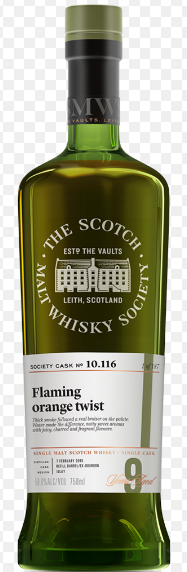
What we have here are two 9-year old peated Bunnahabhains, one from a refill ex-bourbon barrel (200-litre cask), and one from a refill ex-bourbon hogshead (250-litre cask), so this should make for an interesting comparison. 10.116 "Flaming Orange Twist" was distilled in February 2008, and came from the aforementioned refill barrel, which yielded 187 bottles at a cask strength of 59.6% ABV. Whisky number two, 10.130 "Chimney Sweep on a Trawler", was distilled in October 2007, and the refill hogshead yielded 270 bottles at 61.9% ABV. So the larger cask was responsible for the slightly older whisky, but at a notably higher ABV and (it would seem) not as much attention from those thirsty angels. Time for a closer look!

SMWS 10.116 (Bunnahabhain) "Flaming Orange Twist", 59.6%. Islay, Scotland. 
Distilled 2/2008, matured in single refill ex-bourbon barrel, bottled 2017 (9 year old). 187 bottles. Non-chill filtered, natural colour.

Colour: Pale gold.

Nose: Surprisingly subtle and refined, with grassy, oily, fresh vegetal peat, bitter orange peel, and semi-sweet vanilla paste. There's a lovely briny and sandy coastal note too. With more time in the glass it becomes more herbal and grassy, with some fennel seed coming through.

Texture: Medium to heavy weight, nice and oily, there's some heat but it's felt more in the chest than on the palate, which is different, but it's not a harsh or rough spirit-y heat.

Taste: Creamy vanilla and more dark, oily, vegetal peat, some old marine tar and hot bitumen or asphalt (which tastes better than it sounds). Some hot chilli spice and more bitter orange peel.

Finish: Short length, becomes surprisingly soft quite quickly, with that herbal grassy note from the nose coming back through, and the fennel seed as well, but it's been toasted this time.

Score: 3 out of 5.

Notes: It's always hard to combat the power of suggestion with these SMWS bottlings. As soon as you've sighted the label or just the name of the bottling your brain is pre-programmed into looking for, and often finding, certain aromas and flavours. But this one definitely does seem to do what it says on the tin, with the bitter orange, chilli spice and peat notes coming through nicely. I can't say that I find it particularly smoky, it's definitely more peaty and herbal for my palate, but it's nicely balanced as well. Admittedly there's not a huge amount of complexity here, and the finish is surprisingly short and light, but it's a nice young, fresh peated Bunnahabhain with a great weighty texture.


SMWS 10.130 (Bunnahabhain) "Chimney Sweep on a Trawler", 61.9%. Islay, Scotland.
Distilled 10/2007, matured in single refill ex-bourbon hogshead, bottled 2017 (9-year old). 270 bottles. Non-chill filtered, natural colour.

Colour: Pale gold.

Nose: Immediately very different to the .116. Much lighter, softer and cleaner on the nose, despite the higher ABV. There's some charcoal BBQ briquettes, floral honey and dried leafy herbs, some wallpaper paste (flour-y glue) and putty, and a nice sweet lemon citrus note.

Texture: Medium weight, soft on entry with a quick crescendo. There's slightly less heat than the .116 as well, again despite the higher ABV, and it doesn't hang around as long either.

Taste: Cleaner and fresher, more floral honey, sweet citrus, a dry powdery peat and some coal dust. Is this Bunnahabhain's take on a Bowmore? And that's absolutely not a complaint! There's a dry spice as well that releases its heat gradually, like a cayenne powder or dried chilli flakes. Some sweet leafy herbs and a light wood smoke as well.

Finish: Medium length, more staying power here. A little astringent to start with, with more of that floral honey and some lemon oil, then more dry chilli powder and a touch of musty old oak coming through. Sweet citrus again, and maybe a hint of honeydew melon? Some coal dust again, and a good pinch of dark cocoa powder to finish.

Score: 3 out of 5.

Notes: Very interesting! It's less peaty and much less coastal than the .116, and it's dryer as well. There's also less heat, and the heat that is there is more on the front of the palate & tongue rather than the back like it was in the previous dram. I definitely get the "chimney sweep" part of the name of this bottling, but not so much the "trawler" part. And I don't think I'd pick this whisky as a Bunnahabhain if it was served blind, it's much less obvious here with the distillery style more hidden, which makes for a very interesting dramming experience. I really think I could be convinced that this was a Bowmore. But after all, that is the beauty, and also the fun, of tasting single cask whiskies. No two are exactly alike, even when they look similar on paper, and some are vastly different!

Overall notes: They may not be astronomical scores, but these are both very enjoyable whiskies, and they made for a great comparison! In fact the scores wouldn't be this close if I'd gone with a 10-point system way back when. Good old hindsight is always so accurate! The .130 is the winner for me, partly because it's so unexpectedly different, and also because of the longer and more assertive finish. But both are interesting whiskies, and both are different (to different degrees) from the typical distillery style, which is all as we should expect from the SMWS. That's pretty much what they do! Both are also quite mature for the age and strength, and without the helping hand of fresh casks, which is a good sign of careful production from the distillery, and discerning cask selection from the society. Thanks to Scott Mansfield from the SMWS for the samples, and for the opportunity to taste these bottles!

Unfortunately there'll be a short break between reviews over the next five weeks or so, since I'm off on holidays! England, Italy and then of course Scotland - almost exactly 13 months after the last visit! See you on the flip side folks!

Cheers!

Monday, 1 October 2018

Springbank 14 Bourbon Wood Whisky Review!

An ex-bourbon only matured Springbank isn't a very common thing, since there are usually some sherry or wine casks involved in their whiskies, so this'll be interesting!

For quite some time, Campbeltown's Springbank Distillery has had a wide and eclectic range of whiskies that were either fully matured or finished in unusual or uncommon cask types. Known as the wood finish bottlings, they ranged from Rum and Calvados casks, to Gaja Barolo and Tokaji wine casks, with many more in between. They were very simply packaged with largely hand written-style brown labels, and a stamp-style descripton of the cask type stamped across the front label. Those varied and often much-loved bottlings are still being released, although seemingly not as often, but the presentation is now more in-line with Springbank's current packaging. So the off-white labels are gone, the hand written-fonts are gone, and the generic plain outer boxes are gone, replaced by more modern and more appealing designs, as you can see below. It's also worth noting that this new design is also now used for Springbank's single cask bottlings, albeit with a darker shade of blue.


But the contents are the main thing, which were always cask strength, with the month and year of both distillation and bottling printed on the bottle label, and hailing from Springbank Distillery of course means they were -and obviously still are- always non-chill filtered and naturally coloured. None of the above has changed with the move to the new packaging, which is great to see. Some of these releases were more limited than others, and some were more lusted after than others, but all offered something different. There were also releases of Longrow, Springbank's heavily-peated and double-distilled whisky, and Hazelburn, Springbank's un-peated and triple-distilled whisky, in this range, alongside the lightly-peated and 2.5-times distilled Springbank namesake whisky. I really can't wait to finally visit this very "old school" distillery later this year. To stand in those musty warehouses in Campbeltown and breathe it all in will be an almost... spiritual experience!

The bottling we're looking at today is Springbank 14-year old Bourbon Wood, which was fully matured in both first-fill and refill ex-bourbon casks. It was distilled in November 2002, and bottled in August 2017 at a cask strength of 55.8% ABV, with a yield of 9000 bottles. 14-year old Bourbon Wood retails for around $190 AUD and is still around at the time of writing (probably because there aren't any sherry casks involved), and while that's a bit of a step up from the more regular 12-year old Cask Strength bottlings, that's quite reasonable for a slightly older limited cask strength release in Australia. Since an ex-bourbon cask-matured Springbank is quite unusual, in fact the last time one was released was over 15 years ago, it'll be interesting to see how well Springbank's briny, musty "dirty" funky-ness gets along with the lighter and sweeter cask influences from the ex-bourbon casks. And since there are also some refill ex-bourbon casks involved, we may also get to see more of the actual spirit presence in this one. Let's find out...


Springbank 14-year old Bourbon Wood, 55.8%. Campbeltown, Scotland.
Distilled 11/2002, matured in first- and re-fill ex-bourbon casks, bottled 08/2017 at cask strength. 9000 bottles. Non-chill filtered, natural colour.

Colour: Gold.

Nose: Sweet & fresh with a light funk & minerality. There's loads of vanilla custard & marshmallows, and bright tropical fruit - banana, green papaya & melon, plus some lemon & a little apple. Lightly malty & dusty, and some muddy river rocks & icing sugar. With more time, a dry, herbal & floral honey and mixed peppercorns come out.

Texture: Medium weight, silky. Rich & sweet, then dry and funky. Plenty of character here, and no alcohol heat or roughness.

Taste: Sweet entry with more vanilla custard & marshmallow, then a lovely dry minerality with damp stone, dank dunnage warehouses and muddy hay. Crystallised ginger chunks, white pepper and more dry honey. A light hint of bitter & vegetal peat behind as well.

Finish: Medium length. The white pepper, ginger & dry honey carry through, then becomes a little sweeter again and the tropical fruit from the nose resurfaces. No banana this time though, and there's lemon juice alongside. Then vanilla butter icing / frosting and light brine, and a lightly bitter ginger to round things out.

Score: 4 out of 5.

Notes: Great stuff! As expected, it's a sweeter take on the typical Springbank single malt, the 12 year old cask strength for example, and perhaps there's more of the actual spirit character showing through thanks to there being less overt cask influence. It's definitely less "funky" than some Springbank bottlings, and there's a touch more minerality here, but it's still very much a characterful and complex whisky. I really enjoyed having that sweetness switching places with the dryness and minerality, and that trademark farmyard-style musty dirty-ness that Campbeltown is known (and loved) for. That kept things more interesting, and of course is a sign of a very well-made whisky. Having said that, this dram has definitely become more complex and less sweet as it oxidised, on initial opening it was considerably sweeter, and perhaps less interesting. But with the magic of time and a little air it's opened up beautifully, and the Springbank DNA is now much more evident. It was still tasty on first contact of course, but this is a seriously delicious dram as it sits now.

Surprisingly this 14-year old Springbank is still available from a few Australian retailers, and it's still very reasonably priced for what's on offer. I would've put that down to the bourbon cask-maturation not having the immediate "sexy-ness" of a sherry cask, but then the 17-year old Sherry Wood Springbank can also still be found within our shores, and that's a considerably earlier release (but is considerably more expensive). So I'm not sure what's going on there, but I can say that if you're a Campbeltown fan and you haven't tried this one, you're going to want to. Personally, I think I'll be needing a second bottle before this one is gone.

Cheers!

Sunday, 23 September 2018

Bowmore Tempest Whisky Review!

Possibly one of the best recent official bottlings from Bowmore, which is sadly now discontinued and hard to find.


Tempest was a series of limited release / small batch 10-year old Bowmores, all matured in first-fill ex-bourbon casks and bottled at cask strength, with one batch of around 12,000 bottles released per year. Batch 1 debuted back in 2009, and the Batch 6 release that I'm reviewing today was the last of the line in 2015. This series was named "Dorus Mor" in the United States due to a trademark issue, meaning something along the lines of "wild ocean". On face value it may sound like these bottlings were a bourbon cask-matured version of the much-lauded Devils Cask series that were matured in sherry casks, but there were only three batches released of that one, and those three batches were around half the size of the Tempest batches, meaning that the Tempest was far easier to find, and was more affordable and far less collectible. Plus the first 'Devils' debuted in 2013, so they're not closely related, although the specifications are similar.

Nowadays it's pretty much impossible to find cask strength Bowmore official bottlings, particularly with an age statement, unless you happen to be on Islay during the Feis Ile (or unless you buy a flipped bottle at auction a few days later). In fact you'll be hard-pressed to find an official Bowmore with an ABV higher than 43%, with the NAS 'Vault Edition' series being pretty much the only option at present. I've tried the first release in that series, and it was enjoyable, but with an asking price of $220 in Australia it 's roughly twice the price of the last of the Tempests, which is a bit nasty! That said, there is a 'Vintner's Trilogy' series coming which will consist of three age-stated expressions finished in various wine casks, but - if they get to Australia - I'd say we can expect them to be rather expensive as well. That lack of higher strength available Bowmores is a real shame, because they can be delicious, particularly thanks to the lack of chill filtration. Aside from showing a more assertive side to the distillery, they can also showcase some of the bright tropical fruit character that older Bowmore bottlings were known for, particularly when they were matured in ex-bourbon casks.

Which brings us to the whisky at hand. Bowmore Tempest, Batch 6, which was released in 2015. This is a 10-year old single malt that was matured in first-fill ex-bourbon casks before being bottled at a cask strength of 54.9%. Unlike the vast majority of Bowmore's official bottlings it's non-chill filtered and naturally coloured, so this is pretty much as natural as the distillery's bottlings get. This one was a real bargain when it was last released in Australia, with a certain large retailer selling it for around $95 AUD, which is only a few dollars above what the regular 12-year old at 40% ABV goes for on this continent. For a limited release, cask strength Islay malt with an age statement, that is an absolute steal. In fact I suspect that either that large retailer made an error with their pricing, or they got a bargain price from their source, whoever it was. That deal is now long gone of course, but a couple of smaller online retailers still have some stock at higher prices. Seeing that this Tempest was matured in all first-fill casks, and that Bowmore is only peated to around 25 ppm, we shouldn't expect a big peat monster here, but we can expect a little more Islay character than the 'core range' offers. It's tasting time!

Bowmore Tempest, 10 Year Old, 54.9%. Islay, Scotland.
Matured in first-fill ex-bourbon casks, bottled at cask strength. Batch 6 released 2015, 12,000 bottles. Non-chill filtered, natural colour.

Colour: Light-medium gold.

Nose: Soft and a little closed initially, with semi-dried pineapple, coal dust, spicy wood embers and candied grapefruit. Once it opens up more there's rich vanilla fudge, mango skins, some lemon and a little floral sweetness. Further on there's a nice wet stone minerality and some damp malted barley.

Texture: Medium weight, builds slowly, warming but no heat.

Taste: Soft on entry, with loads of dried citrus - grapefruit and lemon, and a soft minerality with damp rocks and sea spray. Some more coal dust / chimney soot and more vanilla fudge.

Finish: Short-medium length. More dried citrus and chimney soot, and a little astringent and drying. Then dried pineapple again, white pepper, and vanilla sponge cake with lemon icing.

Score: 3.5 out of 5.

Notes: It may not be massively complex, and it doesn't have the immediate intensity of most 10-year old cask strength Islays, but it's a very enjoyable dram regardless with plenty of character. In fact I can comfortably say it's the best bourbon cask-only Bowmore that I've tasted to date. That tropical fruit that I mentioned earlier is there, as is the citrus that I've found in pretty much all of the better Bowmores. The chimney soot / coal dust note is excellent too, which might have something to do with the distillery using powdered peat for their floor-malted barley (although that only makes up a small part of their malt requirements), but I could be wrong there. In any case it works very well in this dram, and this one was an absolute bargain at the last price that that large retailer had it going for. If you managed to get one back then, that was definitely a win for you!

If you've been hearing good things about Bowmore but the distillery has never quite clicked for you, I suggest you get your hands on a cask strength version without the chill filtration, and preferably from first-fill casks. I'm guessing it'll all make more sense to you after that!

Cheers!

Sunday, 16 September 2018

Starward Bourbon Cask Whisky Review!

The first ever ex-bourbon cask bottling from Starward, the best bang-for-buck Australian single malt distillery around. Exciting stuff!


Ex-bourbon cask malts may be a dime a dozen from most whisky producers around the world, but they're far less common in Australian single malts. There are only a couple of Australian distilleries that are using ex-bourbon casks on a regular basis, largely thanks to our massive import costs, their relative scarcity, and the abundance of Australian wine and fortified wine casks. So the majority of high quality Australian single malts are matured in Australian ex-port (officially 'tawny') and ex-sherry (officially 'apera') casks, and red wine casks to a lesser extent. But ex-bourbon casks can work very well with Australian single malts, with Melbourne's Bakery Hill and Tasmania's Sullivan's Cove being the most widely-known examples.

Melbourne-based Starward, produced by New World Distillery, are best known for their accessible and (by Australian standards) affordable Wine Cask and Solera "core" expressions, with the former being matured in fresh Australian red wine casks, and the latter being matured in Apera (Australian sherry) casks in a solera system. They're both intentionally very easy-drinking and crowd-pleasing whiskies, at 41% and 43% ABV respectively, but for the more hardcore whisky fans they can be a little light. Aside from 2017's Tenth Anniversary release, the only way to get higher strength offerings from New World Distillery was the "New World Projects" range of limited and often experimental bottlings. The "Projects" releases have been around for quite some time, and actually started off with the distillery staff playing around and experimenting with different casks and different maturation techniques. But the label has been a little quiet recently.

But the distillery hasn't been slacking off - the demand has been so strong that they recently ran out of their core range whiskies for a while, and haven't recovered yet - and they've recently re-launched the Projects range, now known as Starward Whisky Projects, now in a 500ml bottle with a more presentable design. And the first Projects release since the re-launch is Starward / New World's first bourbon cask-matured whisky! It's substantially older than the core bottlings at 4.5 years of age, and it spent all of that time in first-fill ex-bourbon casks from Maker's Mark and Wild Turkey, before being bottled at 52% ABV without chill filtration or added colouring. That ABV won't be full cask strength of course, but it's a nice substantial drinking strength and it worked very well with the aforementioned Tenth Anniversary bottling. There wasn't a lot of build-up or marketing hype for this new whisky, in fact it was all done relatively quietly, but it didn't matter: the 1200 bottles released sold out on the official website within hours of release, despite only a select few having tasted it in advance. Which just goes to show the loyal following that Starward & New World has, and the level of faith that following has in the distillery crew. But then again, if you decide to try a new limited release Australian whisky before buying in the current climate, you're essentially deciding either to miss out completely or to pay an inflated price further down the track, so it often involves a slight leap of faith.

Some naysayers may be baulking at that 500ml bottle size, but let's remember that the reduction in size means there were nearly 30% more bottles to go around than there would have been otherwise, and that pricing is generally kept to a reasonable level. At least it is in Starward's case, since unfortunately there are plenty of other Australian producers that go the other way, even with 500ml bottles. Speaking of pricing, this one was priced at $109 AUD - including shipping - straight from the distillery, which is extremely reasonable for a limited-release Australian single malt at a higher strength. Some may also baulk at that 4.5-year age, and no there isn't an age statement printed on the label, but don't forget that Starward take full advantage of Melbourne's famously indecisive climate, and as a result their whiskies are far more mature than the numbers would suggest. But as always, the proof is in the pudding!

Starward Bourbon Cask, NAS, 52% ABV. Melbourne, Australia.
Matured for 4.5 years in ex-Maker's Mark & Wild Turkey bourbon casks. 1200 bottles. Non-chill filtered, natural colour.

Colour: Gold.

Nose: Quite sweet, banana lollies, slightly dusty, some lightly sour pineapple sherbet, and a little aniseed in the background. Some green apple & melon, vanilla custard powder, a little white chocolate, and marshmallows dusted with icing sugar.

Texture: Medium weight, rich & lightly chewy. There's a little heat, but not an unpleasant amount.

Taste: Drier than the nose suggested, quite astringent as well. More of that sweet banana confectionery (Starward's trademark esters of course), some savoury crystalised (grainy) honey, white pepper, vanilla custard and a little caramelised oak.

Finish: Short-medium length. A little spirit-y initially, becoming mellow with more pineapple, green melon, aniseed and white pepper. Vanilla custard again, but more of a baked custard now, and a flash of those bananas and aniseed before fading away.

Score: 3 out of 5.

Notes: A nice tasty dram for sure, and very much what you'd expect from a light, young, ester-y whisky matured in fresh bourbon casks. It has plenty of character though, as usual from Starward, and the nose is a particular highlight although it's very much on the sweet side of things. The overall effect isn't massively complex, but there is enough going on to keep things interesting. That touch of heat is a little distracting admittedly, but it's not harsh or rough, particularly when you consider that this is a 4.5-year old whisky bottled at 52%. Which is showing the fruits (pun intended) of Starward's labour, and the effects of the local weather conditions of course. So this Bourbon Cask expression doesn't quite have the magic of the Tenth Anniversary bottling in my book, nor the brilliant distillery-exclusive Cognac Cask, but it's nevertheless another enjoyable Starward, and like those aforementioned drams it showcases a different side to the spirit that isn't seen in the two core expressions. Which of course is what the Projects series is all about.

We also need to consider the pricing here. I don't usually account for that that in my scoring, and I haven't in this review. But where some Australian single malts have literally doubled in price over the last few years, and are still selling despite them now being beyond the reach of most drinkers and even their previously loyal fans, to have a limited release at higher strength sell for such a reasonable price is a breath of fresh air. I know the fans of some of those very expensive Aussie whiskies are going to rebut that Starward is one of the largest malt whisky producers in the country, and is the only one to attract international investment so far, which is a fair point - and is no bad thing if you ask me. I'm all for the small producers who are making quality whisky at reasonable prices, but those are becoming harder to find these days. I'd place Starward, Bakery Hill, Black Gate, Belgrove, Bellwether and the newcomer Launceston Distillery in that camp, and that's about it. They're producing great quality whisky at relatively affordable prices, rather than banking on the apparent collectibility of Australian whiskies and choosing to put their product out of reach for most of their initial supporters. And more power to them.

Cheers!

Sunday, 9 September 2018

New Port Charlotte 10 & Islay Barley Whisky Reviews!


I've been a big fan of Bruichladdich's heavily-peated Port Charlotte range for quite some time, since trying the excellent PC7 cask strength expression around five years ago (and I was lucky to find it!). Talk about jumping into the deep end! Since those early days I've loved all of the Port Charlottes that I've come across, some more than others of course, but the label does seem to get a little lost in the crowd in the peated Islay whisky sector. It doesn't have the immediate brand recognition of Laphroaig, Lagavulin or Ardbeg, even among the more serious peat-heads, and I'd say that one of the limiting factors is the excellent quality & success of Octomore, Bruichladdich's super-heavily peated range. Which makes Port Charlotte something of a middle child, stuck between the massively-peated Octomore and the un-peated Bruichladdich whiskies.

Of course Bruichladdich are aware of this, and not being one to sit on their laurels, they've recently taken the bull by the horns and re-launched the Port Charlotte brand. Port Charlotte was always packaged in the same bottles as the namesake Bruichladdich bottlings, carrying very similar labels & designs including those on the outer tins, which wasn't helping the 40 ppm peated Port Charlotte stand out. So they've come up with a new bottle design, including going from clear to dark green-coloured glass, which is more inline with the other Islay staples, and also making sure that the beautiful, but often pale, natural colour doesn't alienate any of the (perhaps less discerning) potential buyers out there. I do like the new design, it has something of a military feel to it in my book - maybe smoke grenades, which is appropriate -  and they're chunkier and more solid in feel as well. The labels and outer tins haven't changed, and you'll find just as much information printed on them as always. Plus the liquid inside is just as good as it's always been, which of course is the main thing!


 Out with the old (L), and in with the new (R)!

The new Port Charlotte bottles actually debuted in June this year at Feis Ile (the Islay festival) with two distillery-exclusive expressions, and a couple of the hand-filled Valinch / Cask Exploration bottlings since, but these two new expressions are the first of the general releases to feature the new design. The two new general releases that I'm looking at today are Port Charlotte 10-year old, which is now a permanent expression (unlike the last two versions and the cask strength PC10), and Port Charlotte Islay Barley 2011 vintage. I was lucky enough to attend the recent Brisbane trade launch of these two new whiskies, which was hosted by Chloe Wood, Bruichladdich's amazing brand ambassador for the Asia Pacific region (based in Singapore), along with Mark Hickey & Casey Gray from Spirits Platform, Bruichladdich's importer & distributor for Australia. Chloe's knowledge of every facet of the distillery was fantastic, and being an Ileach (Islay native) and having worked at Bruichladdich herself, it was all first-hand. It was also great to see this sort of event happen in Brisbane, when we'd normally be passed over in favour of the bright lights of Sydney and/or Melbourne. I was also lucky / sneaky enough to get a couple of samples of both of these new Port Charlottes to review in detail, so let's get to it!

We'll start with the 10-year old, a new permanent Port Charlotte edition at that age. The delicious original Port Charlotte 10-year old (reviewed here) was first released in early 2012 under the reign of the legendary Jim McEwan, and was a 60/40 split of ex-bourbon and ex-sherry casks, bottled at 46%. So not to be confused with the far rarer and more limited PC10, which was bottled at cask strength as the sixth release in the "PC_" series. Both of those were landmark bottlings, since they marked the "coming of age" of the Port Charlotte spirit that was first distilled in May 2001, soon after the distillery's revival. That original 10-year old was intended to be a permanent expression at the time of release, but the stock & production couldn't keep up, and it was discontinued. It was followed by the "second edition" Port Charlotte 10-year old in late 2016, which saw the bottling strength increase to 50% ABV at the same time as the standard strength of the Bruichladdich line-up. That one had an interesting cask profile, being matured in first-fill ex-bourbon, ex-sherry, Spanish and French red wine casks, and it was a limited run of 18,000 bottles, released alongside the Bruichladdich & Octomore 10-year old second editions.

Which brings us to the new permanent addition, simply named Port Charlotte 10. This one is actually replacing the current entry-level Port Charlotte whisky, the NAS (multi-vintage in Bruichladdich speak) Port Charlotte Scottish Barley, and it's slated to arrive in Australia in late October / early November this year, at an RRP of around $115-120 AUD. It's still made from 100% Scottish barley, and has been matured in 65% first-fill ex-bourbon casks, 10% second-fill ex-bourbon casks, and 25% second hill un-named French red wine casks, before being bottled at 50% ABV, without any added colouring or chill filtration. Which is a pretty good resume for an entry-level expression! Tasting time...

Port Charlotte 10 (year old), 50% ABV. Islay, Scotland.
Distilled from Scottish barley peated to 40 ppm, matured in 65% first-fill ex-bourbon, 10% second-fill ex-bourbon, and 25% second-fill French wine casks. Non-chill filtered, natural colour.

Colour: Gold.

Nose: Fresh & bright, very Bruichladdich in ts overall style, with a lovely soft, dry, crumbly peat, light brine, some banana cream and a touch of pineapple. Lovely toasted oak and a little mint, citrus rind, a couple of dried strawberries and some pastry dough.

Texture: Lovely. Creamy and soft, medium weight, and no heat at all.

Taste: The lovely crumbly and soft peat again, with that pastry dough and fresh citrus around the edges. A nice touch of sea salt and a little butterscotch. Creamy vanilla and coconut, and a little mashed banana, with a flash of dry wood smoke behind.

Finish: Medium length. Toasted coconut and creamy vanilla, with a light briny undercurrent. The dry peat returns plus a little ash, and a lovely creamy smoky citrus like a burnt lemon meringue.

Score: 3.5 out of 5.

Notes: Very nice stuff! So soft and balanced, even at 50% ABV. Bright and inviting on the nose, and so creamy on the palate, with no off-notes whatsoever. Very easy drinking as well with no heat or harshness. It's not a big peaty bruiser like some other 10-year old Islays, this is a very approachable and comforting dram with loads of character. It's hard to fathom that this is now the entry-level Port Charlotte! Excellent value for money as well. Sign me up now.


Next up, Port Charlotte Islay Barley 2011! Being a "vintage" release this is obviously a limited bottling, and is the second Port Charlotte release that was distilled from Islay barley. The previous iteration, the fantastic 2008 vintage, was packaged in a white outer tin, was distilled from Oxbridge and Optic barley that was grown on six different farms on Islay, and was matured in ex-bourbon casks for around seven years prior to bottling at 50% ABV. This new release is packaged in a light grey outer tin (I believe the Valinch bottlings now get the white tins), and was distilled from Oxbridge and Publican barley that was grown on three different farms on Islay, but the cask profile is quite different on this one. It was matured for around seven years in 25% first-fill ex-bourbon casks, and 75% second-fill wine casks, of the Syrah and Merlot varieties. Those are both relatively heavy red wines, but being second-fill casks, and being a young whisky, we shouldn't expect a massive wine influence in this one. Islay Barley 2011 has already landed in Australia, and is being distributed as we speak, with an RRP of around $115 AUD. Islay-grown barley now makes up a third of Bruchladdich's annual barley requirements, which is great to see!

Port Charlotte Islay Barley 2011, NAS, 50%. Islay, Scotland.
Distilled from Islay barley peated to 40 ppm, matured in 75% first-fill ex-bourbon casks & 25% second-fill ex-red wine casks, around 6 years old. Non-chill filtered, natural colour.

Colour: Pale gold.

Nose: Richer and heavier, but still bright and inviting. Oily putty, like a dark gritty gap-filler, some sweet citrus (lemon) and warm sandy beaches. A nice light minerality, like wet stone or damp clay, and a nice creamy white chocolate.

Texture: Oh yes. Medium-heavy weight, rich and lightly oily. No heat at all.

Taste: Rich and peaty, a nice dry peat with some wood ash mixed in. Sweet citrus again, a touch of mixed berry jam, fresh tar, some white pepper, and more of the damp clay and that oily putty.

Finish: Medium length. Peaches & cream, sweet citrus again, more damp earthy clay and a nice dry peatyness that surges & fades. Some salty driftwood and ashy wood smoke, and a lovely golden barley pokes through!

Score: 4 out of 5.

Notes: Love this dram. Again it's very drinkable for what is a very young whisky, especially at 50% ABV, and I doubt that you'd guess it to be just six-ish years old. It's definitely more peat-forward and perhaps less complex, and it's also less expressive on the nose than the 10 year old, but if you like your peat you'll dig (pun intended) this one. It's definitely very different to the last Port Charlotte Islay Barley as well, which is no doubt down to those second-fill wine casks. It's still quite a light, clean and easy-drinking malt for what is a 40 ppm (on the barley) whisky at six years of age and 50%. Which of course is the beauty of Bruichladdich!

Overall notes: Well, both of these Port Charlottes were just added to my "buy" list. Both are of excellent quality, they're full of character with plenty of interesting new notes to discover, but the 'laddie DNA is still present in both of these whiskies. If I had to pick an outright winner it would obviously be the Islay Barley, but you can't go wrong with either of these really. The 10 is softer and more rounded, as you'd expect, and the nose is definitely more expressive on that one, but the palate and finish on the younger Ileach are just delicious. Both will offer excellent value for money as well, particularly when you consider the higher strengths, natural presentations and the provenance, in 'laddie speak, that they offer. I love pretty much everything that Bruichladdich do these days, and that doesn't seem likely to change in the future.

Along with the re-launch and these two new Port Charlottes, there's also a new and very exciting travel-exclusive Marsala cask expression coming, dubbed MC01 (Marsala Cask 01), which will replace the excellent CC01 Cognac cask bottling, and a limited wine cask finished expression, dubbed MRC01. It just so happens that the Port Charlotte cask that was offered at the distillery's warehouse experience that I attended last year was matured in a similar wine cask, and it was absolutely fantastic, in fact it even overshadowed the 11-year old Octomore that followed it! So I have high hopes for MRC01 as well. I think we can expect even bigger things from Port Charlotte in future, and I'm looking forward to tasting those things!

A big thanks to Mark & Casey from Spirits Platform and Chloe Wood from Bruichladdich for having me at the very informative launch event, and of course for the samples, and an extra thanks to the people at Bruichladdich for continuing to bring us excellent quality whisky. We all love you for it. 

Cheers!

Sunday, 26 August 2018

Two Port Charlotte Valinch (Cask Exploration) Whisky Reviews!

What's a Port Charlotte Valinch, you might ask? They're hand-filled Port Charlottes, filled straight from the cask in Bruichladdich's shop at the distillery! Aside from the inevitable online auctions and private secondary market, the only way to get your hands on one of these whiskies is to get yourself to the distillery shop on Islay. Having done so myself, believe me when I say it's definitely worth the trip!


All but one of the island's distilleries (I'm looking at you, Ardbeg!) offer either a distillery exclusive or hand-filled bottling (plus Feis Ile bottlings if your timing - and luck - are spot on), with even giant Caol Ila now offering hand-filled 200ml bottles for purchase in their shop, in addition to their distillery exclusive bottling that was released in 2017. Laphroaig offer hand-filled 250ml bottles as part of their two top-tier distillery tours, the "Distiller's Wares Tour" and the "Water to Whisky Experience", where you taste three whiskies straight from the cask in their warehouse, and then choose your favourite to bottle and take home. Lagavulin have a distillery exclusive bottling and often exclusive Feis Ile or Jazz Festival bottlings, and Bunnahabhain usually offer both hand-filled and distillery exclusive bottlings, often taken from unusual cask types. Kilchoman usually have a high-level distillery shop exclusive single cask bottling, while Bowmore offers distillery exclusive hand-filled bottles, again if your timing is right, although you don't actually bottle those yourself. And I should add that most of these exclusive bottlings are quite reasonably priced.

But there aren't many that can match Bruichladdich's Valinch offerings, where there are usually two casks to choose from, an un-peated Bruichladdich and a heavily-peated Port Charlotte (40 ppm). Or you could also get both, of course! A valinch by the way is a long tube-shaped siphon used to draw liquid from casks through the bung hole. These single cask bottlings are sold in 500ml bottles, usually for around 70-75 pounds, and are filled straight from the tapped casks in the distillery shop. There's no need to do a distillery tour to purchase, although I do recommend both that and the fantastic warehouse experience if you're making the journey. Adding to the allure is the fact that these Valinch casks are often unusual, most commonly being a wide variety of red wine casks (in typical Bruichladdich style), but also dessert wine, white wine, virgin oak, and of course sherry and bourbon casks have been released. The Bruichladdich releases are titled 'The Laddie Valinch', and are often named for distillery staff members, while the Port Charlotte releases are titled "Cask Exploration", and often have a Gaelic name. Obviously these whiskies are always bottled at cask strength, and are never chill filtered or artificially coloured, and the quality level is usually very high.

The two that I'm looking at today are Port Charlotte Cask Exploration 07, which was released in mid-2016, and Port Charlotte Cask Exploration 12, which was released in early 2017. Cask Exploration 07 is a 9-year old Port Charlotte that was fully-matured in a Rivesaltes red wine cask, cask number 1653, which yielded 393 bottles at a huge ABV of 64.7%. Rivesaltes is a style of sweet fortified wine, usually red, produced in the south-west of France, and it's often left outdoors in glass containers to stabilise before being filled into casks. Cask Exploration 12 is a 9-year old Port Charlotte that was fully-matured in a Barolo wine cask, cask number 1739, which yielded 436 bottles at 59.9% ABV. Barolo is a red wine from northern Italy, made from Nebbiolo grapes, and is often quite heavy and tannic wine. Port Charlotte often gets overlooked by some whisky fans, with either the un-peated Bruichladdich or the super-heavily-peated Octomore getting most of the attention. But Port Charlotte is a little bit of a sleeper, nicely smoky & sweet, which should work well with these first-fill red wine casks! The samples I'm reviewing came from a fellow whisky nerd, who sourced both bottles from a popular UK auction site. Let's get to it...

Port Charlotte Cask Exploration 12, 9-years old, 59.9%. Islay, Scotland.
Distillery exclusive hand-filled. Distilled 9/2007, released 2017. Matured in a single first-fill Barolo Italian wine cask, cask number 1739, yielded 436 500ml bottles. Non-chill filtered, natural colour.

Colour: Gold.

Nose: Quite shy, even after breathing time & warming. Nicely dirty & funky though, with dried sour red & citrus fruits, some 'laddie lactic funk but in a more dirty & drier way than usual. A little floral & heather-y sweetness, and some dry earthy peat in the background.

Texture: Medium weight, quite dry and peppery, a little heat but not a huge amount for a 9-year old whisky at nearly 60% ABV.

Taste: More peat here, quite dry as well with that peppery spice. Still not a lot of peat though, more of a dry earthy-ness. Certainly not at the level of smoke that I've found in other cask strength Port Charlottes. Some thick stewed fruits and that dirty funky-ness in the background.

Finish: Medium length, a little hot and peppery again. A little cologne and stewed fruit, and it is tannic, but they're more wood tannins than wine tannins to my palate.

Score: 3 out of 5.

Notes: Not a big heat for me to be honest, the funky-ness and fruit are a nice touch but that dry peppery spice is too dominant and doesn't play nicely with others. I did add a little water after the tasting notes, just to see what happened, and as you'd expect it dialled down the pepper and dialled up the sweetness, bringing it more towards the lactic sweetness that Bruichladdich is famous for.

Port Charlotte Cask Exploration 07, 9-years old, 64.7%. Islay, Scotland.
Distillery exclusive hand-filled. Distilled 8/2006, released 2016. Matured in a single first-fill Rivesaltes French wine cask, cask number 1653, yielded 393 500ml bottles. Non-chill filtered, natural colour.

Colour: Full amber. Much darker.

Nose: Much richer & fuller. Loads of dark chocolate and shredded coconut, toasted oak and some lanolin (sheep's wool grease used in skin creams) which is very interesting! Some sweet & musty dessert wine, can't quite put my finger on it so I assume it's the Rivesaltes showing itself. There's a little peat smoke as well, but only a trace.

Texture: Rich & funky. medium weight, far less hot than the Barolo cask despite the added 5% ABV.

Taste: More chocolate! Fruit & nut semi-dark chocolate, and a little more of that lanolin and shredded coconut, and the toasted oak. Some dried fruit, and a touch of dry earthy peat.

Finish: Medium length. A little spice initially, then that sweet, syrupy & musty dessert wine, more lanolin, dried stone fruit and a flash of earthy peat.

Score: 4 out of 5.

Notes: Very nice! Totally different to the Barolo cask, as it should be of course, but it's much richer, and more mature in my humble opinion. Really enjoyable, and I'm loving that lanolin note that I don't remember finding before to this degree. It's a big whisky of course but it's not hot or aggressive with the alcohol being well hidden, and the flavours carry through very well. Great stuff.

Overall Notes: Two extremely different whiskies! Both a surprisingly light on the peat and smoke, in fact they're very different animals compared to the other cask strength Port Charlottes that I've tried at a similar age. But that's the beauty of single cask whiskies of course, no two are the same, as nature intended. There's no denying how special these drams are, being hand-filled single cask Port Charlottes that have come from that cosy haven of a shop / visitor's centre at the distillery, there's no more where they came from. And being matured in usual cask types just adds to that allure, which is often the case with these valinch bottlings from Bruichladdich.

Obviously the Barolo cask and I didn't quite hit it off, and the Rivesaltes cask absolutely smashed it despite the not-insignificant jump in strength. I suspect that given these two in a blind tasting I would've guessed the latter to be older than the former, which isn't the case, I'm assuming it was just a more active cask. Nonetheless, knowing where these whiskies came from takes me right back to that grey, rainy "dreich" day on the shore of Loch Indaal, when the rain started as I arrived and stopped as I departed, and I wouldn't trade that experience for anything. I can't wait to get back there again in a couple of month's time!

Cheers!

Aberargie Inaugural Release Whisky Review!

The inaugural release from one of the newer breed of Lowland distilleries, albeit one that was founded nearly ten years ago! Aberargie Disti...