It's been a while since I reviewed a Highland Park, and - despite being a bit of an outlier - this just happens to be one of the best HP official bottlings that I've tried in a long time!
Why is this whisky an outlier? Because rather than the usual Highland Park maturation method of various types of Oloroso sherry cask (American or European oak, first-fill or refill etc.), Full Volume has been matured only in first-fill ex-bourbon casks. That might put some old-school Highland Park fans off, but it shouldn't, because this expression has been bottled at a higher strength than the vast majority of their official bottlings, which tend to be 40% or 43% ABV. Despite the name though, Full Volume has not been bottled at cask strength, but rather at the odd strength of 47.2%. So not really full volume, just a higher volume than normal! And although this whisky has been chill filtered, the details on the side of the outer box clearly state that it was filtered at 4 degrees Celsius, which is the upper limit for chill filtration. When was the last time you saw a distillery quote the temperature that a whisky was chilled down to prior to filtering? It certainly doesn't happen very often! With different temperatures and other factors like the grade of filter (fine or coarse) and pressure used, determining how much of the oils, fats & proteins are actually stripped from the whisky during chill filtration, this whisky is essentially less chill filtered than most chill filtered whiskies. But I do have to ask, since this whisky was bottled at over 46%, why bother chill filtering it at all? Why not just barrier filter it, keeping it a more natural product? Particularly when a few of Highland Park's many limited releases are already non-chill filtered. When a large number of distilleries are bottling most or all of their products without chill filtration these days, it seems an odd choice. Especially for a whisky named 'Full Volume'.
Speaking of which, that name is actually a reference to the electric instrument musician's skill at tweaking an amplifier and equaliser to avoid distortion, and achieve the desired tone and volume. Highland Park have drawn the comparison between this and the skill of their master blender when creating a whisky, and as you can see below they've gone all out with that theme on the whisky's packaging. The outer box represents an amplifier and equaliser, and there's even a set of tuning knobs on one side that are meant to give an idea of this whisky's profile, including a volume knob - also found on the bottle's front label - that is turned up to 11 in a nod to Spinal Tap (but it's not cask strength, remember). Something else that is a bit strange is a few of the details that are printed on the other side of that outer box. There you'll find information like the exclusive use of first-fill bourbon casks, and the sizes of those casks (200-litre barrels and 250-litre hogsheads), but also extra and rather unusual details like the exact number of casks in the vatting (a not insignificant 481), the exact filling dates of those casks (6 different days in mid-1999), and that those casks were "filled at strengths of between 63.6% and 63.7%". Kudos for adding more information than usual, but I really don't see why that's relevant, when the vast majority of whisky is filled into casks at 63.5%, and like I've mentioned once or twice already this isn't a cask strength whisky, so the filling strength back in 1999 has very little bearing on the final product. Maybe I'm nitpicking here but it does seem like an odd thing to mention, particularly right there on the side of the box! Likewise that number of casks, it's not exactly a small figure and means that this limited release can't really be that limited after all. Particularly since it was bottled two years ago and is still easy to source. But luckily the packaging does also state that this whisky is naturally coloured, and while this Highland Park doesn't exactly have an age statement, it does have a year of distillation, 1999, and a year of bottling, 2017, making this a 17-18 year old whisky.
Before we get into the whisky itself, let's have a quick recap on Highland Park. Owned by the Edrington group, the distillery is located in Kirkwall, on the 'mainland' of the Orkney islands north of the Scottish mainland, and has been there since 1798, although it's first license wasn't granted until 1826. They floor-malt a portion of their barley, and that portion is peated to around 20 ppm with local peat from Hobbister Moor on Orkney, which is largely comprised of heather. That floor-malted peated barley is then mixed with externally-sourced un-peated barley, usually at a mix of around 20% peated and 80% un-peated. After double-distillation in their four stills the distillery fills the majority of their 2.5 million litre annual output into Oloroso sherry-seasoned casks, with the rest going into ex-bourbon and a few other types. They also marry, or rest, each new vatting for at least a month before bottling, to allow the whiskies to "harmonise". I can't find any information on what vessel that happens in, so I'd presume it to be stainless steel vats, which of course is no bad thing for that purpose. Highland Park produce a massive range of expressions, and on their website you'll currently find a frankly ridiculous 39 different bottlings listed as their current range of single malts. Naturally some of those are old vintage bottlings, plus the standard core range of the 12 and 18-year olds, but there are also a huge number of non-age statement, marketing-heavy, viking-themed expressions with very little real information published that are, honestly, a little tiresome. In fact they're a little hard to keep up with, even in the age of the internet and social media. Making them even harder to keep up with is the fact that many of those are also travel retail (duty free) exclusive and/or are only sold in certain countries or regions, and on that note Full Volume was actually exclusive to the US when first launched, and is only sold in travel retail in Australia, and has only been available there for a year or so. It's priced at $129 AUD, which is quite reasonable for a 17-18 year old limited release whisky at a decent strength, but I can't help but wish that it was more widely available for those who don't frequently travel overseas. I know that most of the above sounds a little negative or even cynical, which is not really intentional, I'm just calling it as I see it. I'm still a fan of Highland Park's work, particularly when bottled at cask strength. But the main thing of course is that this is a tasty and good value whisky. So let's find out, shall we?
Highland Park Full Volume, 17-18 year old, 47.2%. Orkney, Scotland.
Distilled 1999, bottled 2017. Fully matured in first-fill ex-bourbon casks, lightly peated. Chill filtered at 4 degrees, natural colour. Travel exclusive in Australia.
Colour: Semi-pale gold.
Nose: Very nice! Vanilla custard, russian fudge (lighter style sweet fudge), lots of lemon peel and some dried apricot. That dry heathery peat is there, like burnt herbs, and a subtle hint of heather honey as well. Some lightly spicy charred wood (cinnamon & pepper), and a couple of dried apples in the distance.
Texture: Medium weight. Richly flavoured with a generous pinch of pepper, lightly waxy.
Taste: More wood spice and more dry heather-y peat, some beeswax (natural honeycomb with the honey drained out), and a bit of orange. Drier than I would've guessed from the nose, which wasn't massively sweet either in the scheme of things (not a criticism by any means). More burnt herbs (that peat showing itself again), and more lemon peel, plus that vanilla but it's vanilla paste here, and it's definitely drier to boot.
Finish: Medium length. More black pepper, vanilla paste, still-smoking burnt herbs and that floral heathery peat. But it's soft overall once that pepper note subsides, with more beeswax, fudge and lemon peel.
Score: 3.5 out of 5.
Notes: Quite a tasty dram this! And definitely one of the best official bottlings of Highland Park that I've tasted in recent times. Plenty of flavour, and more peat is evident than in most HPs, particularly at this age level, which I'd say would be down to the ex-bourbon casks being a little less dominant than the sherry-seasoned ones that are HP's modus operandi (M.O.), and also the higher bottling strength. I'm digging that vanilla, lemon, heather & pepper combo too, it works very well and those flavours are nicely balanced, which of course is the whole premise behind this whisky, showing off the balancing skills of the blenders. And all the marketing and other little niggles aside, I think it does achieve that.
I can't help but wonder what this whisky would've been like at it's actual full volume (cask strength and completely non-chill filtered), but that would've put the price up, and it's pretty reasonable at the $129 AUD mark. Particularly when you consider that the asking price for the standard Highland Park 18-year old, which is only bottled at 43%, is $200-250 AUD these days. Which despite being a nice whisky is one of the most expensive 18-year old core range / standard official bottlings on the market at the moment. But then if Full Volume had been released to the general market rather than travel retail, that price would probably have increased. On the flip-side that doesn't make it particularly easy to get hold of a bottle, so it's a bit of a Catch-22. Definitely worth grabbing a bottle when you're next going through an international airport, though!
Cheers!
Sunday, 28 July 2019
Sunday, 21 July 2019
Hazelburn Rundlets & Kilderkins Whisky Review!
A cask strength, 10-year old, small cask-aged Hazelburn, and the third & final instalment in the Rundlets & Kilderkins releases. Bring on the (sexy) funk...
Hazelburn is the triple-distilled and un-peated spirit produced by Springbank Distillery in Campbeltown, named after the Hazelburn Distillery which closed in 1925. A few of the original distillery's buildings still stand, the majority of which now form a business park 300 metres down the road from Springbank. Hazelburn only makes up 10% of Springbank's annual production, while 80% goes to the namesake Springbank spirit which is lightly-peated and 2.5-times distilled, and the heavily-peated and double-distilled Longrow takes up the remaining 10%. Bear in mind that Springbank have a maximum annual production capacity of around 750,000-litres of spirit, a positively tiny amount compared to most operating Scottish distilleries, so there really isn't a lot of Hazelburn produced. There's also less spirit produced thanks to that triple distillation, where the un-peated wash is run through each of Springbank's three stills (pictured above) in series, starting with the direct-fired wash still, then the worm tub condenser-equipped first low wines still, and the shell & tube condenser-equipped second low wines still. Which means it's a lighter and more refined spirit, at a higher alcohol level with a spirit / heart cut average of 75% ABV when it leaves that third still. Triple distillation is associated more with Irish whiskeys these days, and only a few Scottish malt distilleries have dabbled in the practice, with Auchentoshan in the Lowlands being the only Scottish distillery to triple-distill the entirety of their production.
As a result of triple distillation and also the lack of peat used in the kilning of the applicable malted barley, Hazelburn tends to be a lighter, cleaner and more refined whisky than the Springbank and Longrow malts. So there's generally less Campbeltown "funk" to be found in these bottles, but if you play your cards right (cask strength required, in my experience) you'll still find it. Personally, and like many Springbank fans I suspect, I do tend to prefer Springbank & Longrow, so my experience with Hazelburn isn't on the same level, but I have had a couple of excellent expressions in the past. The winner so far was a refill Sauternes cask-matured Springbank Society bottling, which I'm not likely to ever come across again, unfortunately. It's hard to argue with the statement that the finished product tends to be less "Campbeltown-y" than the other Campbeltown malts (Kilkerran and Glen Scotia included), but it's still a Springbank, which means that everything other than growing the actual barley itself is done on-site. From malting, milling, fermenting, distilling, maturing and bottling, it all happens at the distillery. And for 100% of the distillery's production. Which is certainly not something you see everyday!
This particular Hazelburn is the third and final instalment in Springbank's Rundlet's & Kilderkins releases, following on from 2012's 10-year old Springbank release, and 2013's 11-year old Longrow release (reviewed here). A rundlet is a 68-litre (approx.) cask, and a kilderkin is an 82-litre cask, compared to the 200-, 250- and 500-litre casks commonly used for Scotch whisky maturation. Smaller casks equals more surface area contact equals more cask influence, so these whiskies tend to drink well beyond their modest age statements. This 10-year old Hazelburn (not to be confused with the regular 10-year old expression) was bottled at a cask strength of 50.1% ABV, and of course is non-chill filtered and naturally coloured like everything that comes out of Springbank's narrow driveways. While both the Springbank and Longrow releases consisted of 9,000 bottles apiece, there were 12,000 units of the Hazelburn released, which is a significant number, but I was nevertheless surprised to see this whisky still available in Australia here in mid-2019. Why? Because it was bottled over five years ago, way back in early 2014! It's still quite reasonably priced as well at around $165 AUD, and while Hazelburn doesn't quite have the cult following of the distillery's other two products, I can tell you now that it is a serious bargain. Get in quick folks, and tell them Peated Perfection sent you!
Hazelburn Rundlets & Kilderkins, 10-years old, 50.1%. Campbeltown, Scotland.
Un-peated triple-distilled single malt from Springbank Distillery. Fully matured in re-coopered 68-litre rundlet and 82-litre kilderkin casks. Cask strength, non-chill filtered, natural colour. 12,000 bottles, released 2014.
Colour: Gold.
Nose: Oily, lightly cheesy, slightly herbal & earthy. Olive oil, baked red apples, semi-sweet herbal honey. Some brine, damp earth (dunnage) and white pepper. Lemon oil, and some light fresh oak - reminds me of balsa wood. Some damp malt and a little marzipan with more breathing time.
Texture: Medium weight, oily & surprisingly savoury. A little peppery, but not in a harsh or overly spirit-y way.
Taste: More olive oil, more white pepper, and more light fresh oak. A lighter version of the classic Campbeltown "funk"as well, that damp earthy dunnage warehouse & old dusty farmyard / barn note. Dryer than the nose, not a sweet whisky by any means. Still has that lemon oil note in the background.
Finish: Medium length. Getting quite dry here with more pepper and light oak, before that olive oil, lemon, baked apple and dunnage earthy-ness come through. Those apples are powdery now though. More clean olive oil and light brine to finish.
Score: 3.5 out of 5.
Notes: A very tasty dram, and probably the richest and most 'Campbeltown-y' Hazelburn that I've tasted to date. And also one of the best. It's definitely miles above the standard 10-year old, although at cask strength and with small casks involved that could be expected. Considering the relatively small jump in price over that entry-level bottling, and considering that this one was bottled over five years ago, it's a bit of a hidden gem. If you find Springbanks too funky and a little too wild for your tastes, give Hazelburn a try. And if you prefer a dryer, oily, richer style of malt then this Rundlets & Kilderkins is the one to go for. Personally it's not on the same level as the Longrow version, but since the base malts are so different that's probably just down to personal preference rather than overall quality.
Yet another tasty single malt from Campbeltown's finest, and a real bargain at the still-current pricing here in Australia. Just don't expect the remaining stocks to last long. It's still a hidden gem at the moment, but people are catching on to that sort of thing very quickly these days!
Cheers!
Hazelburn is the triple-distilled and un-peated spirit produced by Springbank Distillery in Campbeltown, named after the Hazelburn Distillery which closed in 1925. A few of the original distillery's buildings still stand, the majority of which now form a business park 300 metres down the road from Springbank. Hazelburn only makes up 10% of Springbank's annual production, while 80% goes to the namesake Springbank spirit which is lightly-peated and 2.5-times distilled, and the heavily-peated and double-distilled Longrow takes up the remaining 10%. Bear in mind that Springbank have a maximum annual production capacity of around 750,000-litres of spirit, a positively tiny amount compared to most operating Scottish distilleries, so there really isn't a lot of Hazelburn produced. There's also less spirit produced thanks to that triple distillation, where the un-peated wash is run through each of Springbank's three stills (pictured above) in series, starting with the direct-fired wash still, then the worm tub condenser-equipped first low wines still, and the shell & tube condenser-equipped second low wines still. Which means it's a lighter and more refined spirit, at a higher alcohol level with a spirit / heart cut average of 75% ABV when it leaves that third still. Triple distillation is associated more with Irish whiskeys these days, and only a few Scottish malt distilleries have dabbled in the practice, with Auchentoshan in the Lowlands being the only Scottish distillery to triple-distill the entirety of their production.
As a result of triple distillation and also the lack of peat used in the kilning of the applicable malted barley, Hazelburn tends to be a lighter, cleaner and more refined whisky than the Springbank and Longrow malts. So there's generally less Campbeltown "funk" to be found in these bottles, but if you play your cards right (cask strength required, in my experience) you'll still find it. Personally, and like many Springbank fans I suspect, I do tend to prefer Springbank & Longrow, so my experience with Hazelburn isn't on the same level, but I have had a couple of excellent expressions in the past. The winner so far was a refill Sauternes cask-matured Springbank Society bottling, which I'm not likely to ever come across again, unfortunately. It's hard to argue with the statement that the finished product tends to be less "Campbeltown-y" than the other Campbeltown malts (Kilkerran and Glen Scotia included), but it's still a Springbank, which means that everything other than growing the actual barley itself is done on-site. From malting, milling, fermenting, distilling, maturing and bottling, it all happens at the distillery. And for 100% of the distillery's production. Which is certainly not something you see everyday!
This particular Hazelburn is the third and final instalment in Springbank's Rundlet's & Kilderkins releases, following on from 2012's 10-year old Springbank release, and 2013's 11-year old Longrow release (reviewed here). A rundlet is a 68-litre (approx.) cask, and a kilderkin is an 82-litre cask, compared to the 200-, 250- and 500-litre casks commonly used for Scotch whisky maturation. Smaller casks equals more surface area contact equals more cask influence, so these whiskies tend to drink well beyond their modest age statements. This 10-year old Hazelburn (not to be confused with the regular 10-year old expression) was bottled at a cask strength of 50.1% ABV, and of course is non-chill filtered and naturally coloured like everything that comes out of Springbank's narrow driveways. While both the Springbank and Longrow releases consisted of 9,000 bottles apiece, there were 12,000 units of the Hazelburn released, which is a significant number, but I was nevertheless surprised to see this whisky still available in Australia here in mid-2019. Why? Because it was bottled over five years ago, way back in early 2014! It's still quite reasonably priced as well at around $165 AUD, and while Hazelburn doesn't quite have the cult following of the distillery's other two products, I can tell you now that it is a serious bargain. Get in quick folks, and tell them Peated Perfection sent you!
Hazelburn Rundlets & Kilderkins, 10-years old, 50.1%. Campbeltown, Scotland.
Un-peated triple-distilled single malt from Springbank Distillery. Fully matured in re-coopered 68-litre rundlet and 82-litre kilderkin casks. Cask strength, non-chill filtered, natural colour. 12,000 bottles, released 2014.
Colour: Gold.
Nose: Oily, lightly cheesy, slightly herbal & earthy. Olive oil, baked red apples, semi-sweet herbal honey. Some brine, damp earth (dunnage) and white pepper. Lemon oil, and some light fresh oak - reminds me of balsa wood. Some damp malt and a little marzipan with more breathing time.
Texture: Medium weight, oily & surprisingly savoury. A little peppery, but not in a harsh or overly spirit-y way.
Taste: More olive oil, more white pepper, and more light fresh oak. A lighter version of the classic Campbeltown "funk"as well, that damp earthy dunnage warehouse & old dusty farmyard / barn note. Dryer than the nose, not a sweet whisky by any means. Still has that lemon oil note in the background.
Finish: Medium length. Getting quite dry here with more pepper and light oak, before that olive oil, lemon, baked apple and dunnage earthy-ness come through. Those apples are powdery now though. More clean olive oil and light brine to finish.
Score: 3.5 out of 5.
Notes: A very tasty dram, and probably the richest and most 'Campbeltown-y' Hazelburn that I've tasted to date. And also one of the best. It's definitely miles above the standard 10-year old, although at cask strength and with small casks involved that could be expected. Considering the relatively small jump in price over that entry-level bottling, and considering that this one was bottled over five years ago, it's a bit of a hidden gem. If you find Springbanks too funky and a little too wild for your tastes, give Hazelburn a try. And if you prefer a dryer, oily, richer style of malt then this Rundlets & Kilderkins is the one to go for. Personally it's not on the same level as the Longrow version, but since the base malts are so different that's probably just down to personal preference rather than overall quality.
Yet another tasty single malt from Campbeltown's finest, and a real bargain at the still-current pricing here in Australia. Just don't expect the remaining stocks to last long. It's still a hidden gem at the moment, but people are catching on to that sort of thing very quickly these days!
Cheers!
Sunday, 7 July 2019
Laphroaig Cairdeas 2019 Whisky Review!
A new Cairdeas release is always exciting, but this year's just happens to be even more so. This is a cask strength version of Laphroaig Triple Wood!
But before we get into the details and the review, I have a point to address. If you go searching online for information about this particular Laphroaig, 90% of the regurgitated press releases listed in Google have stated an incorrect bottling strength in their articles. This cask strength whisky was not bottled at 51.4% as you'll read on most of those sites. I actually fell for this myself when this bottling was first officially announced and social media quickly became flooded with dozens of slightly-altered versions of the same short article, and thought that strength was unexpectedly - and disappointingly - low for what is a relatively young whisky. But all is not lost, because they got it wrong: the actual strength of this little beauty is a substantial 59.5% ABV. Which puts it among the highest strength official bottlings of Laphroaig in recent history! If memory serves it's only been beaten by the US bottling of the 10-year old Cask Strength Batch 008 (reviewed here), which hit 59.9%. So there's definitely nothing to be concerned about here when it comes to bottling strength, and this promises to be a rather intense whisky!
Now, onto the juicy bits. Like 2017's release from the home of some of Islay's peatiest whiskies, this year's Cairdeas (Gaelic for "Friendship") bottling, which is released annually to coincide with the Islay festival a.k.a. Feis Ile, is a cask strength version of a core range / regular expression of Laphroaig. Some may find this a little less thrilling than an exotic cask finishing like the majority of recent Cairdeas', but for Laphroaig fans - myself included - the opportunity to try an old favourite at it's natural cask strength is extremely exciting. It also means that both pricing and availability are kept at reasonable levels, which is no bad thing for those who can't spend a week on Islay in June each year because they just happen to reside on the other side of the planet. The 2017 Cairdeas was a cask strength version of Laphroaig's Quarter Cask, at 57.2% ABV rather than the usual 48%, with 32,000 bottles released. This year's bottling is a cask strength version of Triple Wood, which is also normally bottled at 48%, and shares most of it's maturation method with the aforementioned Quarter Cask expression. Both are a vatting of 5-11 year old first-fill ex-bourbon casks, and are then finished for around 7-months in re-coopered 125-litre quarter casks which are also first-fill ex-bourbon. That's where the journey ends for the Quarter Cask expression, but as you can probably guess by the name, Triple Wood takes a third step before it can hit the road: a second cask finishing, or triple maturation if you prefer, in ex-Oloroso sherry European oak butts (500-litre casks) for around two years. Both of these core bottlings are non-chill filtered and reportedly naturally coloured, as is the delicious travel-exclusive PX Cask expression which swaps out the Oloroso casks in the Triple Wood for sweet Pedro Ximinez sherry casks.
This cask strength version of Triple Wood follows exactly the same cask recipe as the standard release, right up to the bottling stage, including the lack of chill filtration & artificial colouring. 36,000 bottles have been released at a price of 63 Euros, or approximately $104 AUD at today's rate. But due to our unfortunate geography Australians are then looking at another $73 AUD in shipping on a single bottle order. You could of course buy two bottles to spread the shipping cost a little further, but you'll then be up for $108 in shipping. And of course either way you'll most likely be hit with our ridiculous duty, tax and GST charges from Australian Customs, because how dare you bring spirits into this country you peasant, plus the extra charges from the usual freight company just because they can. By my calculations those charges would come to around $83 on a single bottle order (around $63 to customs and $20 to the courier), which makes this a $250 bottle once landed in Australia. All of which of course has nothing to do with Laphroaig or the people that made this whisky, but doesn't make for a cheap proposition. Especially considering that the regular version of Triple Wood retails for around $120 AUD on our shelves. But like the annual bottlings of Cask Strength 10-year old these Cairdeas bottlings are not officially imported to Australia by the national distributor, and they haven't been since at least 2015, so importing it yourself is essentially the only option. It's very tough for a Laphroaig fan to say no to something like this and then watch the bottling slip through your fingers, thanks to the fear of missing out and all that. For you peat-heads not in Australia that are not lumped with our truly horrible duty & excise rates, particularly for those in the United States which are usually - maybe even unfairly - treated to obscenely low pricing on high strength Laphroaigs, I hope you realise how lucky you are!
But that's enough aimless whingeing / yelling at clouds for this post. We have a cask strength Laphroaig to review! I was lucky enough to get a sample of this tasty number from Dan Woolley, Beam Suntory's National Whisky Ambassador for Australia, who recently just happened to get married among the casks in the famous No. 1 Warehouse at Laphroaig, a few days prior to working at the distillery during Feis Ile week. As you do!?! Congratulations to Dan & his lovely wife Billie, and many thanks for the sample. Let's get to it!
Laphroaig Cairdeas 2019, Triple Wood Cask Strength. NAS, 59.5%. Islay, Scotland.
Vatting of 5-11 year old ex-bourbon casks, finished in 125-litre ex-bourbon quarter casks for approx. 7 months, then finished in 500-litre ex-Oloroso sherry casks. Non-chill filtered, natural colour. 36,000 bottles.
Colour: Dark amber.
Nose: Rich, sweet like a dark toffee, and lightly salty. Toffee almonds, drying seaweed, baking spices and a nice dry minerality, like wave-washed volcanic rock. Warm brown sugar, maybe even treacle, and a little orange peel with a light, dry vegetal peat in the background. Extra breathing time brings out more orange and some sugary vanilla paste.
Texture: Medium-heavy weight, rich & syrupy. Warming but not harsh or hot, even at nearly 60%.
Taste: Dried fruits macerating in syrup, and there's lots of orange peel now. Some dry, ashy smoke, more drying seaweed, and some more dry spices - cinnamon and clove in particular, and a bit of aniseed behind. That treacle note is there, as is some dark chocolate.
Finish: Medium-long length. Warming with those spices, and that orange peel is even more evident here, in fact it's more of an orange zest now. There's more dark chocolate, but it's fruit & nut chocolate here with a few raisins & almonds mixed in. That dry mineral saltiness returns, with more aniseed and a puff of that dry vegetal peat.
Score: 3.5 out of 5.
Notes: A very rich & condensed whisky this, no question. There's plenty of flavour, but there's not a huge amount of Laphroaig's peaty or medicinal DNA showing itself. Very little, in fact. There is loads of orange and chocolate though, particularly on the palate and finish, and it's very drinkable for the (substantial) strength. It is recognisable as Triple Wood, but with almost everything dialled up to 10, particularly in the texture and richness departments. But I did say "almost everything", because the peat and smoke have been subdued and kept in the background. Which only goes to show the power of those sherry casks!
So despite being "only" a cask strength version of a regular expression, once again Laphroaig have brought a different whisky to the table for this year's Cairdeas. Which is entirely the point after all, and as we could've safely expected it's a very tasty one. Definitely one that fans of the distillery, and of richly flavoured whisky in general, will want to get their hands on. Despite the difficulty and expense required to do so in many parts of the world. Given the choice between this and 2017's cask strength Quarter Cask, personally I would probably go for the latter, but then I tend to prefer the regular Quarter Cask to the regular Triple Wood anyway, so that's not really a surprise and should be taken with a grain of salt.
As a bit of a footnote, some may want to know how it compares to the regular 48% ABV version of Triple Wood. Well, at least I did! Given the substantial difference in strength you'd expect the standard version to be relatively mild in comparison, and it definitely is. In fact when poured immediately after it's big brother it's actually very light and almost watery, which is not something that I'd normally say about almost any Laphroaig, and demonstrates just how rich and flavoursome this new Cairdeas release is. Now if they'd just hurry up and release this year's 10-year old Cask Strength, I could finally place my order...
Cheers!
But before we get into the details and the review, I have a point to address. If you go searching online for information about this particular Laphroaig, 90% of the regurgitated press releases listed in Google have stated an incorrect bottling strength in their articles. This cask strength whisky was not bottled at 51.4% as you'll read on most of those sites. I actually fell for this myself when this bottling was first officially announced and social media quickly became flooded with dozens of slightly-altered versions of the same short article, and thought that strength was unexpectedly - and disappointingly - low for what is a relatively young whisky. But all is not lost, because they got it wrong: the actual strength of this little beauty is a substantial 59.5% ABV. Which puts it among the highest strength official bottlings of Laphroaig in recent history! If memory serves it's only been beaten by the US bottling of the 10-year old Cask Strength Batch 008 (reviewed here), which hit 59.9%. So there's definitely nothing to be concerned about here when it comes to bottling strength, and this promises to be a rather intense whisky!
Now, onto the juicy bits. Like 2017's release from the home of some of Islay's peatiest whiskies, this year's Cairdeas (Gaelic for "Friendship") bottling, which is released annually to coincide with the Islay festival a.k.a. Feis Ile, is a cask strength version of a core range / regular expression of Laphroaig. Some may find this a little less thrilling than an exotic cask finishing like the majority of recent Cairdeas', but for Laphroaig fans - myself included - the opportunity to try an old favourite at it's natural cask strength is extremely exciting. It also means that both pricing and availability are kept at reasonable levels, which is no bad thing for those who can't spend a week on Islay in June each year because they just happen to reside on the other side of the planet. The 2017 Cairdeas was a cask strength version of Laphroaig's Quarter Cask, at 57.2% ABV rather than the usual 48%, with 32,000 bottles released. This year's bottling is a cask strength version of Triple Wood, which is also normally bottled at 48%, and shares most of it's maturation method with the aforementioned Quarter Cask expression. Both are a vatting of 5-11 year old first-fill ex-bourbon casks, and are then finished for around 7-months in re-coopered 125-litre quarter casks which are also first-fill ex-bourbon. That's where the journey ends for the Quarter Cask expression, but as you can probably guess by the name, Triple Wood takes a third step before it can hit the road: a second cask finishing, or triple maturation if you prefer, in ex-Oloroso sherry European oak butts (500-litre casks) for around two years. Both of these core bottlings are non-chill filtered and reportedly naturally coloured, as is the delicious travel-exclusive PX Cask expression which swaps out the Oloroso casks in the Triple Wood for sweet Pedro Ximinez sherry casks.
This cask strength version of Triple Wood follows exactly the same cask recipe as the standard release, right up to the bottling stage, including the lack of chill filtration & artificial colouring. 36,000 bottles have been released at a price of 63 Euros, or approximately $104 AUD at today's rate. But due to our unfortunate geography Australians are then looking at another $73 AUD in shipping on a single bottle order. You could of course buy two bottles to spread the shipping cost a little further, but you'll then be up for $108 in shipping. And of course either way you'll most likely be hit with our ridiculous duty, tax and GST charges from Australian Customs, because how dare you bring spirits into this country you peasant, plus the extra charges from the usual freight company just because they can. By my calculations those charges would come to around $83 on a single bottle order (around $63 to customs and $20 to the courier), which makes this a $250 bottle once landed in Australia. All of which of course has nothing to do with Laphroaig or the people that made this whisky, but doesn't make for a cheap proposition. Especially considering that the regular version of Triple Wood retails for around $120 AUD on our shelves. But like the annual bottlings of Cask Strength 10-year old these Cairdeas bottlings are not officially imported to Australia by the national distributor, and they haven't been since at least 2015, so importing it yourself is essentially the only option. It's very tough for a Laphroaig fan to say no to something like this and then watch the bottling slip through your fingers, thanks to the fear of missing out and all that. For you peat-heads not in Australia that are not lumped with our truly horrible duty & excise rates, particularly for those in the United States which are usually - maybe even unfairly - treated to obscenely low pricing on high strength Laphroaigs, I hope you realise how lucky you are!
But that's enough aimless whingeing / yelling at clouds for this post. We have a cask strength Laphroaig to review! I was lucky enough to get a sample of this tasty number from Dan Woolley, Beam Suntory's National Whisky Ambassador for Australia, who recently just happened to get married among the casks in the famous No. 1 Warehouse at Laphroaig, a few days prior to working at the distillery during Feis Ile week. As you do!?! Congratulations to Dan & his lovely wife Billie, and many thanks for the sample. Let's get to it!
Laphroaig Cairdeas 2019, Triple Wood Cask Strength. NAS, 59.5%. Islay, Scotland.
Vatting of 5-11 year old ex-bourbon casks, finished in 125-litre ex-bourbon quarter casks for approx. 7 months, then finished in 500-litre ex-Oloroso sherry casks. Non-chill filtered, natural colour. 36,000 bottles.
Colour: Dark amber.
Nose: Rich, sweet like a dark toffee, and lightly salty. Toffee almonds, drying seaweed, baking spices and a nice dry minerality, like wave-washed volcanic rock. Warm brown sugar, maybe even treacle, and a little orange peel with a light, dry vegetal peat in the background. Extra breathing time brings out more orange and some sugary vanilla paste.
Texture: Medium-heavy weight, rich & syrupy. Warming but not harsh or hot, even at nearly 60%.
Taste: Dried fruits macerating in syrup, and there's lots of orange peel now. Some dry, ashy smoke, more drying seaweed, and some more dry spices - cinnamon and clove in particular, and a bit of aniseed behind. That treacle note is there, as is some dark chocolate.
Finish: Medium-long length. Warming with those spices, and that orange peel is even more evident here, in fact it's more of an orange zest now. There's more dark chocolate, but it's fruit & nut chocolate here with a few raisins & almonds mixed in. That dry mineral saltiness returns, with more aniseed and a puff of that dry vegetal peat.
Score: 3.5 out of 5.
Notes: A very rich & condensed whisky this, no question. There's plenty of flavour, but there's not a huge amount of Laphroaig's peaty or medicinal DNA showing itself. Very little, in fact. There is loads of orange and chocolate though, particularly on the palate and finish, and it's very drinkable for the (substantial) strength. It is recognisable as Triple Wood, but with almost everything dialled up to 10, particularly in the texture and richness departments. But I did say "almost everything", because the peat and smoke have been subdued and kept in the background. Which only goes to show the power of those sherry casks!
So despite being "only" a cask strength version of a regular expression, once again Laphroaig have brought a different whisky to the table for this year's Cairdeas. Which is entirely the point after all, and as we could've safely expected it's a very tasty one. Definitely one that fans of the distillery, and of richly flavoured whisky in general, will want to get their hands on. Despite the difficulty and expense required to do so in many parts of the world. Given the choice between this and 2017's cask strength Quarter Cask, personally I would probably go for the latter, but then I tend to prefer the regular Quarter Cask to the regular Triple Wood anyway, so that's not really a surprise and should be taken with a grain of salt.
As a bit of a footnote, some may want to know how it compares to the regular 48% ABV version of Triple Wood. Well, at least I did! Given the substantial difference in strength you'd expect the standard version to be relatively mild in comparison, and it definitely is. In fact when poured immediately after it's big brother it's actually very light and almost watery, which is not something that I'd normally say about almost any Laphroaig, and demonstrates just how rich and flavoursome this new Cairdeas release is. Now if they'd just hurry up and release this year's 10-year old Cask Strength, I could finally place my order...
Cheers!
Sunday, 30 June 2019
Signatory Vintage Clynelish 21 Year Old Whisky Review!
Back after a few week's hiatus, with a cask strength Clynelish from Signatory's "Un-Chillfiltered Collection", bottled for The Whisky Exchange, fully-matured in a refill sherry cask!
I'm a fan of Clynelish's standard 14-year old bottling (reviewed here), and of the distillery's waxy & fruity character. It's not often seen in sherry casks though, so this independent bottling from Signatory Vintage promises to be very interesting. Signatory is based in Pitlochry, around 90 minutes' drive north of Edinburgh, on the same site as Edradour Distillery. Both are owned by Andrew Symington and his brother Brian, who started Signatory in 1988, and purchased Edradour from Pernod Ricard in 2002 before consolidating everything on the one site. Signatory celebrated their 30th anniversary last year with the release of a number of very old single cask bottlings, such as a 35-year old Port Ellen and a 50-year old Bunnahabhain, which although extremely expensive are beautifully presented and highly desirable.
Highland distillery Clynelish isn't often seen in official bottlings, like many of Diageo's large workhorse distilleries there are only two regularly available expressions, a 14-year old (reviewed here) and the Oloroso sherry-finished and surprisingly scarce Distiller's Edition. Both are bottled at 46% ABV, which Diageo should be commended for, but if you're chasing a higher strength version you'll either need to find one of the bottlings from Diageo's annual Special Releases, which in Clynelish's case tend to be non-age statement bottlings at substantial prices, or you'll need to look to the independent bottlers. Companies such as Gordon & MacPhail, Cadenheads and of course Signatory Vintage will often have cask strength Clynelish bottlings available, since the goal of any independent bottler should be to either showcase distilleries that don't often get the chance to shine on their own, or to showcase more common distilleries in different styles, whether by age, cask type or more natural presentation, or ideally a combination of the three. There are quite a few (relatively) new independent bottlers coming onto the market as well, but for various reasons some of their prices can border on the ridiculous, while the long-established companies mentioned above, among a few others, tend to keep things at a more reasonable level.
This bottling of Clynelish is a 21-year old single cask, exclusive to London's The Whisky Exchange, one of the largest physical and online specialist whisky stores in the world. Between their two locations in central London and their huge website they have a huge range of whisky, including a huge number of old & rare bottlings, and often a large range of exclusive bottlings, often of the single cask and cask strength variety. They tend to be of very good quality and generally sell at reasonable prices as well, but of course it's luck of the draw as to what will be available from the stores at any given time, and some bottlings sell out very quickly, although stock does tend to last longer in the physical stores than it does on the website. This Signatory bottling of Clynelish was hand-picked to mark the 2018 10th anniversary of The Whisky Show, an annual London whisky expo put on by The Whisky Exchange and parent company Speciality Drinks, who are also behind the Elements of Islay, Port Askaig and Single Malts of Scotland independent bottling labels. It was distilled in December 1996, matured in a single refill (presumably Oloroso) sherry cask, number #11390, and bottled in August 2018 at a cask strength of 52% ABV. Naturally (pun intended) it's non-chill filtered and naturally coloured, and 517 bottles were released, now completely sold out. The sample for this review came from a private swap with a generous fellow whisky geek. Tasting time!
Clynelish 21-year old, Signatory Vintage, 52%. Brora, Scotland.
Bottled for The Whisky Exchange / 10th Anniversary of The Whisky Show. Distilled 12/1996, bottled 8/2018, matured in refill sherry butt, cask #11390. 517 bottles. Non-chill filtered, natural colour.
Colour: Amber.
Nose: It does have that Clynelish waxy and floral fruit note, but there's also quite a lot of dry Eastern spices, a lot of orange peel and some woody cologne (aftershave). There's also some dried apricot and nectarine, plus a bit of peach, a little salt, and an interesting meaty fatty-ness, like some cold grease on last night's roast, or even lard. Very interesting!
Texture: Medium weight, oily, warming and spicy but not hot or harsh.
Taste: Spicy and quite mineral to start, warm wood spices with dark chocolate syrup / dessert sauce, more orange peel, and more dried apricot & peach. That waxy note that we all expect from Clynelish is there but it's surprisingly subtle, it's only in the background here. Some white pepper too behind that dried fruit & citrus.
Finish: Medium length. The white pepper continues, as does the stone fruit, and that greasy fatty-ness from the nose comes out in force here. That turns into a clean vegetable oil, plus some marzipan (sweetened almond paste) and a mouth-watering mineral salinity.
Score: 3.5 out of 5.
Notes: A very interesting, maybe even challenging, dram here! It's not what I expected really, there's more wood spice, more orange and certainly more fatty-ness, but it definitely works. There's quite a lot going on in this whisky, especially on the palate & finish, and it does take extra concentration to decipher. That greasy fatty note is particularly interesting, although it could well be an evolution of the Clynelish waxy character, since this is the oldest Clynelish that I've tasted to date. So, a tasty and interesting whisky as we can expect from The Whisky Exchange, and also Signatory Vintage, of course!
I still think Clynelish is one of the best examples of a Northern Highland malt, particularly when sampled at cask strength like this bottling, although I can't help but wonder if an ex-bourbon cask at this age and strength may have shown off that character a little better. Which means I now need to hunt down one of those! Although comparing a single cask whisky to another doesn't always work, they're totally unique, which is all part of the fun.
Cheers!
I'm a fan of Clynelish's standard 14-year old bottling (reviewed here), and of the distillery's waxy & fruity character. It's not often seen in sherry casks though, so this independent bottling from Signatory Vintage promises to be very interesting. Signatory is based in Pitlochry, around 90 minutes' drive north of Edinburgh, on the same site as Edradour Distillery. Both are owned by Andrew Symington and his brother Brian, who started Signatory in 1988, and purchased Edradour from Pernod Ricard in 2002 before consolidating everything on the one site. Signatory celebrated their 30th anniversary last year with the release of a number of very old single cask bottlings, such as a 35-year old Port Ellen and a 50-year old Bunnahabhain, which although extremely expensive are beautifully presented and highly desirable.
Highland distillery Clynelish isn't often seen in official bottlings, like many of Diageo's large workhorse distilleries there are only two regularly available expressions, a 14-year old (reviewed here) and the Oloroso sherry-finished and surprisingly scarce Distiller's Edition. Both are bottled at 46% ABV, which Diageo should be commended for, but if you're chasing a higher strength version you'll either need to find one of the bottlings from Diageo's annual Special Releases, which in Clynelish's case tend to be non-age statement bottlings at substantial prices, or you'll need to look to the independent bottlers. Companies such as Gordon & MacPhail, Cadenheads and of course Signatory Vintage will often have cask strength Clynelish bottlings available, since the goal of any independent bottler should be to either showcase distilleries that don't often get the chance to shine on their own, or to showcase more common distilleries in different styles, whether by age, cask type or more natural presentation, or ideally a combination of the three. There are quite a few (relatively) new independent bottlers coming onto the market as well, but for various reasons some of their prices can border on the ridiculous, while the long-established companies mentioned above, among a few others, tend to keep things at a more reasonable level.
This bottling of Clynelish is a 21-year old single cask, exclusive to London's The Whisky Exchange, one of the largest physical and online specialist whisky stores in the world. Between their two locations in central London and their huge website they have a huge range of whisky, including a huge number of old & rare bottlings, and often a large range of exclusive bottlings, often of the single cask and cask strength variety. They tend to be of very good quality and generally sell at reasonable prices as well, but of course it's luck of the draw as to what will be available from the stores at any given time, and some bottlings sell out very quickly, although stock does tend to last longer in the physical stores than it does on the website. This Signatory bottling of Clynelish was hand-picked to mark the 2018 10th anniversary of The Whisky Show, an annual London whisky expo put on by The Whisky Exchange and parent company Speciality Drinks, who are also behind the Elements of Islay, Port Askaig and Single Malts of Scotland independent bottling labels. It was distilled in December 1996, matured in a single refill (presumably Oloroso) sherry cask, number #11390, and bottled in August 2018 at a cask strength of 52% ABV. Naturally (pun intended) it's non-chill filtered and naturally coloured, and 517 bottles were released, now completely sold out. The sample for this review came from a private swap with a generous fellow whisky geek. Tasting time!
Clynelish 21-year old, Signatory Vintage, 52%. Brora, Scotland.
Bottled for The Whisky Exchange / 10th Anniversary of The Whisky Show. Distilled 12/1996, bottled 8/2018, matured in refill sherry butt, cask #11390. 517 bottles. Non-chill filtered, natural colour.
Colour: Amber.
Nose: It does have that Clynelish waxy and floral fruit note, but there's also quite a lot of dry Eastern spices, a lot of orange peel and some woody cologne (aftershave). There's also some dried apricot and nectarine, plus a bit of peach, a little salt, and an interesting meaty fatty-ness, like some cold grease on last night's roast, or even lard. Very interesting!
Texture: Medium weight, oily, warming and spicy but not hot or harsh.
Taste: Spicy and quite mineral to start, warm wood spices with dark chocolate syrup / dessert sauce, more orange peel, and more dried apricot & peach. That waxy note that we all expect from Clynelish is there but it's surprisingly subtle, it's only in the background here. Some white pepper too behind that dried fruit & citrus.
Finish: Medium length. The white pepper continues, as does the stone fruit, and that greasy fatty-ness from the nose comes out in force here. That turns into a clean vegetable oil, plus some marzipan (sweetened almond paste) and a mouth-watering mineral salinity.
Score: 3.5 out of 5.
Notes: A very interesting, maybe even challenging, dram here! It's not what I expected really, there's more wood spice, more orange and certainly more fatty-ness, but it definitely works. There's quite a lot going on in this whisky, especially on the palate & finish, and it does take extra concentration to decipher. That greasy fatty note is particularly interesting, although it could well be an evolution of the Clynelish waxy character, since this is the oldest Clynelish that I've tasted to date. So, a tasty and interesting whisky as we can expect from The Whisky Exchange, and also Signatory Vintage, of course!
I still think Clynelish is one of the best examples of a Northern Highland malt, particularly when sampled at cask strength like this bottling, although I can't help but wonder if an ex-bourbon cask at this age and strength may have shown off that character a little better. Which means I now need to hunt down one of those! Although comparing a single cask whisky to another doesn't always work, they're totally unique, which is all part of the fun.
Cheers!
Sunday, 9 June 2019
Southern Coast Distillers 7 Year Old Whisky Review!
A very rare single cask from an Australian distillery that closed over six years ago, selected by & bottled for one of Australia's best online whisky stores, The Odd Whisky Coy.
Southern Coast Distillers was founded circa 2004 in the Adelaide suburb of Welland, in South Australia. The distillery was setup as a part-time venture, but closed in December 2012 after a falling out between the three business partners. The distillery was housed in a flagpole factory of all things, using two small copper pot stills that were built by the owners themselves, and it was operating on an extremely small scale, filling less than a dozen casks per year. Those casks were usually re-coopered fortified wine casks and were generally small in capacity, at around 50-litres or so, which when combined with the Adelaide conditions meant the whisky could be ready for bottling in as little as two years. In fact their whisky was seldom older than five years of age. Interestingly a small portion of their malted barley was lightly peated, but I can't find any word on where that malt or the peat itself came from. Southern Coast was reborn in 2013 as the Tin Shed Distilling Company, with one of the original partners, Ian Schmidt, taking the helm. The resulting whisky is now sold under the Iniquity brand, which is very widely acclaimed.
South Australia now has a few whisky distilleries, including the excellent Fleurieu Distillery in Goolwa and the mysterious and sporadic Smith's Angaston whisky, plus quite a few gin producers, which is - unfortunately - still the flavour of the month in Australia. The state is home to some of Australia's most famous wineries in the Barossa Valley & McLaren Vale, including famous names in fortified wine like Penfolds, Seppeltsfield and Grant Burge, producing large amounts of Australian port (officially named Tawny) and Australian sherry (officially named Apera), among many other types. The state is also home to one of the country's largest breweries, Coopers (who already supply malt to Starward), and smaller and more recent additions like Pirate Life. So there's certainly no shortage of barley around, and there's certainly no shortage of wine casks around, and the local climate has a wide temperature swing with hot summers and mild winters, and relatively low humidity year-round. Oh and one of Australia's major cooperages is located a short drive south of Adelaide. Sounds like a good recipe for a good whisky region!
The single malt we're looking at today was distilled in 2009 under the original distillery name and the original owners, and is from a single cask that was selected by & bottled for Graham Wright's The Odd Whisky Coy, which is a hidden gem of an online whisky retailer also based in Adelaide, offering a very extensive range of international and Australian whiskies including many older bottlings. Graham has been part of Australia's whisky scene for a very long time, in addition to his extensive wine background, and he provides excellent service to boot. This Southern Coast Distillers bottling was matured for seven years in a single French oak Port cask, cask number #14 (told you it was a small operation!), and was bottled at 50% ABV with no chill filtration or added colouring. I couldn't find word on the number of bottles released, but it will be well under 200, particularly considering that seven years of maturation through Adelaide's hot & dry summers. In fact there are only a few Australian whiskies that are aged for much longer than this on a regular basis, even when matured in milder climates. The sample for this review came from a generous fellow whisky geek who had this bottled stored away for quite a while, since it it sold out some time ago. So you may have to live vicariously through me for this one...
It may seem like a bit of a shame that Southern Coast shut down, and it's definitely a shame that it was a messy situation that hasn't been fully resolved yet, but from all reports the distillery that rose from the ashes, Tin Shed, is only going from strength to strength. Another feather in South Australia's food & drink cap, then. I'm going to have to get down there and take a closer look!
Cheers!
Southern Coast Distillers was founded circa 2004 in the Adelaide suburb of Welland, in South Australia. The distillery was setup as a part-time venture, but closed in December 2012 after a falling out between the three business partners. The distillery was housed in a flagpole factory of all things, using two small copper pot stills that were built by the owners themselves, and it was operating on an extremely small scale, filling less than a dozen casks per year. Those casks were usually re-coopered fortified wine casks and were generally small in capacity, at around 50-litres or so, which when combined with the Adelaide conditions meant the whisky could be ready for bottling in as little as two years. In fact their whisky was seldom older than five years of age. Interestingly a small portion of their malted barley was lightly peated, but I can't find any word on where that malt or the peat itself came from. Southern Coast was reborn in 2013 as the Tin Shed Distilling Company, with one of the original partners, Ian Schmidt, taking the helm. The resulting whisky is now sold under the Iniquity brand, which is very widely acclaimed.
South Australia now has a few whisky distilleries, including the excellent Fleurieu Distillery in Goolwa and the mysterious and sporadic Smith's Angaston whisky, plus quite a few gin producers, which is - unfortunately - still the flavour of the month in Australia. The state is home to some of Australia's most famous wineries in the Barossa Valley & McLaren Vale, including famous names in fortified wine like Penfolds, Seppeltsfield and Grant Burge, producing large amounts of Australian port (officially named Tawny) and Australian sherry (officially named Apera), among many other types. The state is also home to one of the country's largest breweries, Coopers (who already supply malt to Starward), and smaller and more recent additions like Pirate Life. So there's certainly no shortage of barley around, and there's certainly no shortage of wine casks around, and the local climate has a wide temperature swing with hot summers and mild winters, and relatively low humidity year-round. Oh and one of Australia's major cooperages is located a short drive south of Adelaide. Sounds like a good recipe for a good whisky region!
The single malt we're looking at today was distilled in 2009 under the original distillery name and the original owners, and is from a single cask that was selected by & bottled for Graham Wright's The Odd Whisky Coy, which is a hidden gem of an online whisky retailer also based in Adelaide, offering a very extensive range of international and Australian whiskies including many older bottlings. Graham has been part of Australia's whisky scene for a very long time, in addition to his extensive wine background, and he provides excellent service to boot. This Southern Coast Distillers bottling was matured for seven years in a single French oak Port cask, cask number #14 (told you it was a small operation!), and was bottled at 50% ABV with no chill filtration or added colouring. I couldn't find word on the number of bottles released, but it will be well under 200, particularly considering that seven years of maturation through Adelaide's hot & dry summers. In fact there are only a few Australian whiskies that are aged for much longer than this on a regular basis, even when matured in milder climates. The sample for this review came from a generous fellow whisky geek who had this bottled stored away for quite a while, since it it sold out some time ago. So you may have to live vicariously through me for this one...
Southern Coast Distillers 7-year old for Odd Whisky Coy, 50%. Adelaide, Australia.
Distilled 2009, matured in a single French oak Port cask, bottled 2016. Distillery closed 2012. Natural colour, non-chill filtered.
Colour: Dark rust red.
Nose: Musty & port-y, oaky, and very Australian. Loads of milk chocolate and dark fruit syrup, spiked (soaked) raisins and some dried orange. Eucalypt forest, spicy oak, a flash of melting butter and some spent coffee grounds around the edges.
Texture: Medium-heavy weight, loads of port influence, and a slight touch of heat.
Taste: Quite intense up front, with more dark fruit syrup, spicy charred oak, milk chocolate and a little peppermint. The eucalypt forest is still there too, drying and slightly earthy.
Finish: Short-medium length. Fades quite quickly, most of the flavour is up front. There's more spice here, and more oak but it turns lightly bitter and chalky early on. Finishes with some dry cough drops and dark grape must.
Score: 3 out of 5.
Notes: An enjoyable dram, with loads of cask influence. I can see why Graham chose to bottle this at 50%, if it was much higher in strength it would probably have been very port-heavy, and very intense. Perhaps too intense. And it's not exactly shy as it is! This is a very Australian whisky, and it won't be unfamiliar to fans of the style. Big, intense, cask-driven but still characterful and enjoyable. And that eucalyptus note is often found in some of the best examples, particularly at high strengths. It actually is reminiscent of the Australian bush, as strange as that sounds.
It may seem like a bit of a shame that Southern Coast shut down, and it's definitely a shame that it was a messy situation that hasn't been fully resolved yet, but from all reports the distillery that rose from the ashes, Tin Shed, is only going from strength to strength. Another feather in South Australia's food & drink cap, then. I'm going to have to get down there and take a closer look!
Cheers!
Sunday, 2 June 2019
Clynelish 14 Year Old Whisky Review!
My first Clynelish review, and it's been a long time since I last tried their flagship bottling. This should be interesting!
As part of Diageo's 'Classic Malts' range, this one is a bit of an outlier. How so? Well rather than being bottled at the minimum alcoholic strength of 40% or the slightly better 43% like most of its stable-mates, Clynelish 14-year old weighs in at 46%. Although there's no official word on chill filtration it does seem to be less affected by that nasty process than the others, and it also appears to have slightly less added colouring than many of its siblings. Which is a very good thing! It's said to be a coastal Highland whisky, and it is actually lightly peated, but don't go expecting an Islay or Island-style experience here. In fact experienced peated whisky drinkers will find it difficult to detect any trace of peat whatsoever. There's plenty of flavour, but it's lighter in character than some may expect when they read that description. Clynelish single malt is actually known for a waxy note that is attributed to oily build-up in their feints receiver, the contents of which is fed back into the spirit stills during distillation after being combined with the incoming low wines from the wash stills. They discovered the cause when the receiver was emptied and thoroughly cleaned out in the past, resulting in the spirit losing its waxy qualities. Since then when cleaning time comes around the contents are tipped back into the feints tank after cleaning.
Clynelish Distillery is located in the remote village of Brora near the north-east coast of the Scottish Highlands, around 75 minute's drive north of Inverness. The word Clynelish translates roughly to "grassy slope" in Gaelic, referring to the slight hill that the distillery sits on. The label on this whisky states "originally established 1819", which is technically correct, but things aren't quite that simple. The original Clynelish distillery did open in 1819, but the current and much larger distillery opened in 1968 across the road from that original site, with the original then closing for around a year before re-opening, and later being re-named as Brora Distillery. The now-legendary Brora closed in 1983, alongside quite a few others under the same owners (United Distillers/DCL/Diageo), although the buildings still stand and some of the warehouses are used to mature casks of modern Clynelish. From 1969 to 1973 Brora produced heavily-peated whisky to satisfy the blenders' demand while Islay was in severe drought and Caol Ila was being rebuilt (otherwise Brora may have never existed), while from 1973-1983 it produced a mix of lightly-peated and unpeated spirit. To date I've only had the privilege of tasting a couple of Brora single malts (one example reviewed here), both of which were phenomenal and deserving of the cult status that the name enjoys. In late 2017 it was announced that Brora, along with Port Ellen on Islay, would be re-opened, with both expected to start producing again in late 2020.
The modern Clynelish is quite a large operation, with ten washbacks, six stills and an annual production capacity of nearly five million litres per year. Around 95% of that production goes into various Johnnie Walker blended whiskies, particularly Gold Label. The current flagship 14-year old single malt that we're looking at today first appeared back in 2004, and like many of Diageo's malts there isn't much information on cask type, chill filtration or colouring available. In my opinion there's definitely some added colouring at work here, and possibly a little chill filtration, but certainly to a lesser extent than many other whiskies. I would assume it to be matured in refill ex-bourbon casks, but there are rumours of a few refill ex-sherry casks being in the mix as well. This expression retails at around $100 AUD here in Australia, which is quite reasonable for a 14-year old single malt at 46% ABV. Let's get to it!
As part of Diageo's 'Classic Malts' range, this one is a bit of an outlier. How so? Well rather than being bottled at the minimum alcoholic strength of 40% or the slightly better 43% like most of its stable-mates, Clynelish 14-year old weighs in at 46%. Although there's no official word on chill filtration it does seem to be less affected by that nasty process than the others, and it also appears to have slightly less added colouring than many of its siblings. Which is a very good thing! It's said to be a coastal Highland whisky, and it is actually lightly peated, but don't go expecting an Islay or Island-style experience here. In fact experienced peated whisky drinkers will find it difficult to detect any trace of peat whatsoever. There's plenty of flavour, but it's lighter in character than some may expect when they read that description. Clynelish single malt is actually known for a waxy note that is attributed to oily build-up in their feints receiver, the contents of which is fed back into the spirit stills during distillation after being combined with the incoming low wines from the wash stills. They discovered the cause when the receiver was emptied and thoroughly cleaned out in the past, resulting in the spirit losing its waxy qualities. Since then when cleaning time comes around the contents are tipped back into the feints tank after cleaning.
Clynelish Distillery is located in the remote village of Brora near the north-east coast of the Scottish Highlands, around 75 minute's drive north of Inverness. The word Clynelish translates roughly to "grassy slope" in Gaelic, referring to the slight hill that the distillery sits on. The label on this whisky states "originally established 1819", which is technically correct, but things aren't quite that simple. The original Clynelish distillery did open in 1819, but the current and much larger distillery opened in 1968 across the road from that original site, with the original then closing for around a year before re-opening, and later being re-named as Brora Distillery. The now-legendary Brora closed in 1983, alongside quite a few others under the same owners (United Distillers/DCL/Diageo), although the buildings still stand and some of the warehouses are used to mature casks of modern Clynelish. From 1969 to 1973 Brora produced heavily-peated whisky to satisfy the blenders' demand while Islay was in severe drought and Caol Ila was being rebuilt (otherwise Brora may have never existed), while from 1973-1983 it produced a mix of lightly-peated and unpeated spirit. To date I've only had the privilege of tasting a couple of Brora single malts (one example reviewed here), both of which were phenomenal and deserving of the cult status that the name enjoys. In late 2017 it was announced that Brora, along with Port Ellen on Islay, would be re-opened, with both expected to start producing again in late 2020.
The modern Clynelish is quite a large operation, with ten washbacks, six stills and an annual production capacity of nearly five million litres per year. Around 95% of that production goes into various Johnnie Walker blended whiskies, particularly Gold Label. The current flagship 14-year old single malt that we're looking at today first appeared back in 2004, and like many of Diageo's malts there isn't much information on cask type, chill filtration or colouring available. In my opinion there's definitely some added colouring at work here, and possibly a little chill filtration, but certainly to a lesser extent than many other whiskies. I would assume it to be matured in refill ex-bourbon casks, but there are rumours of a few refill ex-sherry casks being in the mix as well. This expression retails at around $100 AUD here in Australia, which is quite reasonable for a 14-year old single malt at 46% ABV. Let's get to it!
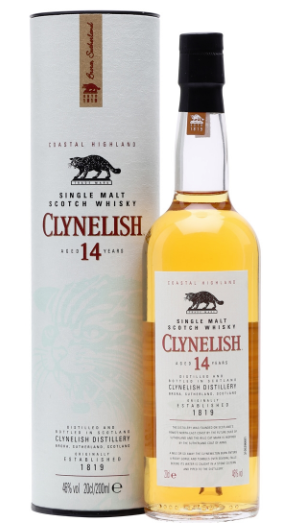
Clynelish 14-Year Old, 46%. Brora, Scotland.
Unknown maturation, suspected lightly chill filtered & light added colouring.
Colour: Gold.
Nose: Very soft to start with, with powdery red apples and a little chalk dust. Opens up with some craft glue & warmed honey, and a slight nip - but only if you get too eager. With more time, soft malt and honey and a light whiff of rock salt.
Texture: Light-medium weight, soft and waxy with a drying salty tang.
Taste: Surprisingly gentle on entry, with more honey, soft dusty malt, waxy red apples and hints of banana & melon. Then a nice pinch of salt, drying and slightly astringent, with a very tiny puff of earthy peat underneath.
Finish: The salt continues, with a few drying spices thrown in. Warm (not hot) cinnamon, and a touch of white pepper. Then the malt returns, but it's damp now, and hints of those waxy red apples following behind.
Score: 3 out of 5. Almost a 3.5 though.
Notes: A very enjoyable whisky, easy drinking with a few nice points of difference setting it apart. A great example of a northern Highland whisky here, and in fact it's definitely in the realm of an ex-bourbon cask Old Pulteney or maybe even a Highland Park without that Orkney peat. Although I was quite surprised to find that tiny puff of peat in this Clynelish, I don't remember encountering that on previous experiences with this whisky. This malt could easily square up to all of the core expressions from those aforementioned further-north distilleries, most of which are bottled at 40-43% and at younger ages or with no age statement, so there's very good value for money on offer here.
It may not be the most complex malt out there, but for a core / flagship expression, and considering that price point, it'd make for a great daily drinker. And huge kudos must be given to Diageo for bottling this Clynelish 14-year old at 46% and holding back, at least partially, on the colouring and chill filtration. They could've easily bottled it at 43% with added colouring and chill filtration, as is the case with most of the Classic Malts range, and it probably wouldn't have affected total sales to any massive extent. But they chose to present this particular whisky more naturally, and we should be thanking them for it!
Cheers!
Sunday, 26 May 2019
Caol Ila Distillery Exclusive Whisky Review!
The last time I tasted this glorious liquid was at the distillery during my first trip to Islay back in 2017, shortly before literally running back to the bus stop to get back to Port Ellen. Time for a trip down memory lane, then!
Caol Ila Distillery may be the largest distillery on Islay, producing over four million litres of spirit per year, but it's actually somewhat of an underdog. It's not the easiest of the island's distilleries to visit, despite being a quick turn off from the main road to & from the main ferry terminal of Port Askaig. When staying in any of Islay's main towns or villages, you'll either need to catch one of the island's two buses, or you'll need to drive or arrange an expensive taxi. It's not the prettiest of the island's distilleries, despite having one of the best views across the Sound to the Isle of Jura. While Caol Ila was originally founded in 1846, the distillery was completely demolished and rebuilt in 1972, with the aesthetics you can expect from that era. And it's certainly not the most celebrated and appreciated of the island's distilleries, in fact it's quite the opposite, despite it being a major contributor to some of the highest selling blended whiskies in the world. It's safe to say that most of those blends, and maybe even the island itself, would not be the same if this workhorse distillery wasn't there quietly doing its thing. Blends aside, single malt bottlings of Caol Ila can be truly exceptional, and absolutely on par with Islay's most popular producers.
There are a large amount of independent bottlings of Caol Ila out there, and some can be fantastic, but as far as Diageo's official bottlings go, the distillery doesn't get the chance to shine as often as it should. The most easily obtained expressions, the standard 12-year old and the moscatel-finished Distiller's Edition, are very enjoyable whiskies, and they're reasonably priced to boot, but they're held back a little by chill filtration, added colouring, and the relatively low bottling strength of 43% ABV. There are a few options for higher-strength official bottlings, such as the annual unpeated releases, the generally fantastic but very scarce Feis Ile bottlings, and the highly lauded 30- and 35-year old special releases. But in 2017, along with a few other Diageo distilleries, Caol Ila took an unexpected step by releasing a Distillery Exclusive bottling, available only from the distillery shop itself. Bottled at cask strength, without chill filtration or added colouring, and with a maturation regimen that is still unusual for Islay, it was a fitting reward for those who made the effort to visit the distillery. And then subsequently, as is the unfortunate state of the whisky scene at the moment, those who purchased unwanted and unappreciated bottles from flippers at secondary auction or with huge mark-ups from certain retailers. The last time that Caol Ila offered a distillery exclusive (not Feis Ile) bottling was in 2007, so this is a special whisky! With Lagavulin's equivalent bottling released at the same time, this leaves Ardbeg as the only distillery on Islay (not including the newborn Ardnahoe) that does not offer a distillery exclusive bottling of any sort, which is a sorry state of affairs...
There have been two versions of this Caol Ila Distillery Exclusive bottling to date, the first 2017 release of 3,000 bottles, and a 2018 release of 6,000 bottles. Both are bottled at natural cask strength, and both are a little mysterious, with no age statement and precious little detail being made available. The former, which is the subject of this review, was bottled at 58.8% ABV, and was matured in both refill ex-bourbon casks and first-fill red wine casks. Which made this the first official bottling of Caol Ila to feature red wine cask-matured whisky, something that is still uncommon for most of the Islay stalwarts. But that was the extent of the official information on the bottle's contents, and you won't even find that last part listed anywhere on the bottle. The latter 2018 release was bottled at 57.4% ABV, and had a small piece of text added to it's front label: "A vatting of refill, first-fill Kentucky bourbon, and first-fill specially-charred Californian red wine casks". Having tasted both bottlings, the 2017 during my first visit to Islay, and the 2018 during the outstanding 'Cask Strength Experience' at the distillery on my second pilgrimage (see here), they are markedly different. The 2018 bottling is sweeter, brighter and a little more rounded, which I assume to be due to the addition of those first-fill bourbon casks, and possibly the different treatment used on the wine casks, although there could also be a higher proportion of wine casks in the vatting. Both were only sold from the distillery shop, at a reasonable price of 90 GBP. This sample of the 2017 release came from a swap with a generous fellow whisky geek. Let's get stuck in!
Caol Ila Distillery Exclusive, 2017. NAS, 58.8%. Islay, Scotland.
Matured in refill ex-bourbon and first-fill red wine casks. Natural cask strength, non-chill filtered, natural colour. 3,000 bottles.
Colour: Gold.
Nose: Lovely. Lightly peaty, a muddy and slightly sweet peat, also quite salty and very coastal. Lightly medicinal too, like old bandages and a little iodine, and a nice bright tropical fruit sweetness behind. A little ripe banana, vanilla cake batter, some seaweed and a couple of dried strawberries. Slightly fatty & greasy too.
Texture: Medium weight, oily & rich with plenty of flavour. A little heat, but pleasant.
Taste: That lovely muddy peat again, and the sweet fruit, then it turns drier with white pepper, a dry earthy peat and grassy smoke. Medicinal again too, more old bandages. Pancake batter and more red berries in the background. A little fatty smoked bacon too.
Finish: Long length. More white pepper, more smoked bacon, a little sweet licorice and iodine. That muddy peat returns, with the old bandages and a light rubbery note as well. Grassy smoke, fatty bacon rind and some husky malt towards the finish.
Score: 4 out of 5.
Notes: Really tasty stuff! It's all too easy to forget just how great Caol Ila can be if you haven't tasted it at high strength for a while. It certainly belongs on the same level of reverence as the Islay stalwarts on the southern coast. There are plenty of coastal and medicinal notes, and plenty of peat and salt, but it's all well-balanced and relaxed. I can't say that I found a distinctly overt red wine character here, just a few subtle hints. Which is no bad thing, they've obviously added some depth and complexity, and haven't been allowed to dominate anything else, and it's all worked very well together. This 2017 release of the Distillery Exclusive is definitely different to the 2018 version, at least if memory serves. I think there's more Caol Ila distillery character on display in this one, while the 2018 had more sweetness, more fruit and more oak.
Another great release from Caol Ila here, and it's well worth hunting down. Distillery Exclusive bottlings like this are yet another reason that we all need to visit Islay more often. And all of the distilleries should be jumping on board!
Cheers!
There have been two versions of this Caol Ila Distillery Exclusive bottling to date, the first 2017 release of 3,000 bottles, and a 2018 release of 6,000 bottles. Both are bottled at natural cask strength, and both are a little mysterious, with no age statement and precious little detail being made available. The former, which is the subject of this review, was bottled at 58.8% ABV, and was matured in both refill ex-bourbon casks and first-fill red wine casks. Which made this the first official bottling of Caol Ila to feature red wine cask-matured whisky, something that is still uncommon for most of the Islay stalwarts. But that was the extent of the official information on the bottle's contents, and you won't even find that last part listed anywhere on the bottle. The latter 2018 release was bottled at 57.4% ABV, and had a small piece of text added to it's front label: "A vatting of refill, first-fill Kentucky bourbon, and first-fill specially-charred Californian red wine casks". Having tasted both bottlings, the 2017 during my first visit to Islay, and the 2018 during the outstanding 'Cask Strength Experience' at the distillery on my second pilgrimage (see here), they are markedly different. The 2018 bottling is sweeter, brighter and a little more rounded, which I assume to be due to the addition of those first-fill bourbon casks, and possibly the different treatment used on the wine casks, although there could also be a higher proportion of wine casks in the vatting. Both were only sold from the distillery shop, at a reasonable price of 90 GBP. This sample of the 2017 release came from a swap with a generous fellow whisky geek. Let's get stuck in!
Caol Ila Distillery Exclusive, 2017. NAS, 58.8%. Islay, Scotland.
Matured in refill ex-bourbon and first-fill red wine casks. Natural cask strength, non-chill filtered, natural colour. 3,000 bottles.
Colour: Gold.
Nose: Lovely. Lightly peaty, a muddy and slightly sweet peat, also quite salty and very coastal. Lightly medicinal too, like old bandages and a little iodine, and a nice bright tropical fruit sweetness behind. A little ripe banana, vanilla cake batter, some seaweed and a couple of dried strawberries. Slightly fatty & greasy too.
Texture: Medium weight, oily & rich with plenty of flavour. A little heat, but pleasant.
Taste: That lovely muddy peat again, and the sweet fruit, then it turns drier with white pepper, a dry earthy peat and grassy smoke. Medicinal again too, more old bandages. Pancake batter and more red berries in the background. A little fatty smoked bacon too.
Finish: Long length. More white pepper, more smoked bacon, a little sweet licorice and iodine. That muddy peat returns, with the old bandages and a light rubbery note as well. Grassy smoke, fatty bacon rind and some husky malt towards the finish.
Score: 4 out of 5.
Notes: Really tasty stuff! It's all too easy to forget just how great Caol Ila can be if you haven't tasted it at high strength for a while. It certainly belongs on the same level of reverence as the Islay stalwarts on the southern coast. There are plenty of coastal and medicinal notes, and plenty of peat and salt, but it's all well-balanced and relaxed. I can't say that I found a distinctly overt red wine character here, just a few subtle hints. Which is no bad thing, they've obviously added some depth and complexity, and haven't been allowed to dominate anything else, and it's all worked very well together. This 2017 release of the Distillery Exclusive is definitely different to the 2018 version, at least if memory serves. I think there's more Caol Ila distillery character on display in this one, while the 2018 had more sweetness, more fruit and more oak.
Another great release from Caol Ila here, and it's well worth hunting down. Distillery Exclusive bottlings like this are yet another reason that we all need to visit Islay more often. And all of the distilleries should be jumping on board!
Cheers!
Subscribe to:
Posts (Atom)
Hellyers Road Richly Peated 9 Year Old Whisky Review!
A new heavily peated ex-bourbon cask release from Tasmania's Hellyers Road Distillery! Might as well take a quick look at the specifics ...
-
A liquid souvenir from the trip to Japan last year, which included a visit to Yamazaki! Peated, 48% ABV and non-chill filtered, and a reason...
-
Ah, Talisker, the medium-to-lightly peated whisky from the Isle of Skye. Their 10-year old was the first peated single malt I ever tasted, a...
-
A reasonably priced & accessible cask strength single malt from Campbeltown's middle child; Glen Scotia. The distillery's follow...